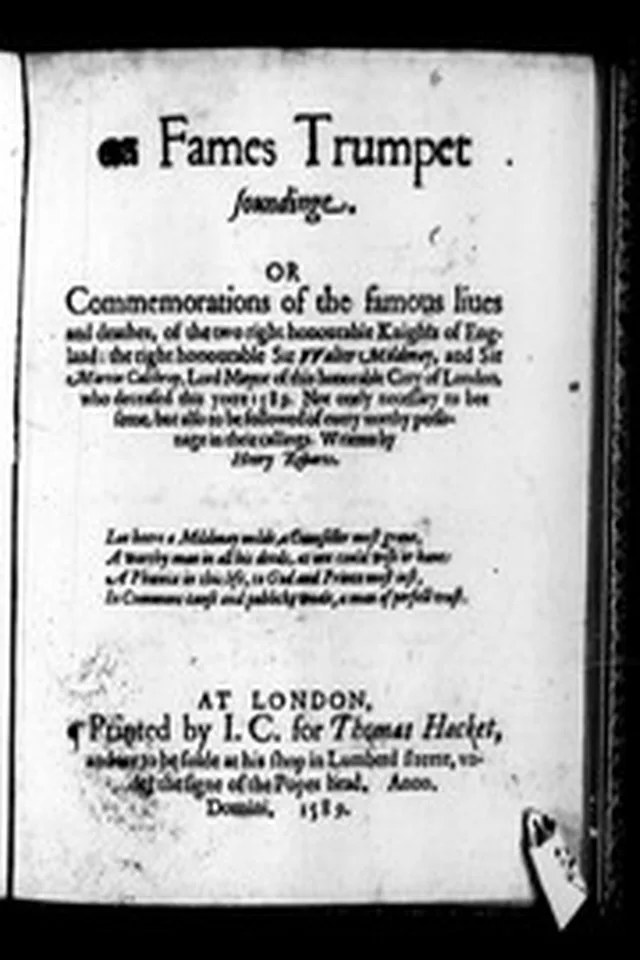
Fames trumpet soundinge. 1589
 73
73

Fames trumpet soundinge. 1589



Silas Hawthorne, Hermetic Studies Editor — "Fames Trumpet Soundinge" is a crucial, albeit scarce, primary source for anyone delving into the historical underpinnings of Western witchcraft and pagan traditions. Roberts masterfully navigates the anxieties and curiosities of his era, offering insights into the perceived mechanisms of the occult. Its strength lies in its directness, providing an unfiltered look at the lore and suspicion surrounding these practices. While challenging in its archaic language, the text rewards persistent study with a deeper appreciation for the historical evolution of magical thought. This is essential reading for serious scholars and dedicated practitioners seeking to connect with the authentic voices of the past. A truly illuminating discovery for our collection.
📝 Description
73
Henry Roberts' "Fames Trumpet Soundinge" appeared in 1589, a period of intense interest in occult philosophy.
Published in 1589, Henry Roberts' "Fames Trumpet Soundinge" offers a look into the esoteric thought of late 16th-century England. The text examines a worldview where natural phenomena and supernatural influences are deeply connected. Roberts details concepts of hidden forces and ancient agreements, presenting a cosmology that fascinated his contemporaries. The book carries an air of serious inquiry, aimed at those interested in the origins of Western esoteric traditions. It functions as both a historical record and a philosophical argument, prompting reflection on prevalent belief systems, public anxieties, and the persistent human interest in the unknown. This work is a significant resource for those studying occult history or foundational esoteric texts from the early modern era.
Roberts uses precise language to describe a complex system of belief. He addresses the intersection of popular superstition and learned magic, reflecting the intellectual climate of his time. The book is not a simple collection of magical lore but an intellectual exercise that engages with the philosophical underpinnings of such practices. Its value lies in its detailed articulation of ideas that were circulating among a select group of thinkers and practitioners.
This work belongs to the tradition of Renaissance magical philosophy, which sought to reconcile Christian theology with Hermeticism, Neoplatonism, and various folk traditions. Unlike later, more organized occult systems, "Fames Trumpet Soundinge" reflects a period where the boundaries between natural philosophy, religion, and magic were still fluid. Roberts' text engages with concepts of angelic and demonic influence, astrological causation, and the power of certain natural objects and incantations, all within a framework that often sought legitimacy through ancient authorities and scriptural interpretation.
💡 Why Read This Book?
Uncover the foundational beliefs and societal fears surrounding witchcraft in late 16th-century England. "Fames Trumpet Soundinge" offers a direct, unvarnished look at historical occult perspectives. Ideal for scholars of early modern history, students of esotericism, and practitioners interested in the roots of magical traditions. Gain a profound understanding of how these practices were perceived and documented in their formative years.
⭐ Reader Reviews
Honest opinions from readers who have explored this book.
❓ Frequently Asked Questions
What is the historical period of "Fames Trumpet Soundinge"?
This seminal work was published in 1589, placing it firmly within the late Elizabethan era, a time of significant intellectual and social upheaval concerning beliefs about magic and the supernatural.
Is this book about actual witchcraft practices?
While the title suggests a focus on witchcraft, the book primarily reflects contemporary perceptions, beliefs, and societal anxieties surrounding occult practices and perceived practitioners of the time, rather than being a direct grimoire.
Who was Henry Roberts?
Henry Roberts was an English author active in the late 16th century, known for works that touched upon religious and historical themes, including this notable exploration of witchcraft discourse.
What is the significance of the 'microfilm' note?
The note indicates that the version available through Esoteric Library is a digitized reproduction from microfilm, preserving this rare text for modern access and study.
What does 'Fames trumpet soundinge' mean?
The title translates from Latin as "Fame's trumpet sounding," implying that the work is intended to bring public attention and renown to the subject matter of witchcraft, or perhaps to herald its perceived presence.
🔮 Key Themes & Symbolism
The Genesis of Witchcraft Discourse
This theme looks at how "Fames Trumpet Soundinge" captures the nascent stages of formal discourse surrounding witchcraft in England. It examines the societal anxieties, religious interpretations, and burgeoning legal frameworks that shaped the perception of individuals accused of occult practices. Roberts' work serves as a vital snapshot, revealing the prevailing narratives and fears that fueled the witch hunts, offering scholars a direct line to the mental range of the late 16th century. Understanding this early discourse is crucial for tracing the evolution of occult studies and its societal impact.
Elements of Paganism in a Christian World
Within the context of its era, the book touches upon the lingering shadows of pre-Christian beliefs and practices, often framed through the lens of diabolism. It explores how elements that might have once been considered folk magic or pagan rituals were reinterpreted and demonized within a dominant Christian theological framework. This theme investigates the tension between ancient traditions and the imposed religious order, highlighting how the concept of 'paganism' itself was constructed and feared. It offers insights into the cultural anxieties of a society grappling with its spiritual heritage.
The Power of Reputation and Public Perception
The title itself, "Fames Trumpet Soundinge," immediately points to the crucial role of public reputation and how 'fame' – or infamy – could be amplified and weaponized. This theme examines how narratives about witches and their supposed powers were disseminated, shaping public opinion and solidifying fear. Roberts' text illustrates the potent influence of rumor, accusation, and sensationalism in the historical construction of the 'witch' archetype. It underscores the importance of understanding how public perception, often fueled by fear and misinformation, could lead to persecution and societal ostracization.
💬 Memorable Quotes
Direct passages from the work, attributed to the author.
“Fames trumpet soundinge. 1589.”
— The title itself, a direct proclamation of fame or notoriety, sets a tone of public declaration and historical significance for the subject matter.
“Digitized from IA40316002-11.”
— This note highlights the accessibility of this rare historical document through modern digital preservation methods, bridging the gap between past and present study.
“Previous issue: bim_early-english-books-1475-1640_a-treatise-of-witchcraft_roberts-alexander_1616.”
— This contextualizes Roberts' work within a lineage of similar texts, suggesting a growing interest and scholarly engagement with the topic of witchcraft during this period.
“Next issue: bim_early-english-books-1475-1640_the-most-royall-a-honou_roberts-henry_1606.”
— This provides further bibliographic linkage, indicating other works by Henry Roberts, and reinforcing his presence as an author engaged with contemporary societal and historical themes.
“Author: Roberts, Henry.”
— Attributing authorship firmly anchors the text, allowing for deeper analysis of the author's potential intent, background, and influence on the discourse of his time.
🌙 Esoteric Significance
Tradition
This text is foundational to the study of Western Esotericism, specifically within the nascent field of early modern witchcraft studies. It predates many later grimoires and occult manuals, serving as a primary source for understanding the societal and intellectual climate from which more formalized magical traditions would later evolve. It offers insights into the pre-systematic phase of occult lore, where folk beliefs, demonology, and theological interpretations converged, impacting later Hermetic, Kabbalistic, and ceremonial magic traditions.
Symbolism
The symbolism within "Fames Trumpet Soundinge" is deeply rooted in the demonological framework of the era. It often involves symbolic representations of pacts with infernal entities, the corruption of natural order through 'witchcraft,' and the perceived perversion of sacred rites. The 'trumpet' in the title itself can be seen as symbolic of a divine or infernal call to judgment or revelation, amplifying the gravity of the subject. Understanding these symbols requires an immersion in the theological and folklore context of the 16th century, where signs and portents held significant weight.
Modern Relevance
For modern practitioners and scholars, "Fames Trumpet Soundinge" provides an invaluable historical anchor. It allows for a nuanced understanding of the roots of contemporary witchcraft and paganism, demonstrating the dramatic shift in perception from fear and persecution to reclamation and spiritual practice. By studying the historical anxieties and misinterpretations, contemporary occultists can gain a deeper appreciation for their traditions and engage in informed dialogue about the evolution of magical beliefs. It serves as a reminder of the power of narrative and the importance of critical historical inquiry in understanding esoteric traditions.
👥 Who Should Read This Book
This rare tome is indispensable for several distinct audiences. **Scholars of Early Modern History and Religious Studies** will find it a crucial primary source for understanding the socio-cultural anxieties surrounding witchcraft and the supernatural in Elizabethan England. **Students of Western Esotericism and Occult History** will gain exceptional insight into the pre-Victorian roots of witchcraft discourse and the evolution of magical beliefs. **Practitioners of modern witchcraft and pagan traditions** seeking to understand their historical lineage and the societal forces that shaped their predecessors will find profound context. Even **curious general readers** with an interest in historical mysteries and the darker aspects of human belief will be captivated by its evocative portrayal of a bygone era.
📜 Historical Context
Published in 1589, "Fames Trumpet Soundinge" emerges from the heart of the late Elizabethan era, a period marked by profound religious and political flux in England. The Reformation's ripples were still felt, creating an atmosphere of heightened scrutiny over religious orthodoxy and the perceived presence of malevolent forces. Witchcraft accusations were on the rise, fueled by a blend of genuine fear of the unknown, social anxieties, and the influence of theological tracts that demonized perceived practitioners of magic. This was a time when the boundaries between folk belief, heterodox religion, and outright heresy were intensely debated, and the concept of witchcraft became a focal point for these societal tensions. Henry Roberts' work participates in this critical discourse, reflecting and potentially shaping contemporary understanding and fear of the occult. Its existence underscores the intellectual curiosity and the prevalent anxieties surrounding the supernatural that characterized this central period in Western history.
📔 Journal Prompts
How did the religious and political climate of 1589 influence the discourse on witchcraft as presented by Roberts?
Reflect on the societal fears that might have fueled the 'sounding of fame' for witchcraft during this period.
Consider the symbolic meaning of a 'trumpet' in the context of historical accusations and public perception.
How does Roberts' portrayal of witchcraft compare to modern understandings or depictions of pagan practices?
What ethical considerations arise when studying historical texts that document persecution and fear of marginalized groups?
🗂️ Glossary
Fames
Latin for 'Fame' or 'reputation,' often implying public knowledge or notoriety, whether positive or negative. In this context, it refers to the widespread discussion and awareness of witchcraft.
Soundinge
An archaic spelling of 'sounding,' meaning to make a sound, to proclaim, or to announce. Here, it suggests the act of bringing the subject of witchcraft to public attention.
Witchcraft
In the context of 1589, this term referred to the perceived practice of magic by individuals, often believed to be in league with supernatural or demonic forces, leading to accusations of maleficium (harmful magic).
Paganism
During this period, 'Paganism' often broadly encompassed any religious or spiritual beliefs and practices outside of orthodox Christianity, including older folk traditions that had not been fully assimilated or were viewed with suspicion.
Esotericism
The study of hidden knowledge, mystical traditions, and secret teachings often concealed within religious, philosophical, or magical systems. This book is a historical artifact relevant to the study of esoteric thought.
This book appears in 2 collections
🔮 Readers Also Liked
Browse all →


![D. [i. e., Doktor] Balthasar Bekkers reformierten Predigers in Amsterdam bezauberte Welt. ... 1781: Vol 3 Iss 81](/img/thumb/d-i-e-doktor-balthasar-bekkers-reformierten-predigers-in-amsterdam-bezauberte-welt-1781-vol-3-iss-81-bekker-balthasar-1634-1698.webp)



![Histoire de M. Oufle, par abbé Bordelon Cretouchée et réduite par M. G.] et la Description du sabbat. ... 1793: Iss 140](/img/thumb/histoire-de-m-oufle-par-abb-bordelon-cretouch-e-et-r-duite-par-m-g-et-la-description-du-sabbat-1793-iss-140-bordelon-laurent-1653-1730.webp)

From the “Witchcraft” Collection
View all →




More Free Witchcraft & Paganism Books
View all →