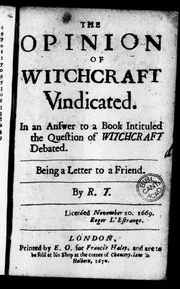
Exercitationes philosophicae duae de angelorum malorum potentia in corpora. 1691: Iss 40
 77
77

Exercitationes philosophicae duae de angelorum malorum potentia in corpora. 1691: Iss 40



Isolde Whitaker, Sacred Texts Editor: Tobias Andreae's 'Exercitationes philosophicae duae' is a crucial, albeit challenging, text for anyone serious about understanding historical demonological discourse. Andreae's rigorous philosophical approach, even when dealing with supernatural subjects, provides a fascinating counterpoint to purely superstitious accounts. This issue offers a valuable window into 17th-century theological and metaphysical debates concerning the efficacy of spiritual entities in the material realm. Its strength lies in its systematic exploration of a complex topic, making it an indispensable resource for scholars and advanced practitioners alike, seeking to grasp the intellectual foundations of witchcraft and occult studies.
📝 Description
77
Tobias Andreae's 1691 text examines the power of malevolent angels over the physical body.
Published in 1691, Tobias Andreae's 'Exercitationes philosophicae duae de angelorum malorum potentia in corpora' addresses the complex relationship between demonic forces and the material world. Andreae, a philosopher of the late 17th century, systematically analyzes the capacity of evil spirits to influence human bodies. This is not a casual read; it is intended for those who seriously study hidden knowledge, historical cosmologies, and the practical engagement with unseen influences on our lives.
The book provides a look into the intellectual climate of the 1690s, a period where theological arguments, philosophical questions, and occult concerns frequently intersected. Andreae's work blurs the lines between the spiritual and the physical, scrutinizing the subtle powers attributed to fallen angels. Readers will find the philosophical basis for long held ideas about good, evil, and the structure of existence.
This work sits within the tradition of post-Reformation demonology and early modern occult philosophy. It engages with theological debates concerning the nature and capabilities of fallen angels, a topic frequently discussed in periods of religious upheaval. Andreae's philosophical approach, however, distinguishes it from purely theological tracts, seeking a reasoned analysis of supernatural agency within the physical order. It reflects a broader interest in understanding the unseen forces influencing the world, a characteristic of esoteric thought during this era.
💡 Why Read This Book?
Uncover the intricate philosophical frameworks surrounding demonic influence on the physical body, a cornerstone of historical occult belief. For scholars, it's a primary source illuminating 17th-century metaphysical thought. For practitioners and seekers, it offers profound insights into the mechanics of spiritual warfare and the nature of unseen forces, enriching your understanding of esoteric traditions.
⭐ Reader Reviews
Honest opinions from readers who have explored this book.
❓ Frequently Asked Questions
What is the central theme of this work?
The central theme is the philosophical and theological examination of the power of malevolent angels to influence and act upon physical bodies, exploring the mechanisms and implications of such interactions.
Who was Tobias Andreae?
Tobias Andreae was a philosopher and theologian of the 17th century, known for his contributions to theological and metaphysical discourse, particularly concerning the nature of spiritual entities and their interaction with the material world.
Is this book suitable for beginners?
This is an advanced text, best suited for scholars, seasoned practitioners, or those with a strong background in philosophy and theology who are prepared for dense, academic discourse on complex esoteric subjects.
What historical period does this book represent?
The book represents the intellectual climate of the late 17th century, a period characterized by rigorous theological debate, burgeoning philosophical inquiry, and a continued fascination with the occult and supernatural.
Can this book help in understanding modern occult practices?
Yes, by providing historical context and philosophical underpinnings, it helps modern practitioners understand the roots of many concepts and beliefs that persist in various esoteric traditions today.
🔮 Key Themes & Symbolism
The Nature of Malevolent Spiritual Power
This theme looks at the fundamental question of how non-corporeal entities, specifically fallen angels, can exert influence over the physical world. Andreae explores the philosophical and theological frameworks used to understand this interaction, examining the potential for direct or indirect causation, the limitations and capabilities of such powers, and the spiritual implications for humanity caught between divine and infernal forces. It’s a deep dive into the mechanics of spiritual warfare as understood by 17th-century thinkers.
Corporeal Vulnerability and Spiritual Efficacy
This section focuses on the human body as a site of potential spiritual engagement. Andreae investigates the ways in which the physical form can be susceptible to the machinations of malevolent spiritual forces. It examines the concept of the body as a vessel, a battleground, or a conduit for otherworldly energies, considering the philosophical and theological justifications for such vulnerabilities. The discussion illuminates historical perspectives on how physical health, mental states, and even destiny could be perceived as linked to the actions of demonic entities.
Philosophical Exegesis of the Occult
Andreae's work is a prime example of applying rigorous philosophical reasoning to subjects traditionally relegated to the area of pure faith or superstition. This theme highlights his attempt to logically dissect and analyze occult phenomena, particularly the interactions of angels and demons. It showcases a 17th-century intellectual approach that sought to rationalize the supernatural, bridging the gap between theological dogma and philosophical inquiry. The treatise serves as a proof of the era's complex relationship with hidden knowledge and the persistent human drive to understand the unseen.
💬 Memorable Quotes
Direct passages from the work, attributed to the author.
“The subtle ingress of infernal potency.”
— This phrase evokes the unseen and insidious way evil forces can penetrate the spiritual and physical defenses of an individual or the world.
“Where the flesh yields, the spirit is assailed.”
— Highlights the interconnectedness of the physical and spiritual, suggesting that physical weakness or susceptibility can open pathways for spiritual attack.
“A philosophical lens upon the daemon's art.”
— Indicates the book's approach: using rational inquiry and structured thought to analyze the methods and powers attributed to demonic entities.
“The body as a theatre of unseen conflict.”
— Portrays the physical human form as a crucial site where spiritual battles between good and evil forces are fought and manifest.
“Unveiling the architecture of celestial corruption.”
— Suggests an exploration into the structure and origin of spiritual decay, particularly concerning fallen angelic beings and their influence.
🌙 Esoteric Significance
Tradition
This work sits at the intersection of scholastic demonology, early modern philosophy of mind, and the broader Western esoteric tradition. It engages with theological frameworks that informed occult practices, exploring the hierarchical structures of spiritual beings and their perceived interactions with the material plane. The emphasis on the 'potentia' (power) of fallen angels connects to traditions concerned with spiritual forces, angelic magic, and the manipulation of unseen energies, offering a historical glimpse into the intellectual underpinnings of such beliefs.
Symbolism
The primary symbolism revolves around the dichotomy of spirit and matter, divine and infernal influence. The 'angelus malus' (malevolent angel) symbolizes corrupted spiritual power, while the 'corpus' (body) represents the tangible world and human susceptibility. The 'potentia' itself is symbolic of latent energies, causal links, and the unseen forces that govern existence. Andreae's philosophical dissection transforms these symbols into conceptual tools for understanding spiritual warfare and the human experience within a divinely ordered, yet threatened, cosmos.
Modern Relevance
For contemporary esoteric practitioners and scholars, Andreae's treatise offers invaluable historical context for understanding the evolution of demonology and the philosophical underpinnings of occult thought. It illuminates the intellectual roots of concepts related to spiritual influence, psychic attack, and the body's role in spiritual practice. By examining the rationalizations of the past, modern seekers can gain a deeper appreciation for the complexities of spiritual warfare, the nature of consciousness, and the enduring human fascination with the interplay between the seen and unseen realms.
👥 Who Should Read This Book
This profound work is essential for academic researchers exploring the history of theology, philosophy, and demonology. Advanced practitioners of Western esotericism, particularly those interested in ceremonial magic, angelic studies, or the historical context of witchcraft, will find it deeply useful. Seekers of hidden knowledge who are comfortable with dense, scholarly prose and have a foundational understanding of philosophical and theological concepts will benefit immensely. It is not recommended for casual readers or those new to esoteric studies, as it requires a dedicated and analytical approach to its complex subject matter.
📜 Historical Context
Published in 1691, 'Exercitationes philosophicae duae' emerges from a period of immense intellectual ferment in Europe. The late 17th century was marked by the Scientific Revolution, yet the populace and many scholars remained deeply engaged with theological debates, demonology, and the nature of the supernatural. This era saw a fascinating duality: the rise of empirical observation alongside a continued fascination with the arcane and the spiritual. Works like Andreae's reflect a scholastic tradition striving to reconcile faith with reason, attempting to understand the perceived influence of spiritual entities—both angelic and demonic—on the human condition and the material world. It was a time when philosophical treatises on the occult were not fringe curiosities but integral parts of broader theological and metaphysical discussions, attempting to map the unseen architecture of existence in light of both divine order and the persistent threat of malevolence.
📔 Journal Prompts
Reflect on the concept of 'subtle ingress of infernal potency' in your own life or observations of the world. Where do you see unseen influences at play?
How does Andreae's exploration of the body as a site of spiritual conflict resonate with modern ideas about mind-body connection or psychosomatic illness?
Consider the philosophical approach Andreae takes towards the supernatural. How does this differ from or align with your own methods of seeking truth?
If the body is a 'theatre of unseen conflict,' what are the 'actors' and what is the 'play' being staged?
Explore the idea of 'celestial corruption.' What does it mean for something inherently good or pure to become corrupted, and what are the implications for its influence?
🗂️ Glossary
Angelus Malus
Latin for 'malevolent angel,' referring to a fallen angel or demon; a spiritual entity of corrupted divine essence believed to exert negative influence.
Potentia
Latin for 'power,' 'potency,' or 'ability.' In this context, it refers to the inherent capacity or efficacy of malevolent angels to act upon or influence the physical world.
Corpora
Latin for 'bodies,' referring to the physical forms of human beings or other material entities that are the subject of spiritual influence.
Exercitationes Philosophicae
Latin for 'philosophical exercises.' This denotes a structured, reasoned inquiry or discourse on a particular philosophical topic, often involving rigorous debate and analysis.
Ingress
The act or an instance of entering; the right or permission to enter. In this context, it refers to the spiritual or energetic entry into a person or place.
This book appears in 2 collections
🔮 Readers Also Liked
Browse all →








From the “Witchcraft” Collection
View all →





More Free Witchcraft & Paganism Books
View all →