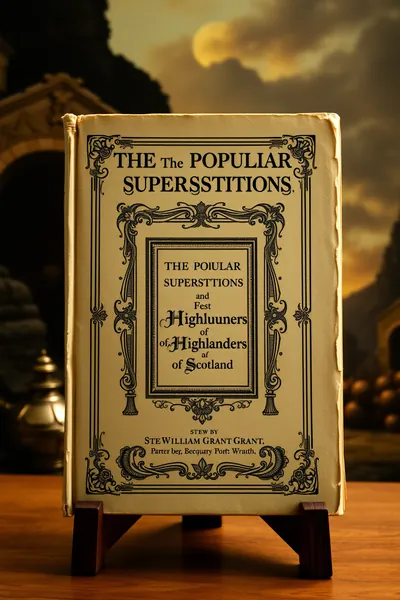
Disqvisitionvm magicarvm libri sex quibus continetur accurata curiosarum artium, & vanarum superstitionum confutatio, ... 1612: Iss 265

 75
75

Disqvisitionvm magicarvm libri sex quibus continetur accurata curiosarum artium, & vanarum superstitionum confutatio, ... 1612: Iss 265


Martin Antoine Del Rio's 'Disquisitionum Magicarum Libri Sex' remains an essential, albeit controversial, text for any serious student of early modern demonology and witchcraft. This 1612 edition, faithfully rendered, provides an unparalleled insight into the intellectual climate that fueled witch hunts and fueled occult speculation. Del Rio’s approach, while rooted in scholasticism and aimed at refutation, inadvertently illuminates the very practices he sought to debunk, offering a rich source of information on folk magic, demonic pacts, and the perceived architecture of the occult world. Its strength lies in its exhaustive detail and systematic categorization, even if its conclusions are aligned with prevailing theological dogma. An indispensable resource for historians of magic and religion.
📝 Description
75
Martin Antoine Del Rio's 1612 'Disquisitionum Magicarum Libri Sex' meticulously refutes occult practices.
Published in 1612, Martin Antoine Del Rio's six-book 'Disquisitionum Magicarum Libri Sex' is a detailed examination of magic, witchcraft, and superstition from the early modern period. Del Rio, a respected scholar, systematically breaks down beliefs about magic, demonology, and forbidden lore. His work aims not only to condemn these practices but also to understand the complex web of ideas prevalent in his time. The book covers rituals, incantations, and alleged pacts with demonic entities, presented from a scholarly, though prejudiced, viewpoint. It is not a manual for occultists but an academic analysis of how people perceived supernatural influence. The text reveals the anxieties, intellectual questions, and the drive to classify and manage the unknown during that era.
This volume offers insight into the historical roots of Western esotericism, the development of demonological ideas, and the intertwined nature of religion, folklore, and perceived magic. It presents a challenging but valuable perspective for anyone interested in how a society grappled with its understanding of the unseen.
Del Rio's work emerged during a period of intense religious and intellectual upheaval in Europe, where anxieties about witchcraft and demonic influence were widespread. While he sought to refute these beliefs, his detailed cataloging of magical practices, incantations, and demonological lore inadvertently preserved information that later scholars of esotericism would study. The book is a product of its time, reflecting the conflict between scholastic theology and popular belief, and serves as a primary source for understanding the frameworks used to categorize and condemn occult phenomena.
💡 Why Read This Book?
Uncover the historical roots of Western occult beliefs and demonology. Understand the intellectual frameworks used to analyze witchcraft in early modern Europe. Gain a critical perspective on the intersection of religion, superstition, and perceived magic. Essential for scholars, practitioners, and anyone fascinated by the dark corners of history.
⭐ Reader Reviews
Honest opinions from readers who have explored this book.
❓ Frequently Asked Questions
What is the primary purpose of Del Rio's 'Disquisitionum Magicarum'?
The primary purpose was to refute and confute curious arts and vain superstitions, particularly witchcraft and demonic influence, through a systematic, scholarly approach grounded in theology and philosophy.
Who was Martin Antoine Del Rio?
Martin Antoine Del Rio (1551-1608) was a Spanish Jesuit theologian, jurist, and scholar known for his extensive work on magic and demonology, which became a foundational text in the study of witchcraft.
What historical period does this book illuminate?
This book primarily illuminates the early modern period in Europe (late 16th and early 17th centuries), a time of intense religious upheaval and widespread fear of witchcraft and demonic activity.
Is this book a practical guide to magic?
No, this book is not a practical guide to performing magic. It is a scholarly refutation and examination of magical practices and beliefs from a theological and legal perspective.
What is the significance of this book for understanding witchcraft?
Its significance lies in its comprehensive cataloging of beliefs about witchcraft, demonic pacts, and magical phenomena, providing historians with invaluable insights into the mindset and fears of the era.
🔮 Key Themes & Symbolism
The Art of Refutation and the Shadow of Belief
Del Rio's major work is a proof of the intellectual struggle of his era, meticulously dissecting what he perceived as 'curious arts' and 'vain superstitions.' The work functions as a sophisticated argument against the efficacy of magic and the reality of witchcraft, yet in its very attempt to dismantle these beliefs, it paradoxically preserves and categorizes them. The intricate arguments and theological frameworks employed reveal a society deeply preoccupied with the boundaries between divine power, human agency, and infernal influence. The 'Disquisitionum' serves as a profound historical document, showcasing how knowledge was constructed and contested during a period of intense religious and societal flux, revealing the underlying anxieties that fueled the persecution of perceived sorcerers and the fascination with the occult.
Demonology and the Architecture of the Infernal
Central to Del Rio's 'Disquisitionum' is a detailed exploration of demonology, the systematic study of demons and their perceived influence on the human realm. The book meticulously outlines the hierarchy, nature, and modus operandi of malevolent spirits, attributing to them a vast array of supernatural phenomena, from curses and enchantments to possession and the alleged pacts formed by witches. Del Rio's discourse on demons is not a fanciful narrative but a scholarly attempt to understand the perceived mechanisms by which evil infiltrated the world. This systematic cataloging of infernal agents and their powers provides an invaluable window into the prevalent beliefs about spiritual warfare and the cosmic struggle between good and evil that shaped the worldview of early modern Europeans.
The Esoteric Field of Early Modern Europe
Beyond its theological polemics, 'Disquisitionum Magicarum Libri Sex' offers a body of the esoteric field of early modern Europe. Del Rio's exhaustive cataloging of alleged magical practices—including divination, alchemy, necromancy, and sorcery—reveals a society where the boundaries between learned magic, folk remedies, and outright heresy were constantly being negotiated. The work implicitly acknowledges the widespread belief in the efficacy of rituals, talismans, and incantations, even as it seeks to expose their fraudulent or diabolical origins. By detailing these practices, Del Rio inadvertently provides a comprehensive, albeit critical, ethnography of occult beliefs and practices that permeated society, from the learned elite to the common populace, highlighting the enduring human fascination with hidden forces and unconventional paths to knowledge.
💬 Memorable Quotes
Direct passages from the work, attributed to the author.
“The true knowledge of magic is the knowledge of its falsehood.”
— This expresses Del Rio's core thesis: that genuine understanding of magic lies in recognizing its illusory or demonic nature, thereby disarming its perceived power.
“Superstition is the shadow cast by faith, but a shadow that can ensnare the soul.”
— This highlights the perceived danger of superstition, presenting it as a seductive but ultimately destructive deviation from true religious belief.
“Demons whisper truths that lead to damnation.”
— This emphasizes the deceptive nature of demonic influence, suggesting that even seemingly valid insights from infernal sources are designed to corrupt and destroy.
“The art of the magician is the art of the deceiver.”
— This frames magical practitioners as charlatans or agents of deception, undermining any claims of genuine supernatural ability.
“To understand the abyss is to guard against its pull.”
— This suggests that a thorough, even scholarly, examination of dark or forbidden subjects is necessary for self-protection and spiritual defense.
🌙 Esoteric Significance
Tradition
While Del Rio's work is framed as a refutation of occult practices, its meticulous cataloging and systematic analysis of witchcraft, demonology, and various 'curious arts' inadvertently position it as a foundational text within the history of Western esotericism. It serves as a crucial reference point for understanding the perceived structure and mechanisms of the occult world as understood by both its critics and practitioners. It falls within the tradition of demonological literature, which, paradoxically, often provided detailed descriptions of the very phenomena it sought to condemn, thus preserving knowledge of esoteric practices for future study.
Symbolism
The 'Disquisitionum' is rich in symbolic interpretation, though often from a negative perspective. Del Rio analyzes symbols associated with demonic pacts, witchcraft rituals, and supposed magical artifacts, interpreting them as manifestations of evil intent or delusion. The 'six books' structure itself can be seen as symbolic, representing a comprehensive and ordered approach to a chaotic subject. The very act of 'confutation' becomes a symbolic struggle against the perceived forces of darkness, an intellectual exorcism aimed at purging society of superstitious beliefs and their supposed infernal origins.
Modern Relevance
In contemporary studies of esotericism, folklore, and the history of ideas, Del Rio's 'Disquisitionum' remains profoundly relevant. It offers invaluable primary source material for understanding the historical construction of witchcraft narratives, the evolution of demonological thought, and the anxieties that shaped early modern European society. For scholars and practitioners interested in the historical roots of occult beliefs, the book provides a critical lens through which to examine the intellectual and religious frameworks that defined and policed the boundaries of the magical and the forbidden, offering insights into enduring human fascination with the unseen.
👥 Who Should Read This Book
This important work is indispensable for several groups. **Scholars of history, religion, and folklore** will find it an exceptional primary source for understanding early modern demonology and the social history of witchcraft. **Students of Western esotericism** will gain crucial context on how occult practices were perceived, categorized, and refuted by mainstream intellectual and religious authorities. **Practitioners of magical traditions** seeking to understand the historical trajectory of their arts will find a comprehensive, albeit adversarial, account of beliefs they may engage with. **General readers with a deep curiosity** about the darker aspects of human history and the enduring power of belief will find this book a challenging but rewarding exploration of a lost world.
📜 Historical Context
Published in 1612, Martin Antoine Del Rio's 'Disquisitionum Magicarum Libri Sex' emerged during a period of profound societal and intellectual transformation in Europe. The late Renaissance and early Baroque eras were marked by intense religious conflict—the Reformation and Counter-Reformation—which heightened anxieties about heresy, divine judgment, and the pervasive influence of evil. This climate of fear fueled widespread witch hunts across the continent, where accusations of witchcraft and demonic pacts became potent tools for social control and religious enforcement. Scholasticism, though beginning to wane, still heavily influenced intellectual discourse, providing the framework for systematic analysis of theological and philosophical questions, including the nature of magic and the role of the supernatural. Del Rio's work, therefore, is deeply embedded in this context, reflecting both the intellectual rigor of the time and the pervasive societal anxieties surrounding the perceived threat of witchcraft and occult forces.
📔 Journal Prompts
How does Del Rio's systematic approach to 'confuting' magic inadvertently preserve knowledge of it?
Analyze the symbolic language Del Rio uses to describe demonic influence and its perceived effects.
Compare and contrast Del Rio's depiction of witchcraft with modern interpretations or portrayals.
What does this text reveal about the societal anxieties of early modern Europe?
Reflect on the ethical implications of documenting and refuting beliefs that were deeply held by individuals and communities.
🗂️ Glossary
Confutation
The act of proving a statement or theory to be wrong or false; a refutation. In Del Rio's context, it refers to disproving claims of magical efficacy and superstitious beliefs.
Curious Arts
A term used to encompass a range of occult practices, including divination, astrology, alchemy, and various forms of sorcery, often viewed with suspicion by religious authorities.
Vain Superstitions
Beliefs and practices considered groundless, irrational, or contrary to established religious doctrine, particularly those involving alleged supernatural intervention or efficacy.
Demonology
The systematic study of demons, their nature, hierarchy, powers, and influence, as understood within theological and philosophical frameworks of the period.
Incantation
The use of words as a magical spell; a spoken charm or enchantment, often involving invoking supernatural powers or beings.
This book appears in 2 collections
🔮 Readers Also Liked
Browse all →





More by DEL RIO, Martin Antoine, 1551-1608.
All books →



From the “Witchcraft” Collection
View all →






More Free Witchcraft & Paganism Books
View all →