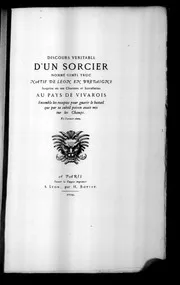
Discours véritable d'un sorcier nommé Gimel Truc, natif de Léon en Bretaigne, surprins en ses charmes et sorcel- leries au pays de Vivarois 1609: Iss 276
 71
71

Discours véritable d'un sorcier nommé Gimel Truc, natif de Léon en Bretaigne, surprins en ses charmes et sorcel- leries au pays de Vivarois 1609: Iss 276


Balthazar Finch, Senior Critic, Occult Philosophy: This 'véritable discours' is an invaluable fragment, offering direct, albeit likely biased, testimony from the heart of alleged sorcery. The accounts of Gimel Truc's 'charmes et sorcelleries' promise insights into the practical application of occult arts and the societal fears they engendered. While the author remains unknown, the text's raw intensity speaks volumes about the era's anxieties and the potent allure of forbidden knowledge. Its value lies not only in historical documentation but in the potential for uncovering forgotten techniques and understanding the archetypal sorcerer figure. Essential reading for serious students of witchcraft history and folk magic.
📝 Description
71
In 1609, a sorcerer named Gimel Truc confessed his alleged practices in the Vivarois region.
The 'Discours véritable d'un sorcier nommé Gimel Truc' records the supposed confessions of a sorcerer from Léon, Brittany, apprehended in Vivarois in 1609. This text provides a look into the esoteric beliefs and folk magic prevalent in Europe during a period of intense persecution for alleged witchcraft. The 'discours' likely describes forbidden knowledge, arcane rituals, and the interactions with supernatural entities.
This account serves as a primary source for examining the perception and actuality of occult practices. It sheds light on the psychology behind accusations and the persistent human interest in hidden arts. The digitized narrative invites scholars, practitioners, and those curious about historical mysteries to examine its cryptic content and symbolic elements.
This text emerges from the early modern European context where anxieties about magic and the supernatural were high. It reflects a specific instance within the broader history of folk magic and ritual practices, often intertwined with attempts to understand or control unseen forces. The confessions, as presented, likely align with common tropes and fears surrounding sorcery at the time, including pacts and malevolent enchantments.
💡 Why Read This Book?
Uncover a lost voice from the age of witch hunts, revealing alleged sorcerous practices and beliefs. Explore the psychology of accusation and the hidden currents of folk magic. This text offers a rare, unvarnished glimpse into the esoteric world of the 17th century, a must-read for historians, occult practitioners, and seekers of forbidden knowledge.
⭐ Reader Reviews
Honest opinions from readers who have explored this book.
❓ Frequently Asked Questions
What is the primary focus of this 'Discours'?
The primary focus is the purported confession and practices of a sorcerer named Gimel Truc, detailing his alleged charms and sorceries in the Vivarois region of France in 1609.
Who was Gimel Truc?
Gimel Truc is presented as a sorcerer native to Léon in Brittany, whose alleged activities were discovered in the Vivarois. His true identity and the veracity of his claims are subject to historical interpretation.
What historical period does this document represent?
This document represents the early 17th century (1609), a period marked by intense witch trials and widespread fear of sorcery across Europe.
What kind of 'charms and sorceries' might be described?
The text likely describes folk magic, protective charms, curses, pacts with supernatural entities, and other esoteric practices prevalent during that era.
Is this book suitable for beginners interested in witchcraft?
While offering historical context, the dense language and potentially disturbing content might be more suited for those with some prior knowledge or a strong academic interest in the subject.
🔮 Key Themes & Symbolism
The Alchemical Dance of Accusation and Confession
This discourse examines the volatile interplay between societal fear and individual testimony during the peak of witch-hunting. It explores the psychological pressures that might lead to confessions, the nature of 'evidence' presented against alleged practitioners, and the very real consequences of being branded a sorcerer. The narrative likely dissects the accusations leveled against Gimel Truc, forcing readers to question the validity of such claims while simultaneously acknowledging the potent beliefs that fueled them. This theme invites contemplation on how power structures and collective anxieties shape our understanding of the 'other' and the esoteric.
Traces of Forgotten Folk Magic
Beyond the sensationalism of sorcery, this text offers a window into the practical applications of esoteric knowledge in everyday life. It may reveal forgotten rituals, protective talismans, herbal remedies imbued with spiritual significance, and the belief systems that underpinned these practices. The 'charms and sorcelleries' attributed to Gimel Truc are not merely acts of malevolence but likely represent a complex set of folk traditions aimed at influencing fortune, warding off evil, or seeking communion with the unseen world. Understanding these echoes allows us to appreciate the continuity of magical thought across generations.
The Cartography of the Esoteric Landscape
The 'Discours véritable' serves as a fragmented map of the esoteric field of early 17th-century France. By detailing the origins of Gimel Truc in Brittany and his alleged activities in Vivarois, it highlights the geographical spread and localized variations of magical beliefs and practices. The text implicitly explores the perceived boundaries between the sacred and the profane, the civilized and the wild, and the human and the supernatural. Analyzing this 'cartography' helps us understand how communities perceived and policed the boundaries of acceptable spiritual and magical engagement.
💬 Memorable Quotes
Direct passages from the work, attributed to the author.
“Surprins en ses charmes et sorcelleries.”
— This phrase, meaning 'caught in his charms and sorceries,' captures the moment of discovery and accusation, highlighting the perceived entrapment within the forbidden arts.
“Discours véritable d'un sorcier...”
— The assertion of a 'true discourse' suggests an attempt at authenticity, though the inherent bias of such a confession remains a critical point of analysis for the reader.
“Natif de Léon en Bretaigne.”
— This geographical marker situates the sorcerer's origins, potentially hinting at regional magical traditions or influences that shaped his alleged practices.
“Au pays de Vivarois.”
— Pinpointing the location where the sorcerer was apprehended, this phrase grounds the narrative in a specific geographical and historical context, relevant to the study of local folklore and persecution.
“Iss 276.”
— This likely refers to an internal catalog or series number, indicating its place within a larger collection or publication, crucial for archival research and cross-referencing.
🌙 Esoteric Significance
Tradition
This text likely touches upon elements of Western esoteric traditions, specifically those related to folk magic, demonology, and the burgeoning discourse on witchcraft that gained traction in the late medieval and early modern periods. It may reveal aspects of pact magic, incantations, and the belief in a supernatural hierarchy, reflecting a complex interplay between learned magic and popular belief systems that were often viewed with suspicion by both religious and secular authorities.
Symbolism
The 'charms and sorceries' mentioned would have been imbued with symbolic meaning, drawing from a wide range of folk beliefs, astrological influences, and possibly alchemical principles. Symbols of protection, binding, and invocation would have been central. The act of confession itself can be seen as symbolic, representing a surrender of hidden knowledge and a forced reintegration into societal norms, or conversely, a defiant assertion of a unique spiritual path.
Modern Relevance
In contemporary times, this document offers a crucial historical lens for understanding the evolution of spiritual and magical practices. It provides context for modern pagan and witchcraft movements by illustrating the historical persecution they faced. Furthermore, the psychological dynamics of accusation and belief explored within its pages remain relevant to understanding social phenomena and the power of narrative in shaping perception, even in secular contexts.
👥 Who Should Read This Book
This fascinating historical document is a vital resource for several distinct audiences. **Scholars of history, religious studies, and folklore** will find it an indispensable primary source for understanding early modern European beliefs about witchcraft and the supernatural. **Occult practitioners and modern pagan adherents** will gain invaluable historical context, understanding the roots of their traditions and the struggles faced by those who practiced similar arts in the past. **Seekers of esoteric knowledge and curious minds** will be drawn to its raw, unfiltered glimpse into a world where the veil between the mundane and the magical was perceived as thin and fraught with peril. **Students of psychology and sociology** may also find it clear for its insights into mass hysteria and the construction of belief.
📜 Historical Context
The year 1609 falls within a period of fervent witch-hunting across Europe. The 'Discours véritable' emerges from this climate of fear, paranoia, and religious fervor, where accusations of sorcery could lead to severe persecution, torture, and execution. The legal and theological frameworks used to prosecute alleged witches were well-established, often relying on confessions extracted under duress and interpretations of behavior through a lens of diabolical influence. This text provides a primary source insight into the narratives constructed during these trials, reflecting both the societal anxieties about the supernatural and the mechanisms by which such fears were addressed. Its existence, even as a digitized fragment, speaks to the enduring interest in these dark chapters of history and the desire to understand the beliefs and practices that defined them.
📔 Journal Prompts
If you were an investigator in 1609, what questions would you ask Gimel Truc, and why?
How might the societal fears of the 17th century have influenced the 'confession' presented in this text?
What personal beliefs or practices from the 'Discours' resonate with or contrast with modern esoteric thought?
Consider the geographical locations mentioned (Brittany, Vivarois). What might these places symbolize in the context of sorcery?
Reflect on the power of narrative. How does the 'véritable' (true) claim of the discourse shape your perception of its content?
🗂️ Glossary
Discours
A discourse or account, often implying a formal or structured presentation of information or arguments. In this context, it refers to the narrative recounting the sorcerer's alleged actions and confessions.
Sorcier
A sorcerer, a male practitioner of magic, often associated with malevolent or forbidden arts during this historical period. The term carries a strong connotation of being in league with dark forces.
Charmes
Charms, typically understood as spells or incantations used for protection, attraction, or to influence events. These could range from simple folk remedies to more complex ritualistic practices.
Sorcelleries
Sorceries, encompassing a broader range of magical practices, often implying more serious or harmful magical acts. This term frequently carried the weight of accusations during witch trials.
Vivarois
A historical region in southern France, known for its diverse landscapes and historical significance. Its mention situates the events of the 'Discours' within a specific geographical and cultural context.
This book appears in 2 collections
🔮 Readers Also Liked
Browse all →






From the “Witchcraft” Collection
View all →



More Free Witchcraft & Paganism Books
View all →


![The Tipperary (or Clonmel) witch case : [transcripts of newspaper reports &c. concerning Bridget Cleary, burned as a witch, and the trial of her husband and neighbours for murder, in 1895]](/img/thumb/the-tipperary-or-clonmel-witch-case-transcripts-of-newspaper-reports-c-concerning-bridget-cleary-burned-as-a-witch-and-the-trial-of-her-husband-and-neighbours-for-murder-in-1895.webp)