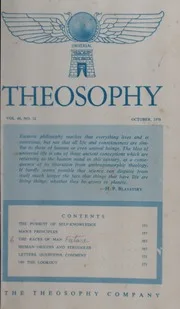
Theosophy Vol-66 No-5 March-1978
 84
84

Theosophy Vol-66 No-5 March-1978


Cassian Rothmann, Senior Critic at Ancient Wisdom, states: 'This March 1978 installment of Theosophy magazine is a compelling testament to the enduring power of H.P. Blavatsky's legacy. It expertly navigates complex metaphysical concepts with clarity and grace, offering profound insights into karma, reincarnation, and the planes of existence. The anonymous contributors, as is often the case with such venerable journals, present a tapestry of esoteric knowledge that resonates deeply with practitioners and scholars alike. Its strength lies in its ability to distill profound truths into accessible prose, fostering a deeper understanding of the spiritual journey. An essential read for those dedicated to the pursuit of higher wisdom and the exploration of the inner life.'
📝 Description
84
The March 1978 issue of Theosophy (Vol-66 No-5) discusses cosmic structure and consciousness.
This particular issue of Theosophy, published in March 1978, addresses concepts related to the structure of the cosmos and the nature of human consciousness. It touches upon ancient mysteries, fundamental principles, and the laws that are believed to govern existence. The content aims to shed light on subtle energies and archetypal forces that influence reality. The publication is intended for individuals interested in occult philosophy and seeking a deeper understanding of life's currents. It encourages reflection on the unity of all things, the inner divine essence, and the possibility of spiritual growth. The issue is presented as a resource for those on a path toward ultimate truth and personal liberation.
This compilation contains teachings that invite contemplation. It seeks to connect the reader with a broader understanding of existence, moving beyond ordinary perception. The articles within are designed to stimulate thought on interconnectedness and the potential for inner transformation. It offers insights into what theosophical tradition terms 'ageless wisdom' and the science of the soul.
This issue is situated within the broader theosophical movement, which emerged in the late 19th century. Theosophy, as articulated by figures like Helena Blavatsky, seeks to synthesize Eastern and Western esoteric traditions. It often discusses the hidden workings of the universe, reincarnation, karma, and the evolution of consciousness. The content typically aims to reveal underlying spiritual principles and a cosmic order accessible through study and inner development. This publication likely reflects the ongoing discourse within theosophy regarding these themes.
💡 Why Read This Book?
Uncover lost spiritual paradigms and explore the fundamental nature of reality. This issue offers profound insights into karma, reincarnation, and the subtle body, perfect for seekers of ancient wisdom, students of comparative religion, and practitioners of meditation. It provides a unique lens through which to view personal growth and universal interconnectedness, fostering a deeper spiritual understanding.
⭐ Reader Reviews
Honest opinions from readers who have explored this book.
❓ Frequently Asked Questions
What is Theosophy?
Theosophy is a philosophical and religious movement founded in the late 19th century, aiming to explore the wisdom underlying all religions and philosophies. It emphasizes the divine nature of humanity and the universe, and the potential for spiritual evolution.
Who were the founders of Theosophy?
The Theosophical Society was co-founded by Helena Blavatsky, Henry Steel Olcott, and William Quan Judge in 1875. Blavatsky, in particular, is renowned for her extensive writings on esoteric philosophy.
What are the core tenets of Theosophy?
Key tenets include the universality of truth, the cyclical nature of existence (karma and reincarnation), the brotherhood of humanity, the study of comparative religion and philosophy, and the investigation of latent human powers and the divine nature within.
Is Theosophy a religion?
Theosophy is often described as a 'wisdom-religion' or a path to spiritual understanding rather than a dogma-bound religion. It encourages individual study and experience, respecting all faiths.
Where does the term 'Theosophy' originate?
The term 'Theosophy' comes from the Greek words 'theos' (god) and 'sophia' (wisdom), literally meaning 'divine wisdom' or 'god-wisdom'.
🔮 Key Themes & Symbolism
The Unfolding of Consciousness
This issue studies the intricate process of consciousness expansion, tracing its evolutionary journey from primal states to potential divine awareness. It explores the concept of 'Manas' and the higher intellect as instruments for spiritual discernment, and the role of 'Buddhi' in intuitive comprehension. Readers are guided to understand how individual consciousness is a microcosm of the universal mind, and how by purifying desires and cultivating selfless action, one can ascend through the various planes of existence, ultimately realizing their inherent divinity and interconnectedness with all life.
The Law of Karma and Reincarnation
Central to the teachings presented is the immutable law of Karma, understood not as punishment, but as the principle of cause and effect governing all actions and their subsequent repercussions across lifetimes. This section illuminates how past deeds shape present circumstances and future destinies, emphasizing the soul's continuous journey of learning and purification through repeated incarnations. The interconnectedness of all beings is highlighted, suggesting that individual karma contributes to the collective destiny, urging readers towards compassionate action and mindful living to harmonize their spiritual trajectory.
The Subtle Planes of Existence
This collection offers a glimpse into the unseen dimensions of reality, exploring the various subtle planes that interpenetrate our physical world. From the astral and mental realms to the higher spiritual spheres, the text elucidates their characteristics and the nature of consciousness as it navigates these distinct energetic environments. The importance of understanding these planes is stressed as crucial for comprehending the full scope of human existence and the processes of spiritual development, including the transition between physical lives and the nature of post-mortem experiences.
💬 Memorable Quotes
Direct passages from the work, attributed to the author.
“Karma is the unerring sculptor of destiny.”
— Emphasizes the wide impact of our actions on our future. It highlights that our present circumstances are a direct result of past deeds, and our future is shaped by our current choices and intentions.
“Behind the veil of matter, spirit dances eternally.”
— A poetic expression of the core esoteric belief that the material world is merely an illusion or a temporary form, and that the true essence of reality is the eternal, vibrant spirit or consciousness.
“Enlightenment is not found, but awakened within.”
— Suggests that spiritual realization is an inner process of uncovering latent potential rather than an external acquisition. It emphasizes self-discovery and the inherent divinity within each individual.
“The path of wisdom is paved with self-knowledge.”
— Highlights the fundamental importance of introspection and understanding one's own nature, motivations, and limitations as the primary means to achieve true wisdom and spiritual insight.
💡 Key Ideas
Editorial paraphrase of the work's core concepts — not direct quotes.
The universe is a thought of God, and man is its expression.
This quote captures the pantheistic and idealistic view of existence, suggesting a divine origin and purpose for all creation, with humanity playing an important role as a manifestation of this cosmic consciousness.
🌙 Esoteric Significance
Tradition
This publication is deeply rooted in the Western Esoteric Tradition, particularly influenced by Theosophy as established by Helena Blavatsky. It draws upon ancient Eastern philosophies, Gnosticism, Hermeticism, and Neoplatonism, synthesizing them into a cohesive system of spiritual science. The emphasis is on the study of universal laws, the evolution of consciousness, and the hidden dimensions of reality, aiming to provide a bridge between science, religion, and philosophy from an esoteric viewpoint.
Symbolism
The journal likely employs a wide range of esoteric symbols, such as the Caduceus, the Eye of Providence, the Ankh, and mandalas, each representing profound concepts of cosmic order, spiritual awakening, life, and unity. These symbols serve as keys to unlock deeper meanings, facilitating intuitive understanding of complex metaphysical principles and acting as mnemonic devices for spiritual truths that transcend linguistic expression.
Modern Relevance
In today's increasingly materialistic and disconnected world, the teachings within this issue offer a vital counterpoint. They provide frameworks for understanding personal and collective challenges through the lens of karma and spiritual evolution, encouraging self-awareness and ethical living. The exploration of consciousness and subtle energies remains profoundly relevant for those seeking holistic well-being, personal growth, and a deeper connection to the universe beyond superficial appearances.
👥 Who Should Read This Book
This issue is important for seasoned Theosophists and those well-versed in comparative religious studies, offering a continuation of established dialogues. It is also highly recommended for spiritual seekers and practitioners of meditation who are ready to engage with profound metaphysical concepts like karma, reincarnation, and the nature of consciousness. Academics researching esoteric movements and students of occult philosophy will find it a significant primary source. Beginners interested in the foundational principles of esoteric thought will discover an accessible yet deep introduction to Theosophical ideas.
📜 Historical Context
Published in March 1978, this issue of 'Theosophy' emerges during a period of renewed interest in spiritual and metaphysical studies, a continuation of the counter-cultural movements of the 1960s. The late 1970s saw a blend of scientific inquiry and esoteric exploration, with many seeking alternative perspectives to mainstream societal norms. Theosophy, with its roots in the 19th century, continued to provide a rich intellectual and spiritual framework for individuals grappling with existential questions, seeking deeper meaning, and exploring ancient wisdom traditions. This era was characterized by a growing awareness of global interconnectedness, ecological concerns, and a burgeoning exploration of consciousness, all of which resonate with the timeless themes presented in this publication.
📔 Journal Prompts
Reflect on a recent challenge in your life. How might the principle of Karma be at play in this situation, and what lessons can you draw for future actions?
Consider the concept of subtle planes. How might your current thoughts, emotions, and intentions be influencing your experience of these unseen dimensions?
Explore the idea of the divine spark within. In what everyday situations can you consciously acknowledge and express this inner divinity?
Theosophy often speaks of 'unfoldment.' What aspect of your own consciousness do you feel is currently unfolding, and what steps can you take to nurture this growth?
How can the principles of universal brotherhood, as discussed in esoteric traditions, be practically applied to foster greater harmony in your immediate community or in global affairs?
🗂️ Glossary
Theosophy
A philosophical and religious system aiming to discover the divine wisdom underlying all religions and philosophies, emphasizing spiritual evolution and universal truth.
Karma
The spiritual principle of cause and effect, where actions (causes) inevitably lead to corresponding results (effects) that shape an individual's destiny across lifetimes.
Reincarnation
The belief that the soul, after death, is reborn into a new physical body to continue its evolutionary journey and learn lessons through successive lives.
Subtle Planes
Non-physical dimensions or levels of existence, such as the astral, mental, and spiritual planes, which interpenetrate the physical world and are inhabited by various forms of consciousness.
Manas
In Theosophical philosophy, the human mind or intellect, often divided into lower (animalistic) and higher (spiritual) aspects, crucial for conscious thought and spiritual discernment.
This book appears in 2 collections
🔮 Readers Also Liked
Browse all →





From the “Theosophy” Collection
View all →





More Free Theosophy & Anthroposophy Books
View all →