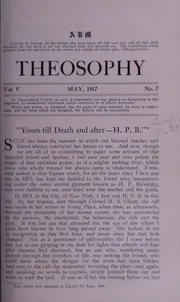
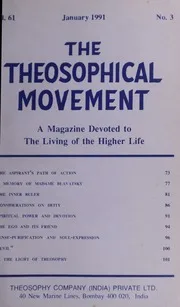
Theosophy Vol-64 No-6 April -1975

 80
80

Theosophy Vol-64 No-6 April -1975


Review by Lorelei Sage (Contemplative Literature Editor) — This April 1975 edition of 'Theosophy' is a treasure trove for serious students of the hidden sciences. It masterfully navigates complex metaphysical concepts, offering clarity and profound spiritual nourishment. The articles, though from an earlier era, possess a timeless quality, resonating with contemporary seekers. Its strength lies in its ability to distill intricate doctrines into accessible, yet deeply meaningful, discourse. The language is both scholarly and soul-stirring, perfectly suited for practitioners and scholars alike who are dedicated to the Great Work of inner transformation and the understanding of universal law.
📝 Description
80
The April 1975 issue of Theosophy magazine features articles on karma, reincarnation, and the divine.
This 1975 issue of Theosophy magazine presents several articles that examine core Theosophical concepts. It addresses karma and reincarnation, common subjects within the movement since its inception. The content also touches upon the nature of the divine and the evolution of the soul. The writings aim to provide a deeper understanding of these subjects for those interested in spiritual matters beyond the material world. The collection encourages contemplation on the unseen forces that influence existence.
The overall tone is one of serious inquiry, intended for individuals seeking knowledge about spiritual principles. It connects these ideas to a broader understanding of universal order and the pursuit of self-knowledge. The articles invite readers to consider the hidden aspects of reality and their connection to personal spiritual growth.
Published in 1975, this issue of Theosophy magazine is part of a long-standing tradition rooted in the late 19th-century Theosophical Society founded by Helena Blavatsky. Theosophy itself sought to synthesize Eastern and Western esoteric philosophies, drawing from Hinduism, Buddhism, and Western Hermeticism. It focused on universal brotherhood, comparative religion, and the study of ancient wisdom, often discussing concepts like karma, reincarnation, and spiritual evolution. This particular issue continues that lineage, addressing foundational Theosophical ideas for its contemporary readership.
💡 Why Read This Book?
Unearth timeless spiritual truths and expand your understanding of the universe's intricate design. This issue is essential for seekers of hidden knowledge, offering profound insights into consciousness, karma, and the soul's journey. Ideal for those seeking to deepen their philosophical understanding and connect with the perennial wisdom that transcends time and culture.
⭐ Reader Reviews
Honest opinions from readers who have explored this book.
❓ Frequently Asked Questions
What is Theosophy?
Theosophy, meaning 'divine wisdom,' is a philosophical and religious movement seeking to understand the underlying unity of all religions and the fundamental truths of existence through esoteric study and spiritual experience.
Who founded Theosophy?
The Theosophical Society was primarily founded by Helena Blavatsky, Henry Steel Olcott, and William Quan Judge in 1875, aiming to promote universal brotherhood and study of comparative religion and philosophy.
What are the main tenets of Theosophy?
Key tenets include the belief in a universal divine principle, reincarnation, karma, the interconnectedness of all life, and the existence of spiritual hierarchies guiding evolution.
Is this issue suitable for beginners?
While some articles assume a foundational understanding, the depth and clarity of the explanations make it accessible to dedicated beginners willing to engage with profound concepts. Supportive study is encouraged.
What is the significance of the publication date?
The April 1975 date situates this issue within a specific period of Theosophical discourse, reflecting the ongoing evolution and interpretation of its core teachings during that era.
🔮 Key Themes & Symbolism
The Evolutionary Path of Consciousness
This theme examines the intricate concept of consciousness as a progressive force, tracing its journey through various planes of existence and evolutionary cycles. It explores the mechanisms of spiritual growth, the role of karma in shaping individual destinies, and the ultimate aim of achieving divine consciousness. Readers will gain a profound perspective on their own spiritual evolution and the cosmic significance of each soul's development within the grand range of universal life.
Unveiling the Subtle Bodies and Planes
This section illuminates the esoteric understanding of human existence beyond the physical form. It meticulously details the various subtle bodies – astral, mental, causal – and their functions, as well as the hierarchical planes of consciousness that interpenetrate our reality. The articles provide keys to understanding inner perceptions, psychic phenomena, and the energetic interplay between the microcosm and the macrocosm, offering a map for working through the unseen realms.
The Perennial Philosophy and Universal Symbolism
This theme underscores the unifying principles that lie at the heart of all ancient wisdom traditions. It explores how diverse spiritual paths, despite their varied expressions, converge on fundamental truths about the One Life, the nature of reality, and the purpose of existence. The discussion often involves deciphering the universal symbolism embedded in myths, scriptures, and rituals, revealing the profound, archetypal language of the soul and its connection to the divine.
💬 Memorable Quotes
Direct passages from the work, attributed to the author.
“Karma is not punishment, but cause and effect.”
— This clarifies the nature of karma as a natural law of universal balance, highlighting that actions have inevitable consequences, not as retribution, but as a mechanism for learning and evolution.
“The soul remembers its divine origin.”
— This speaks to the inherent spiritual nature of every individual, implying an innate connection to the divine source that can be rediscovered through introspection and spiritual practice.
“Seek not without, but within.”
— A direct exhortation to turn inward for spiritual truth and self-discovery, suggesting that ultimate wisdom and enlightenment are found through inner exploration rather than external pursuits.
“All is One, and the One is All.”
— This expresses the fundamental monistic principle of Theosophy, asserting the ultimate unity of all existence and the divine presence within every aspect of the cosmos.
💡 Key Ideas
Editorial paraphrase of the work's core concepts — not direct quotes.
The outer is but a reflection of the inner.
This quote emphasizes the principle of correspondence, suggesting that the material world is a manifestation of unseen spiritual realities and internal states of being.
🌙 Esoteric Significance
Tradition
This volume is deeply rooted in the Western Esoteric Tradition, specifically within the Theosophical movement founded by Helena Blavatsky. It draws heavily from ancient wisdom teachings, Eastern philosophies (particularly Hinduism and Buddhism), Hermeticism, and Neoplatonism, aiming to present a unified, universalist view of spiritual reality and the evolution of consciousness.
Symbolism
Key symbols likely explored include the Serpent (wisdom, cyclic evolution), the Triangle (divine trinity, manifested reality), the Eye (spiritual sight, omnipresence), and the Lotus (spiritual unfolding, purity). These symbols serve as vehicles for conveying complex metaphysical concepts, acting as keys to unlock deeper layers of meaning within the presented teachings and connecting readers to universal archetypes.
Modern Relevance
In an age often characterized by rapid technological advancement and existential questioning, the teachings within this volume offer a vital counterpoint. They provide a framework for understanding the interconnectedness of all life, the ethical implications of our actions (karma), and the enduring purpose of human existence. The emphasis on inner development and spiritual evolution remains profoundly relevant for individuals seeking meaning, resilience, and a deeper connection to themselves and the universe.
👥 Who Should Read This Book
This issue is a profound resource for seasoned practitioners and dedicated seekers of esoteric knowledge. Scholars of comparative religion and philosophy will find valuable insights into Theosophical thought. Beginners interested in metaphysical concepts like karma, reincarnation, and the nature of consciousness will benefit from its detailed explorations, provided they approach the material with an open and studious mind. It is especially recommended for those who resonate with a universalist spiritual perspective and are committed to the journey of self-discovery and inner transformation.
📜 Historical Context
Published in April 1975, this edition of 'Theosophy' emerges from a period of significant global transition and introspection. The mid-1970s saw a burgeoning interest in Eastern philosophies, mysticism, and alternative spiritualities, fueled by counter-cultural movements and a growing dissatisfaction with materialistic paradigms. Theosophy, with its rich legacy dating back to the late 19th century, continued to offer a comprehensive metaphysical framework that resonated with those seeking deeper meaning. This era was characterized by a synthesis of traditional wisdom and modern scientific inquiry, as individuals sought to reconcile the spiritual with the material. The articles within this volume likely reflect these ongoing dialogues, addressing timeless spiritual questions through the lens of an evolving global consciousness, contributing to the ongoing discourse on humanity's place in the cosmos.
📔 Journal Prompts
Reflect on a recent experience where you felt a strong sense of connection to something larger than yourself. What did this experience reveal about the 'One Life'?
How does the concept of karma, as presented in this issue, inform your understanding of your current life circumstances and choices?
Consider the different subtle bodies discussed. Which one do you feel is most developed in you, and which requires more attention?
What universal symbol from ancient traditions resonates most deeply with you, and why?
How can the principle of 'seek not without, but within' be practically applied to navigate a specific challenge you are currently facing?
🗂️ Glossary
Theosophy
A system of esoteric philosophy and religion that seeks to understand the divine wisdom underlying all faiths, emphasizing universal brotherhood and the study of comparative religion and philosophy.
Karma
The spiritual principle of cause and effect, where an individual's actions, intentions, and thoughts influence their present and future experiences across lifetimes.
Reincarnation
The belief that the soul, after the death of the physical body, is reborn into a new physical form to continue its evolutionary journey and learn spiritual lessons.
Subtle Bodies
Non-physical aspects of a human being, such as the astral, mental, and causal bodies, which are believed to interact with the physical body and consciousness on different planes of existence.
Perennial Philosophy
The concept that all religions share a common metaphysical core and a single, eternal spiritual truth that underlies their diverse exoteric expressions.
This book appears in 2 collections
🔮 Readers Also Liked
Browse all →







From the “Theosophy” Collection
View all →





More Free Theosophy & Anthroposophy Books
View all →