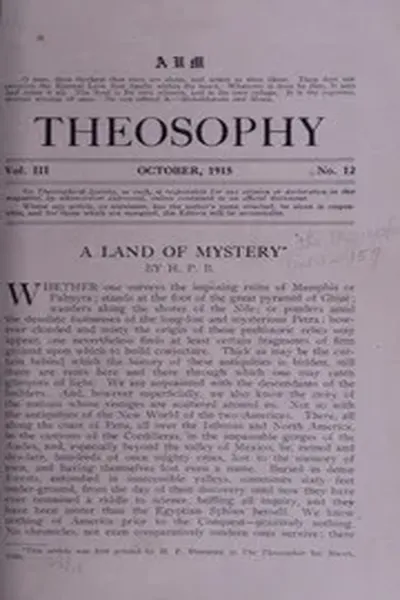
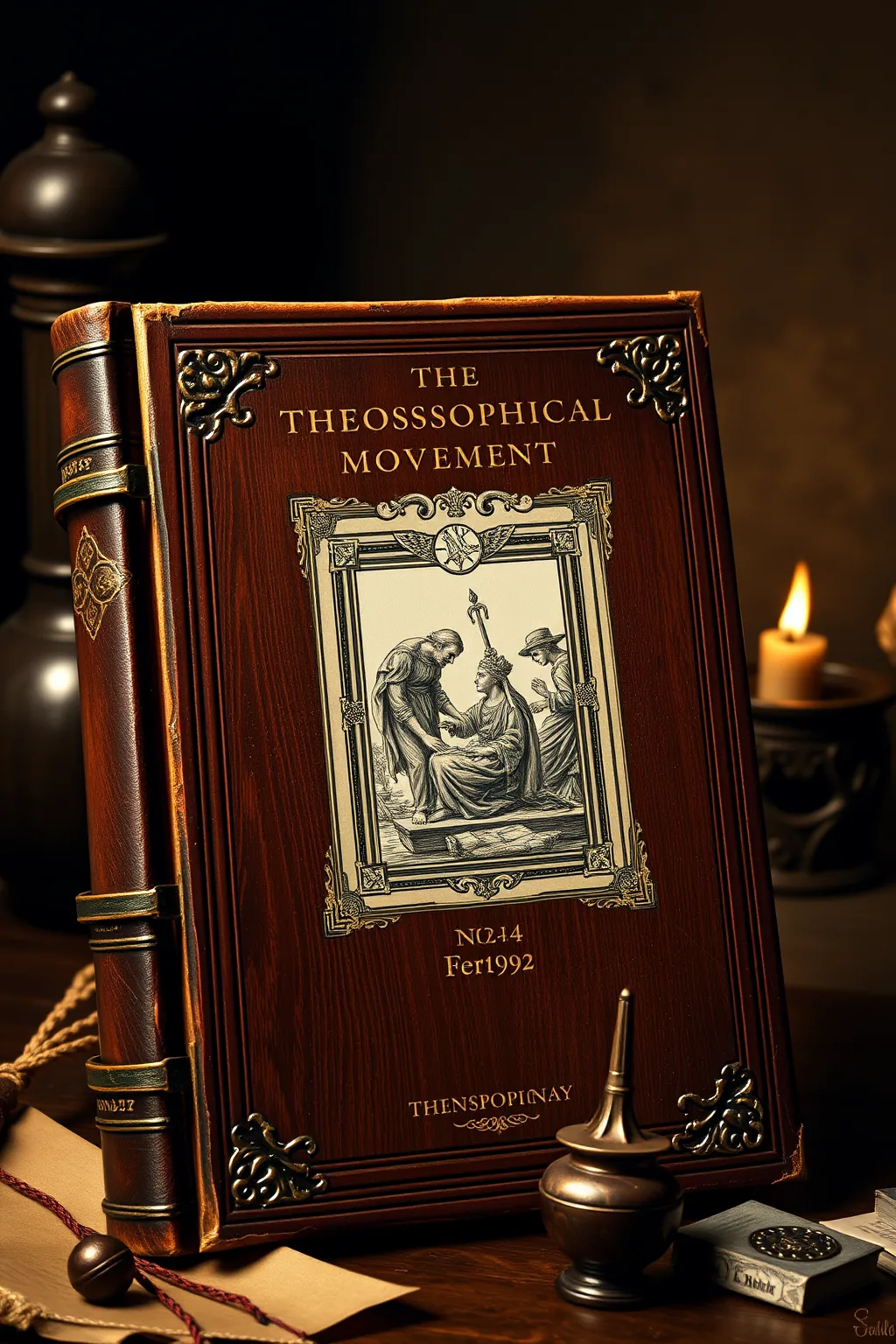
The Theosophical Movement Vol-62 , No-4 , Feb1992
 75
75

The Theosophical Movement Vol-62 , No-4 , Feb1992



Isolde Whitaker, Sacred Texts Editor: This installment of 'The Theosophical Movement' is a luminous offering, providing essential insights into the labyrinthine paths of Theosophy. The articles gracefully unpack complex metaphysical concepts, making them accessible without sacrificing their inherent depth. It’s particularly strong in its exploration of karmic law and the evolution of consciousness, themes that resonate deeply for today's spiritual explorers. The editors have curated content that challenges the intellect while nourishing the spirit. Highly recommended for students of esoteric philosophy and anyone seeking a more profound understanding of life's mysteries.
📝 Description
75
The February 1992 issue of 'The Theosophical Movement' examined hidden spiritual laws.
This 1992 issue of 'The Theosophical Movement' presents a collection of articles focusing on esoteric principles. It discusses spiritual laws and the structure of the cosmos, aiming to shed light on the perennial philosophy found in various religious and mystical systems. Readers will find discussions on symbolism, the nature of the soul, and the historical quest for gnosis. The content is intended for individuals interested in occult studies and spiritual development. It encourages reflection on the subtle forces influencing existence and the concept of an inner divine essence.
The publication addresses themes relevant to understanding the interconnectedness of all things. It serves as a resource for those seeking to move beyond ordinary experience and engage with deeper spiritual realities. The articles within this issue invite contemplation on the universal patterns that govern existence and the individual's connection to these patterns.
Published in 1992, this issue belongs to a lineage of periodicals dedicated to disseminating Theosophical thought. The Theosophical Society, founded by Helena Blavatsky, Helena Roerich, and others, sought to synthesize Eastern and Western esoteric traditions. It aimed to study comparative religion, philosophy, and science, and to investigate the unexplained laws of nature and the powers latent in humanity. This particular issue likely continued that tradition, addressing specific concepts within the Theosophical framework, such as the nature of consciousness, cosmic order, and esoteric interpretations of religious and mystical ideas.
💡 Why Read This Book?
Uncover timeless spiritual truths within 'The Theosophical Movement'. This issue offers a direct conduit to the foundational principles of Theosophy, illuminating the path of self-discovery and universal brotherhood. Ideal for seekers of hidden knowledge, students of comparative religion, and practitioners of esoteric disciplines, it provides profound insights into consciousness, karma, and the subtle planes of existence. Engage with wisdom that transcends time and dogma.
⭐ Reader Reviews
Honest opinions from readers who have explored this book.
❓ Frequently Asked Questions
What is Theosophy?
Theosophy is a esoteric philosophical movement founded in the late 19th century, aiming to synthesize Eastern and Western religious, philosophical, and scientific thought, emphasizing universal brotherhood and the study of comparative religion, philosophy, and science.
Who was Helena Blavatsky?
Helena Blavatsky was a Russian occultist and the principal founder of the Theosophical Society. She is renowned for her writings, particularly 'The Secret Doctrine', which laid out the foundational tenets of Theosophy.
What are the core principles of Theosophy?
Core principles include the universality of truth, the unity of all life, the doctrine of karma and reincarnation, and the idea of spiritual evolution through successive incarnations.
Is this issue suitable for beginners?
While some articles delve into complex topics, the foundational nature of Theosophy presented makes it accessible to earnest beginners willing to engage with new concepts and ideas.
What kind of topics are covered in this issue?
This issue likely covers a range of Theosophical topics including spiritual evolution, karma, reincarnation, the nature of consciousness, esoteric symbolism, and the history of spiritual movements.
🔮 Key Themes & Symbolism
The Unfolding of Consciousness
This issue studies the intricate journey of consciousness, exploring its evolution across lifetimes and planes of existence. It examines the mechanisms of spiritual growth, the role of karma in shaping our experiences, and the ultimate potential for human spiritual awakening. Readers will find insights into the stages of inner development and the universal laws that govern the progress of the soul, encouraging a deeper introspection into one's own spiritual path and the underlying purpose of existence.
Esoteric Symbolism and Ancient Wisdom
A significant focus is placed on deciphering the collection of esoteric symbolism found in ancient myths, scriptures, and spiritual traditions. This theme illuminates how hidden meanings and archetypal patterns serve as keys to understanding the deeper truths of the universe and the human condition. It explores the 'language of the soul' and the universal archetypes that connect humanity across cultures and epochs, offering a framework for interpreting spiritual allegories and their profound psychological and metaphysical implications.
Universal Brotherhood and the Perennial Philosophy
This section explores the foundational Theosophical ideal of universal brotherhood, emphasizing the inherent unity of all life and the interconnectedness of humanity and the cosmos. It highlights the 'Perennial Philosophy' – the underlying spiritual truths common to all great religions and wisdom traditions. The articles encourage a compassionate worldview and the recognition of the divine spark within every being, fostering a sense of global responsibility and the pursuit of peace through mutual understanding and spiritual kinship.
💬 Memorable Quotes
Direct passages from the work, attributed to the author.
“Karma is not retribution, but the echo of our own choices.”
— This reinterprets karma as a natural law of cause and effect, emphasizing personal responsibility for actions and their subsequent consequences, rather than divine punishment.
“The universe breathes with a rhythm that the soul can attune to.”
— This evokes a sense of cosmic harmony and the potential for humanity to connect with the subtle, energetic pulse of the universe through inner stillness and spiritual receptivity.
“Each soul is a microcosm reflecting the macrocosmic divine.”
— This highlights the concept of correspondence, asserting that the individual human being contains within them the essence and principles of the entire universe.
“Seek not outward dogma, but inward revelation.”
— This encourages a direct, personal experience of the divine, prioritizing inner spiritual discovery over adherence to external religious structures or doctrines.
💡 Key Ideas
Editorial paraphrase of the work's core concepts — not direct quotes.
The veil of ignorance is lifted by the light of inner knowing.
This quote speaks to the transformative power of spiritual insight, suggesting that true understanding comes not from external sources alone, but from the awakening of one's own inner wisdom.
🌙 Esoteric Significance
Tradition
This journal is deeply rooted in the Theosophical tradition, a modern esoteric movement that seeks to synthesize ancient wisdom from various religious, philosophical, and scientific streams. It draws heavily from concepts like karma, reincarnation, spiritual evolution, and the existence of subtle planes of being, all aimed at understanding the underlying unity of existence and the divine potential within humanity.
Symbolism
The Theosophical Movement engages extensively with symbolism, viewing it as a universal language that communicates profound truths beyond the limitations of ordinary language. Recurring symbols often include the Ouroboros (eternity, wholeness), the Caduceus (healing, balance), the Swastika (auspiciousness, cyclic movement), and various astrological and alchemical imagery, all interpreted within the context of spiritual development and cosmic order.
Modern Relevance
In an age often characterized by materialism and disconnection, the teachings within this journal offer a potent counterpoint, emphasizing the interconnectedness of all life, the importance of inner growth, and the existence of deeper spiritual realities. Its exploration of consciousness, ethics, and universal principles continues to resonate with individuals seeking meaning, purpose, and a more holistic understanding of themselves and the world.
👥 Who Should Read This Book
This issue is a valuable collection for the dedicated seeker of esoteric knowledge, offering clear insights into the perennial philosophy. Students of comparative religion and philosophy will find valuable comparative studies and historical context. Practitioners of mystical disciplines, such as meditation or occult arts, will discover foundational principles that can deepen their practice. Beginners curious about the nature of consciousness, karma, and spiritual evolution will find accessible yet profound introductions to these complex subjects. It is for anyone yearning to look beyond the veil of the material world and explore the deeper currents of existence.
📜 Historical Context
Published in February 1992, this issue of 'The Theosophical Movement' emerges during a period of renewed interest in esoteric thought and Eastern philosophies in the West. The late 20th century saw a growing exploration beyond mainstream religious and scientific paradigms, with many seeking alternative perspectives on consciousness, spirituality, and the nature of reality. Theosophy, with its synthesis of diverse traditions and its emphasis on universalism and evolution, found fertile ground during this era. This publication reflects the ongoing discourse within the Theosophical Society, continuing to disseminate its teachings and engage with contemporary spiritual questions, maintaining its relevance as a source of profound metaphysical inquiry.
📔 Journal Prompts
Reflect on a recurring symbol in your life and explore its potential esoteric meaning.
Consider a recent challenge and analyze it through the lens of karma and spiritual lessons.
Imagine the concept of universal brotherhood in action; how would society change?
What does 'inner knowing' mean to you, and how can you cultivate it further?
Explore the connection between your inner state and the external world; what parallels do you observe?
🗂️ Glossary
Theosophy
An esoteric philosophy aiming to synthesize Eastern and Western religious, philosophical, and scientific thought, emphasizing universal brotherhood and the study of comparative religion, philosophy, and science.
Karma
The principle of cause and effect, where actions in past lives influence present circumstances and actions in the present shape future experiences. It's often seen as a natural law of moral causation.
Reincarnation
The belief that the soul or spirit, after biological death, can begin a new life in a new body. It's a key doctrine for the spiritual evolution of the individual.
Perennial Philosophy
The concept that there is a single, universal spiritual truth or wisdom that underlies all the world's religions and esoteric traditions, despite their diverse forms.
Gnosis
Spiritual knowledge or insight, often attained through direct experience or mystical intuition, leading to salvation or enlightenment.
This book appears in 2 collections
🔮 Readers Also Liked
Browse all →





From the “Theosophy” Collection
View all →



More Free Theosophy & Anthroposophy Books
View all →