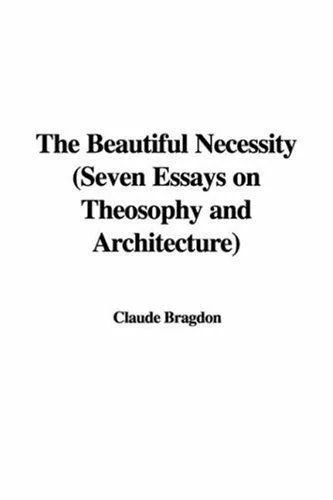
The Beautiful Necessity
 82
82

The Beautiful Necessity
Claude Bragdon’s The Beautiful Necessity offers a compelling argument for the spiritual underpinnings of architecture, moving beyond purely aesthetic concerns. His assertion that beauty is a fundamental cosmic law, rather than a subjective preference, is the book’s greatest strength. The section exploring "four-dimensional geometry" as it applies to physical space is particularly insightful, challenging conventional perceptions of structure. However, the prose can occasionally become dense, requiring careful attention from the reader to fully grasp Bragdon’s intricate concepts. A notable passage discusses how the "architecture of the spirit" is reflected in the proportions of a cathedral, a vivid illustration of his thesis. The Beautiful Necessity provides a unique lens through which to view the built world, suggesting a profound interconnectedness between form and universal principles.
📝 Description
82
Claude Bragdon argued in 1913 that beauty in architecture is a cosmic necessity, not just an aesthetic choice.
Claude Bragdon's 1913 book, The Beautiful Necessity, examines architecture and design through a spiritual lens. Bragdon, an architect, contended that physical structures possess a deeper, almost divine, quality. He proposed that beauty is an intrinsic universal principle, connected to mathematical and geometric truths. This work is for architects, designers, mathematicians, philosophers, and anyone interested in the relationship between form, consciousness, and the cosmic order.
The book appeals to readers seeking to understand the fundamental principles of creation. It moves beyond superficial appearances to grasp the energetic and symbolic aspects of the built environment and the wider universe. Bragdon applies concepts like "four-dimensional geometry" to architecture, suggesting that buildings have a temporal or spiritual dimension beyond their physical existence. He discusses the "architecture of the spirit," positing that universal laws of harmony and proportion govern both the cosmos and human creations. For Bragdon, true beauty is a direct expression of these inherent necessities.
The Beautiful Necessity emerged during a period of renewed interest in esoteric traditions. Bragdon's work connects with earlier occultist explorations of geometry and symbolism. It bridges scientific-mathematical reasoning with metaphysical speculation, finding echoes in the geometric explorations of figures like Buckminster Fuller. The book reflects a broader turn toward understanding universal laws through both rational and intuitive means, seeking a unified vision of cosmos and creation.
💡 Why Read This Book?
• Understand architecture not just as construction, but as a manifestation of universal laws, as Bragdon details in his exploration of "four-dimensional geometry." • Gain a new perspective on beauty, recognizing it as an inherent necessity rooted in cosmic order, as articulated in his concept of the "architecture of the spirit." • Appreciate the symbolic and energetic dimensions of built forms, moving beyond mere visual appeal to grasp deeper meanings, particularly relevant when considering his discussions on proportion and harmony.
⭐ Reader Reviews
Honest opinions from readers who have explored this book.
❓ Frequently Asked Questions
When was Claude Bragdon's 'The Beautiful Necessity' first published?
The Beautiful Necessity by Claude Bragdon was first published in 1997, though its ideas may have circulated in earlier forms.
What is the central argument of 'The Beautiful Necessity'?
The book argues that beauty is not subjective but a fundamental cosmic necessity, intrinsically linked to mathematical and geometric truths that govern the universe and physical forms.
What does Bragdon mean by 'four-dimensional geometry' in architecture?
Bragdon uses 'four-dimensional geometry' to suggest that buildings possess a spiritual or temporal dimension beyond their physical three-dimensional presence, influencing their perceived form and impact.
Who would benefit most from reading 'The Beautiful Necessity'?
Architects, designers, philosophers, mathematicians, and anyone interested in the metaphysical aspects of form, geometry, and the underlying principles of creation would find this book valuable.
What is the 'architecture of the spirit' according to Bragdon?
The 'architecture of the spirit' refers to the idea that universal laws of harmony and proportion are the fundamental blueprints for both the cosmos and all human creations, suggesting a spiritual order behind physical structure.
Does the book discuss specific architectural examples?
While focusing on principles, Bragdon uses examples and discussions of proportions, particularly in relation to cathedrals, to illustrate his theories on the underlying spiritual necessities of design.
🔮 Key Themes & Symbolism
Geometric Necessity
Bragdon posits that geometry is not merely a descriptive tool but a fundamental language of the universe, dictating the very possibility of form and beauty. He suggests that true architectural beauty arises from adherence to these inherent geometric laws, which he links to higher dimensions and spiritual order. This perspective moves beyond stylistic trends to propose an objective basis for aesthetic principles, rooted in the mathematical fabric of existence itself. The work implies that understanding these geometric necessities allows for the creation of spaces that resonate on a deeper, energetic level.
The Architecture of the Spirit
This central concept argues for an underlying spiritual blueprint that informs all physical creation, particularly architecture. Bragdon suggests that buildings, when correctly designed according to universal harmonies, can act as conduits or reflections of this spiritual order. It is not about ornamentation or style, but about the inherent proportional relationships and energetic flows that constitute the 'spirit' of a structure. This perspective invites readers to consider spaces not just for their utility or appearance, but for their capacity to embody or express higher truths and cosmic intelligences.
Four-Dimensional Space in Design
Bragdon interprets four-dimensional geometry not as a purely abstract mathematical concept, but as a means to understand the totality of an object or space, including its temporal or experiential dimension. Applied to architecture, this suggests that a building's impact extends beyond its static physical form to encompass its evolution through time and its effect on consciousness. This challenges the purely volumetric understanding of architecture, proposing that true design must account for this expanded perception, hinting at an energetic or spiritual presence that transcends the material.
Beauty as a Cosmic Law
Contrary to subjective aesthetic theories, Bragdon asserts that beauty is an immutable law of the cosmos, as fundamental as gravity or mathematical principles. He argues that what we perceive as beautiful in art and architecture is simply a recognition of these underlying universal laws manifesting in form. This elevates aesthetic appreciation to an act of perceiving cosmic order. The book advocates for a return to design principles that align with this inherent cosmic beauty, suggesting it holds the key to creating environments that are not only pleasing but also spiritually harmonious and constructive.
💬 Memorable Quotes
Direct passages from the work, attributed to the author.
“Beauty is not an accident, nor is it a matter of taste; it is a necessity.”
— This statement captures Bragdon's core thesis: beauty is an intrinsic, fundamental aspect of the universe, not a subjective human construct or a random occurrence.
“The architect is he who understands the architecture of the spirit.”
— This suggests that true architectural mastery lies in comprehending and expressing the deeper, spiritual principles that govern form and existence, rather than just technical construction.
“The universe is built upon a plan, and the plan is geometric.”
— This highlights Bragdon's belief in an ordered, intelligent cosmos governed by mathematical and geometric laws, which he sees as the foundation for all creation.
“We perceive a building not only with our eyes but with our entire being.”
— This interpretation of four-dimensional space suggests that a structure's impact is holistic, engaging our consciousness and spirit beyond mere visual perception.
💡 Key Ideas
Editorial paraphrase of the work's core concepts — not direct quotes.
Form is the expression of an idea; beauty is the expression of truth.
This quote draws a direct line between the physical manifestation of an idea (form) and the underlying reality or principle it represents (truth), asserting beauty as the indicator of that truth.
🌙 Esoteric Significance
Tradition
Bragdon's work draws heavily from Pythagoreanism and Neoplatonism, traditions that emphasize the primacy of number and geometry as the underlying structure of reality. His exploration of a 'fourth dimension' in architecture echoes esoteric ideas of subtle bodies or planes of existence. While not strictly aligned with any single modern esoteric school like Theosophy or Anthroposophy, his ideas find common ground in their pursuit of universal principles and the spiritual significance of form, characteristic of Western Esotericism's broader interest in cosmic order and symbolic representation.
Symbolism
Key symbols in Bragdon's work include geometric forms themselves, which he sees as pure expressions of cosmic law and divine thought. The concept of the 'fourth dimension' functions symbolically, representing a higher, more complete reality or consciousness that informs our three-dimensional world. Proportion and harmony are also symbolic, representing the inherent order and balance of the universe, and their presence in architecture signifies a connection to these universal truths. These elements collectively point towards an underlying spiritual blueprint that manifests in the material world.
Modern Relevance
Bragdon's ideas continue to influence contemporary thinkers in fields ranging from sacred geometry and architectural theory to consciousness studies. His emphasis on beauty as an inherent cosmic necessity and the spiritual dimension of design finds echoes in movements like biophilia and the growing interest in the psychological and energetic impact of spaces. Architects and designers seeking to move beyond purely utilitarian or postmodern aesthetics often revisit Bragdon for his foundational principles, which offer a framework for creating environments that are both structurally sound and spiritually resonant.
👥 Who Should Read This Book
• Architects and designers seeking to imbue their work with deeper meaning and connect form to universal principles. • Students of geometry and mathematics interested in the philosophical and metaphysical applications of their studies. • Esoteric practitioners and philosophers exploring the relationship between consciousness, form, and the underlying order of the cosmos.
📜 Historical Context
Claude Bragdon's *The Beautiful Necessity*, first published in 1997, emerged at a time when interest in the intersection of spirituality, geometry, and design was experiencing a resurgence. While Bragdon himself was active much earlier, the book’s later publication brought his ideas to a new audience. His work appeals to the symbolic geometry explored by early Theosophists and the broader esoteric revival of the late 19th and early 20th centuries. He was contemporary with figures like Wassily Kandinsky, who also sought to imbue art with spiritual and geometric principles, and Rudolf Steiner, who explored architecture’s relationship to human consciousness. Bragdon’s unique contribution was his specific focus on architecture and his application of concepts like fourth-dimensional geometry to physical structures, offering a counterpoint to the purely functionalist or materialistic trends in design that dominated much of the 20th century.
📔 Journal Prompts
The geometric necessity of a sacred site you admire.
Reflecting on the 'architecture of the spirit' in your own living space.
How does the concept of 'four-dimensional space' alter your perception of a familiar building?
Identifying instances where beauty functions as a fundamental cosmic law rather than mere taste.
The perceived spiritual necessity in the design of a public monument.
🗂️ Glossary
Four-Dimensional Geometry
Bragdon's conceptual application of higher geometric principles to understand objects and spaces, suggesting a dimension beyond length, width, and height that relates to time or consciousness.
Architecture of the Spirit
The underlying spiritual or cosmic blueprint that Bragdon believes informs all physical creation, particularly the built environment, emphasizing harmony and universal law.
Geometric Necessity
The idea that geometry is not arbitrary but represents fundamental, inherent laws of the universe that dictate the possibility and nature of form.
Cosmic Law
Universal principles or truths that govern the operation of the cosmos, which Bragdon believed are reflected in beauty, mathematics, and proportion.
Proportion
The relationship in size or degree between two or more things; Bragdon viewed correct proportion as a key manifestation of cosmic harmony and beauty.
Harmony
A pleasing arrangement of parts; in Bragdon's context, it refers to the agreement and balance found in universal laws and their expression in form.
Form
The visible shape or configuration of something; Bragdon saw form as the outward expression of an underlying idea or truth.
🔮 Readers Also Liked
Browse all →





More by Claude Bragdon
All books →
More Free Theosophy & Anthroposophy Books
View all →