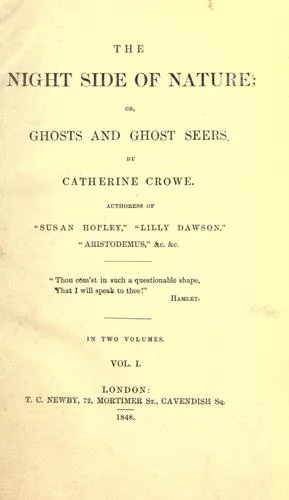
The Night Side of Nature, Or, Ghosts and Ghost Seers
 75
75

The Night Side of Nature, Or, Ghosts and Ghost Seers
Catherine Crowe’s "The Night Side of Nature" offers a remarkable compendium of spectral accounts from a pre-modernist lens. The strength lies in its exhaustive cataloging of phenomena, meticulously detailing ghost sightings and seer experiences with a scholarly, albeit dated, rigor. Crowe’s attempt to categorize these occurrences, particularly her exploration of the 'ghostly double,' provides a fascinating glimpse into Victorian attempts to rationalize the irrational. However, the work occasionally suffers from a lack of critical distance; while presenting numerous anecdotes, it sometimes leans into explanations that feel more like faith than evidence by today's standards. A notable passage detailing the 'spectral influence' on the living, while intriguing, highlights this blend of observation and speculative interpretation. Despite its limitations, the book remains a vital historical document for understanding the evolution of ghost lore and early psychical research. It is an indispensable resource for serious researchers of the paranormal's historical roots.
📝 Description
75
Catherine Crowe published 'The Night Side of Nature' in 1848, compiling ghost accounts from history and personal testimony.
First released in 1848, Catherine Crowe's "The Night Side of Nature" presents a methodical study of ghosts, apparitions, and the people who claim to see them. The book collects a wide range of historical accounts and personal testimonies, aiming to systemize the understanding of supernatural occurrences and the mental or spiritual states of those who witness them. Crowe goes beyond mere storytelling, seeking to analyze the underlying principles and reported methods of spectral perception. She examines concepts like the 'ghostly double' and premonitions, distinguishing between different kinds of apparitions and seer experiences. Crowe often connects these phenomena to the observer's mental or spiritual condition and investigates how belief and expectation shape these encounters.
Published in 1848, "The Night Side of Nature" emerged during a period of intense interest in spiritualism and the nature of consciousness. This era saw figures like Andrew Jackson Davis and the Fox sisters gaining public attention for their claims about the afterlife. Crowe's work fits within this broader fascination with spiritual phenomena, attempting to categorize and explain visions and spectral encounters that were often dismissed by mainstream science. It predates the formal academic study of parapsychology but documents many of the beliefs and experiences that would later become subjects of investigation.
💡 Why Read This Book?
• Gain insight into the systematic cataloging of spectral phenomena as presented in the mid-19th century, moving beyond mere anecdote to early theoretical frameworks. • Understand the concept of the 'ghostly double' and its specific historical interpretations within the context of Victorian spiritualism and psychical research. • Examine the foundational methodologies used by early investigators of the paranormal, particularly Crowe's approach to differentiating types of apparitions and seer experiences.
⭐ Reader Reviews
Honest opinions from readers who have explored this book.
❓ Frequently Asked Questions
When was Catherine Crowe's 'The Night Side of Nature' first published?
Catherine Crowe's 'The Night Side of Nature' was first published in 1848. This places it firmly within the mid-Victorian era, a period of intense interest in spiritualism and psychical phenomena.
What is the 'ghostly double' concept discussed in the book?
The 'ghostly double,' or doppelgänger, refers to an apparition that resembles a living person, often seen by others or even by the individual themselves. Crowe explores this as a distinct category of spectral manifestation.
What historical period does the book primarily cover?
While drawing on older accounts, the book's main focus and publication date are rooted in the mid-19th century, specifically the Victorian era. This period saw a surge in spiritualist activity and early investigations into the paranormal.
Does the book offer scientific explanations for ghost sightings?
Crowe attempts to categorize and find underlying principles for spectral phenomena, often linking them to the observer's state of mind or spiritual condition. While not 'scientific' by modern standards, it represents an early effort at systematic analysis.
Who was Catherine Crowe and what was her contribution?
Catherine Crowe (1800-1872) was an English writer interested in folklore, ghost stories, and the supernatural. 'The Night Side of Nature' is her most famous work, a significant early compilation and study of paranormal accounts.
Is 'The Night Side of Nature' based on personal experiences or collected accounts?
The book is primarily based on collected accounts and historical records. Crowe acted as a compiler and analyst, examining a wide range of reported supernatural experiences from various sources.
🔮 Key Themes & Symbolism
Classification of Apparitions
Crowe meticulously categorizes different types of ghostly encounters, moving beyond a monolithic view of 'ghosts.' She distinguishes between apparitions of the deceased, premonitory visions, and the 'ghostly double.' This systematic approach, detailed in the early sections, aimed to find order within the often chaotic and subjective experiences reported by individuals. Her work implies that understanding the *type* of apparition is key to understanding its nature and origin, reflecting a desire for a taxonomy of the spectral realm.
The Role of the Seer
A central theme is the nature and reliability of the 'seer' or individual experiencing the apparition. Crowe investigates the psychological and spiritual states of these individuals, exploring how factors like illness, emotional distress, or heightened sensitivity might influence their perceptions. She presents accounts where the seer's condition seems intrinsically linked to the spectral manifestation, suggesting a reciprocal relationship between the observer and the observed phenomenon.
Pre-Paranormal Research Frameworks
The book serves as a crucial precursor to modern parapsychology. Crowe's attempt in the 1840s to collect, document, and analyze paranormal accounts with a degree of scholarly rigor anticipates later efforts. Her exploration of 'spectral influence' and the perceived laws governing hauntings reflects an early, albeit non-scientific, effort to establish a framework for studying these persistent human experiences.
The Doppelgänger Phenomenon
Crowe dedicates significant attention to the concept of the 'ghostly double.' This refers to an apparition that appears to be a living person, sometimes seen by others simultaneously, or even by the person themselves. She compiles numerous cases illustrating this phenomenon, examining its potential origins and implications, often linking it to premonitions or imminent events related to the individual's life.
💬 Memorable Quotes
Direct passages from the work, attributed to the author.
“The ghost is not a disembodied spirit, but a spiritual body.”
— This interpretation suggests that apparitions are not merely incorporeal phantoms but possess a form of substance, albeit one derived from the spiritual rather than the material plane. It aligns with theories of subtle bodies prevalent in esoteric traditions.
“The apparition is often a reflection of the seer's own mental state.”
— This highlights Crowe's focus on the subjective experience of the ghost seer. It implies that the perceived spectral event is not solely an external phenomenon but is significantly shaped by the internal psychology, beliefs, and sensitivities of the observer.
“Premonitions and spectral visions are frequently linked.”
— Crowe observed a recurring pattern where visions of ghosts or apparitions seemed to coincide with or precede significant events in the life of the person seen or the seer, suggesting a connection between precognition and spectral perception.
“The spectral influence can affect the living.”
— This concept explores the idea that apparitions or ghostly presences are not passive but can exert an influence on the environment or the individuals within it, a notion explored in various ghost lore traditions.
“The doppelgänger is a manifestation of the self.”
— This interpretation suggests that the 'ghostly double' is not an external entity but a manifestation of the individual's own spiritual or energetic form, often appearing as a harbinger or reflection of their state.
🌙 Esoteric Significance
Tradition
Crowe's work, while presented as a factual compilation, aligns with esoteric traditions concerned with the nature of consciousness, subtle bodies, and the afterlife. It touches upon concepts found in Hermeticism and Neoplatonism regarding the soul's persistence and its potential to manifest or influence the material world. Her attempts to categorize apparitions and seer experiences can be seen as an early, secularized exploration of phenomena often addressed in Gnostic or Kabbalistic texts concerning spiritual intermediaries and visionary states.
Symbolism
The 'ghostly double' or doppelgänger is a potent symbol, representing the self, a harbinger of fate, or a projection of the subconscious. Crowe's treatment of apparitions as having a 'spiritual body' echoes symbolic representations of subtle forms that can traverse different planes of existence. The act of 'seeing' or being a 'seer' symbolizes a heightened, often involuntary, spiritual or psychic awareness, a common motif in mystical traditions where vision grants access to hidden realities.
Modern Relevance
Contemporary parapsychology and ghost investigation groups continue to draw upon Crowe's foundational work. Her methods of documentation and categorization, though dated, provide a historical benchmark. Thinkers exploring consciousness studies and the phenomenology of religious and paranormal experience often reference her analyses of seer states. The concept of the doppelgänger remains a persistent archetype in modern folklore, psychology, and literature, with Crowe's early exploration providing historical context.
👥 Who Should Read This Book
• Researchers of Victorian spiritualism and early psychical investigation seeking primary source material on ghost lore and seer experiences. • Students of comparative folklore and mythology interested in the historical development and categorization of supernatural narratives. • Individuals fascinated by the historical attempts to understand and classify paranormal phenomena, particularly the concept of the 'ghostly double'.
📜 Historical Context
Published in 1848, Catherine Crowe's "The Night Side of Nature" emerged during a period of intense societal fascination with the supernatural, spiritualism, and the burgeoning field of psychical research. The mid-Victorian era was characterized by a tension between scientific rationalism and a deep-seated interest in the afterlife, haunted by the legacy of Romanticism's embrace of the uncanny. Crowe's work sought to bring order to a chaotic array of ghost stories and seer accounts, attempting to identify patterns and potential 'laws' governing these phenomena. This stood in contrast to purely folkloric collections or sensationalized accounts. Her meticulous documentation and categorization prefigured the more systematic investigations that would follow. While not directly engaging with contemporaries like Allan Kardec in France or the later Society for Psychical Research, Crowe's effort to compile and analyze spectral evidence reflects the era's broader intellectual currents exploring the boundaries of human perception and the potential for non-material realities.
📔 Journal Prompts
Analyze your own perceptions of the 'ghostly double' phenomenon as described by Crowe.
Reflect on the connection between the seer's state and the reported apparition, as explored in the text.
Consider the historical context of spectral classification presented in the book.
Examine the concept of 'spectral influence' within your understanding of hauntings.
Map the early attempts at categorizing apparitions against modern paranormal investigation techniques.
🗂️ Glossary
Apparition
A supernatural manifestation of a person or thing, typically a ghost or phantom. Crowe differentiates various types of apparitions based on their perceived origin and nature.
Seer
An individual who possesses the ability to perceive supernatural phenomena, such as ghosts or visions. Crowe extensively discusses the characteristics and experiences of these individuals.
Ghostly Double
A spectral manifestation that resembles a living person, often seen by others or even by the individual themselves. Also known as a doppelgänger.
Spectral Influence
The concept that apparitions or ghostly presences can exert an effect on their environment or on living individuals, a notion explored by Crowe.
Premonition
A strong feeling that something is about to happen, especially something unpleasant. Crowe often links premonitions to spectral visions.
Spiritual Body
A concept suggesting that spirits or apparitions possess a form of substance or body derived from the spiritual rather than the material realm.
Psychical Research
An early scientific and scholarly discipline dedicated to the study of paranormal and psychic phenomena, of which Crowe's work is a precursor.