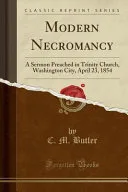
Modern Necromancy
 71
71

Modern Necromancy
C. M. Butler's sermon, "Modern Necromancy," delivered in Washington City in 1854, offers a fascinating glimpse into the mid-19th century's engagement with spiritualism. Its strength lies in its historical specificity, directly addressing the public's belief in spirit communication at a time when such ideas were rapidly gaining traction. The work functions less as a guide to necromancy and more as a socio-religious commentary on contemporary beliefs. A limitation is its brevity and sermonic nature; it critiques rather than deeply explores the mechanics or philosophy of the reported phenomena. The passage concerning the "fully persuaded" individuals who "can and do hold communication with the spirits of the departed" is particularly salient, highlighting the author's awareness of a significant societal shift. Ultimately, this is a valuable historical artifact for understanding a specific moment in occult history.
📝 Description
71
Delivered in 1854, C. M. Butler's sermon addresses the 19th century's fascination with spirit communication.
C. M. Butler's "Modern Necromancy" is not a manual for occult practices but a historical sermon delivered in Washington City on April 23, 1854. Published by Forgotten Books in 2015, the text captures the spiritual climate of the mid-19th century, a time marked by a widespread public interest in communicating with the deceased. Butler's work offers insight into the societal acceptance of spiritualism and the afterlife during this era of significant religious and social change. It serves as a primary source for understanding public attitudes toward the occult and the burgeoning spiritualist movement.
The sermon targets historians of religion, scholars of 19th-century American social movements, and students of spiritualism and early psychical research. It is intended for those interested in the historical discourse surrounding mediumship and the afterlife, rather than for practitioners seeking ritualistic instruction. Readers who value primary source analysis and the historical development of esoteric thought will find value in Butler's examination of these topics.
This sermon emerges from a specific moment in the history of Western esotericism, coinciding with the rise of American spiritualism. The mid-19th century saw a surge in public engagement with phenomena attributed to spirits, exemplified by figures like the Fox sisters. Butler's text, delivered during this period, engages directly with this widespread belief, examining its theological and social consequences. It reflects a broader cultural shift where the boundaries between the material and spiritual worlds were being actively debated and redefined by both the public and intellectual elites.
💡 Why Read This Book?
• Gain insight into the 1854 spiritualist milieu by examining Butler's sermon, which directly addresses public convictions about spirit communication during a period of intense spiritual exploration. • Understand the historical reception of mediumship by analyzing the sermon's theological and social commentary, revealing how established institutions perceived these new spiritual currents. • Discover the specific context of "Trinity Church, Washington City" as a site for discussing spiritual phenomena, offering a concrete location for this historical discourse.
⭐ Reader Reviews
Honest opinions from readers who have explored this book.
❓ Frequently Asked Questions
What is the original publication date of the sermon 'Modern Necromancy'?
The sermon 'Modern Necromancy' by C. M. Butler was delivered on April 23, 1854. The book publication by Forgotten Books is more recent, reflecting its status as a rediscovered historical text.
Does 'Modern Necromancy' by C. M. Butler provide instructions for performing necromantic rituals?
No, this work is a historical sermon, not a practical guide. It discusses the societal belief in spirit communication prevalent in 1854, rather than offering ritualistic techniques.
What historical movement is 'Modern Necromancy' related to?
The sermon is directly related to the spiritualist movement of the mid-19th century, which saw a surge in public interest and belief in communication with the deceased.
Where was the sermon 'Modern Necromancy' originally preached?
C. M. Butler's sermon, 'Modern Necromancy,' was preached in Trinity Church, Washington City, on April 23, 1854.
Who is the author of the sermon 'Modern Necromancy'?
The sermon 'Modern Necromancy' was authored by C. M. Butler. The text was later republished by Forgotten Books.
What is the main topic addressed in Butler's 'Modern Necromancy' sermon?
The sermon addresses the widespread belief and conviction among people in 1854 that they could and did hold communication with the spirits of the departed.
🔮 Key Themes & Symbolism
Spirit Communication Beliefs
The core of Butler's sermon revolves around the widespread conviction in 1854 that direct communication with spirits of the departed was achievable. He notes this belief was 'widely extended and rapidly increasing,' positioning the sermon as a contemporary response to a growing cultural phenomenon. It examines how these beliefs were perceived and discussed within religious and public spheres, reflecting a society grappling with the boundaries between the living and the dead.
Societal Impact of Spiritualism
Butler's discourse highlights the societal impact of the burgeoning spiritualist movement. By preaching in 'Trinity Church, Washington City,' he engages with the implications of such beliefs for established religious doctrines and community norms. The sermon serves as a historical document illustrating the anxieties and fascinations surrounding the afterlife and the potential for interaction with unseen realms during the mid-19th century.
Theological Interpretation
The sermon implicitly engages in theological interpretation by addressing the spiritualist claims from a potentially orthodox Christian perspective. While not a ritual manual, it comments on the spiritual field of its time. Butler's text provides a window into how religious authorities viewed and responded to phenomena that challenged traditional understandings of the soul, death, and divine interaction.
Historical Reception of Mediumship
This work captures a specific moment in the historical reception of mediumship. The author acknowledges the 'conviction' of many individuals regarding their ability to communicate with spirits. This theme underscores the importance of understanding the sermon not as a guide to necromancy, but as evidence of how such concepts were debated and understood in the public consciousness of 1854.
💬 Memorable Quotes
Direct passages from the work, attributed to the author.
“Many persons, in our day, are fully persuaded that they; can and do hold communication with the spirits of the departed.”
— This observation pinpoints the central subject of Butler's sermon: the prevalent belief in spirit communication during the mid-19th century. It highlights the author's awareness of a significant societal shift towards spiritualism and psychical phenomena.
“This conviction is widely extended and rapidly increasing.”
— This phrase emphasizes the pervasive and growing nature of belief in spirit communication in 1854. It suggests that the phenomenon was not isolated but a widespread and accelerating trend influencing public consciousness.
“A Sermon Preached in Trinity Church, Washington City, April 23, 1854”
— This serves as a factual anchor, dating the sermon's delivery and its specific location. It situates the text firmly within a particular historical and geographical context, crucial for understanding its commentary on spiritualism.
“Modern Necromancy”
— The title itself is provocative, framing the contemporary interest in spirit communication through a historical lens. It suggests a re-emergence or reinterpretation of ancient practices within the context of 19th-century spiritualist movements.
“Forgotten Books publishes hundreds of thousands of rare and classic books.”
— This is a publisher's note indicating the source of the modern edition. It signifies that the work is a republication of a historical text preserved for contemporary readers interested in classic literature.
🌙 Esoteric Significance
Tradition
While the sermon predates the formal establishment of many modern esoteric organizations like the Theosophical Society (founded 1875), it speaks to the pre-existing currents of interest in spiritual communication that would later inform such traditions. It engages with a broad, popular fascination with the spirit world, a theme common across various esoteric lineages seeking to understand the planes of existence beyond the material. It reflects an early, less systematized phase of Western esotericism's engagement with phenomena later explored in depth by groups like the Society for Psychical Research.
Symbolism
The primary symbolic concept is 'spirits of the departed' themselves, representing the threshold between life and death and the potential for continued existence and interaction. The 'conviction' held by many signifies a shift in belief systems, symbolizing a move away from purely materialist or orthodox religious explanations towards experiential or intuitive understandings of the afterlife. The church setting ('Trinity Church, Washington City') symbolically grounds the discussion within a traditional religious framework, highlighting the tension between established doctrine and emergent spiritual beliefs.
Modern Relevance
Contemporary occult practices, particularly those within modern witchcraft and spiritualism, often draw on the historical interest in spirit communication that Butler's sermon addresses. Thinkers and practitioners exploring mediumship, ancestral veneration, and necromantic arts in contemporary contexts often revisit the foundational beliefs and societal reactions of the 19th century. The sermon provides historical context for the enduring human desire to connect with those who have passed on, informing current explorations of the veil between worlds.
👥 Who Should Read This Book
• Historians of 19th-century American religion and social movements, who will find a primary source document detailing attitudes toward spiritualism in 1854. • Students of comparative religion and occult history, seeking to understand the evolution of beliefs surrounding death and the afterlife before the formalization of modern esoteric orders. • Researchers of early psychical phenomena, who can use this sermon to contextualize the public discourse surrounding mediumship and spirit communication in the mid-Victorian era.
📜 Historical Context
C. M. Butler's sermon, 'Modern Necromancy,' delivered in Trinity Church, Washington City, on April 23, 1854, emerged during a period of intense spiritual fervor in the United States. This era witnessed the rise of the Second Great Awakening and, more specifically, the burgeoning spiritualist movement, spurred by events like the alleged rappings at Hydesville, New York, around 1848. Butler's text directly confronts the public's growing conviction in the possibility of communicating with the deceased. This was a time when figures like Andrew Jackson Davis, the 'Poughkeepsie Seer,' were publishing influential works on spiritualism, and the Fox sisters were captivating audiences. Established religious bodies often viewed these developments with suspicion, leading to debates about the nature of the soul, the afterlife, and the authenticity of mediumistic claims. Butler's sermon represents a voice within this broader discourse, reflecting anxieties and intellectual currents surrounding the supernatural and its societal implications.
📔 Journal Prompts
The conviction regarding communication with the departed: how might this have altered daily life in 1854?
Butler's specific mention of 'Trinity Church, Washington City' as a venue for such a sermon.
The societal perception of 'spirits of the departed' as discussed by Butler.
The implications of a 'rapidly increasing' belief in spirit communication for religious institutions.
Analyzing the 'Modern Necromancy' title in the context of 19th-century spiritual discourse.
🗂️ Glossary
Necromancy
Historically, a form of divination involving communication with the dead, often through sorcery or conjuration. In the context of Butler's sermon, it refers broadly to the contemporary belief in and practice of spirit communication.
Spirits of the departed
The souls or consciousnesses of individuals who have died. In the 19th century, a prevalent belief held that these entities could communicate with the living, often through mediums.
Conviction
A firmly held belief or certainty. Butler uses this term to describe the strong and widespread adherence to the idea of spirit communication among the populace in 1854.
Spiritualism
A religious movement originating in the mid-19th century, based on the belief that the spirits of the dead can be contacted and can communicate with the living.
Medium
A person believed to be able to communicate with the spirits of the dead, acting as an intermediary between the physical and spiritual worlds. This concept underpins the 'conviction' Butler discusses.
Trinity Church, Washington City
The specific location where C. M. Butler delivered his sermon on April 23, 1854. Its mention grounds the text historically and geographically within the capital of the United States.
Forgotten Books
A publishing company that republishes out-of-print and classic books, making them accessible again. Their role here is to bring Butler's historical sermon to a modern audience.