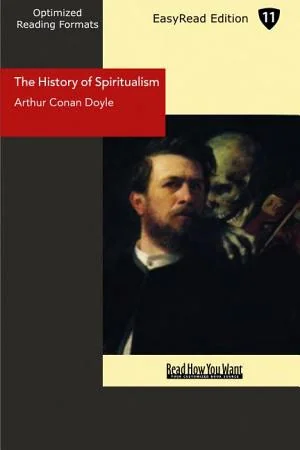
The History of Spiritualism
 83
83

The History of Spiritualism
Arthur Conan Doyle's "The History of Spiritualism" is less a dispassionate historical survey and more a fervent, albeit meticulously documented, personal testament. Doyle, renowned for his rational detective Sherlock Holmes, here champions the seemingly irrational with a lawyerly zeal. His detailed accounts of séances, particularly those involving figures like Eusapia Palladino and the Davenports, are compelling, even when filtered through his unwavering belief. The book’s primary strength lies in its firsthand perspective from a globally recognized figure who actively investigated these claims. However, its chief limitation is this very advocacy; a critical reader will find Doyle's defenses often sidestep more rigorous skeptical counterarguments, particularly concerning fraud. A passage detailing Doyle's own observations of supposed ectoplasmic manifestations, while vivid, exemplifies this tendency to interpret ambiguous phenomena as conclusive proof. The work remains a crucial primary source for understanding Spiritualism's appeal, but its analytical balance is skewed by its author's conviction.
This volume serves as a vital, if biased, record of a significant cultural phenomenon.
📝 Description
83
Arthur Conan Doyle published "The History of Spiritualism" in 1926, detailing his personal investigations.
Arthur Conan Doyle's 1926 book, "The History of Spiritualism," chronicles his personal involvement with the Spiritualist movement. Doyle, a famous author and proponent, presents his investigations into mediums and alleged spirit communications. The work functions as both a historical survey of Spiritualism and a defense of its perceived validity, outlining arguments and evidence Doyle found convincing. He details his own journey into these phenomena and his belief in the reality of spirit contact. The book documents specific cases and personal testimonies that he felt supported his views on life after death.
This volume is directed at individuals interested in the historical trajectory of Spiritualism, especially through the lens of a well-known figure. It will interest those who study the occult, parapsychology, and social history from the late 19th and early 20th centuries. Anyone curious about the interplay of science, belief, and the paranormal during the early 1900s will find material for thought. Doyle's work emerged when public fascination with the afterlife was high, particularly after World War I, and Spiritualism had already gained a following among various social groups, including intellectuals.
Published in an era of widespread interest in the occult and the afterlife, Doyle's work is situated within the broader Spiritualist movement that flourished in the late 19th and early 20th centuries. This period saw many individuals seeking alternative frameworks for understanding existence beyond the material world, often in response to traditional religious structures or societal upheaval like World War I. Spiritualism offered a direct, empirically verifiable (in its adherents' view) connection to the deceased, distinguishing itself from more philosophical or theological esoteric traditions.
💡 Why Read This Book?
• Gain insight into Arthur Conan Doyle's personal conviction regarding Spiritualism, understanding his transition from rationalist creator to fervent believer, particularly after the tragic loss of his son in World War I. • Examine historical accounts of prominent mediums like Eusapia Palladino and the Davenport Brothers, learning about the specific phenomena investigated in the late 19th and early 20th centuries. • Understand the intellectual climate of the early 20th century, where Spiritualism competed with scientific skepticism and other esoteric movements for public attention and acceptance.
⭐ Reader Reviews
Honest opinions from readers who have explored this book.
❓ Frequently Asked Questions
Was Arthur Conan Doyle always a believer in Spiritualism?
No, Arthur Conan Doyle initially approached Spiritualism with skepticism. His deep personal grief following World War I, particularly the loss of his son Kingsley, prompted him to investigate Spiritualist claims more seriously around 1916, eventually leading to his public advocacy.
What kind of evidence did Doyle present for Spiritualism?
Doyle presented a variety of evidence, including firsthand accounts of séances, testimonies from other investigators, alleged spirit photography, materializations, and phenomena attributed to mediums like Eusapia Palladino and the Davenport Brothers.
When was 'The History of Spiritualism' first published?
Arthur Conan Doyle's 'The History of Spiritualism' was first published in two volumes in 1926, several years after the peak of his personal involvement and advocacy for the movement.
Did Doyle acknowledge skepticism or fraud within Spiritualism?
While Doyle acknowledged that fraud was possible and that skeptics existed, his work primarily focuses on presenting evidence he found convincing and refuting accusations of widespread deceit among mediums he trusted.
How does this book relate to Sherlock Holmes?
The book offers a fascinating contrast to Doyle's most famous character, Sherlock Holmes, who embodies strict logic and empirical evidence. In 'The History of Spiritualism,' Doyle applies a similar investigative mindset but reaches conclusions that Holmes would likely dismiss.
Is this book considered a primary source for Spiritualism?
Yes, 'The History of Spiritualism' is considered a significant primary source. It provides a detailed, firsthand account from one of Spiritualism's most influential public figures, documenting his beliefs, investigations, and the movement's history as he saw it.
🔮 Key Themes & Symbolism
The Rationalist Investigating the Irrational
A central theme is Doyle's attempt to reconcile his logical, empirical worldview, famously embodied by Sherlock Holmes, with the subjective and often unprovable claims of Spiritualism. He details his methods of investigation, seeking verifiable proof of spirit communication. This paradox fuels the narrative, as Doyle presents phenomena like ectoplasm and spirit voices not as matters of faith, but as observable facts requiring rational analysis, thereby challenging the prevailing scientific paradigms of his era.
Personal Grief as a Catalyst
The lasting impact of personal loss, particularly the death of Doyle's son, Kingsley, in the aftermath of World War I, serves as a powerful underlying current. The book implicitly argues that Spiritualism offered solace and a framework for understanding the continuity of life beyond death, a need intensified by the war's immense casualties. Doyle frames his later investigations and advocacy as a response to this deeply human search for connection with departed loved ones.
Mediumship and Evidence
The book meticulously documents various forms of mediumship – trance, materialization, psychic photography – and the alleged evidence produced. Doyle champions specific mediums, such as Eusapia Palladino, presenting detailed accounts of séances and the phenomena observed. He critically examines claims, distinguishing between genuine manifestations and potential trickery, though his bias towards affirming the former is evident. The work serves as a historical record of the types of phenomena Spiritualists pointed to as proof.
Spiritualism's Place in Society
Doyle situates Spiritualism not merely as a fringe belief but as a significant intellectual and social movement deserving serious study. He contrasts it with established religion and the limitations of materialistic science. The work charts the movement's rise from its origins in the Hydesville mediumship of the Fox sisters in 1848 to its widespread influence in the early 20th century, arguing for its legitimacy and its potential to revolutionize human understanding of existence.
💬 Memorable Quotes
Direct passages from the work, attributed to the author.
“My own experiences have convinced me that the phenomena of Spiritualism are real.”
— This statement expresses Doyle's firm conviction, formed through personal investigation. It highlights his belief that the occurrences he witnessed provided sufficient evidence to validate the existence of spirit communication, moving beyond mere anecdote to personal certainty.
“The phenomena of Spiritualism are indeed real, and they are to be found in every part of the world.”
— This assertion underscores Doyle's belief in the universality and objective reality of Spiritualist manifestations. It suggests that these occurrences are not isolated incidents but a pervasive aspect of human experience, accessible through diligent observation and open-minded inquiry.
“The evidence for survival is overwhelming.”
— This direct statement reflects Doyle's conclusion after his investigations. He felt the cumulative weight of observed phenomena and testimonies provided undeniable proof of life continuing after death, a conclusion central to his advocacy for Spiritualism.
💡 Key Ideas
Editorial paraphrase of the work's core concepts — not direct quotes.
The war has killed my son, and it has killed my faith in all that is good and beautiful.
This paraphrase reflects the profound personal tragedy that spurred Doyle's deeper engagement with Spiritualism. It illustrates how immense grief can shatter existing worldviews and open individuals to alternative explanations for life, death, and the nature of reality.
The greatest and most vital of all the messages which Spiritualism has for the world is the message of the continuity of life.
This paraphrased sentiment emphasizes the core theological and philosophical contribution Doyle believed Spiritualism offered. It posits the survival of consciousness after physical death as its primary revelation, providing comfort and a radical redefinition of human existence.
🌙 Esoteric Significance
Tradition
While Spiritualism emerged as a distinct movement in the mid-19th century, it shares roots with older traditions concerning communication with the dead and the spirit world. It can be seen as a modern, democratized iteration of phenomena historically associated with shamanism and mediumistic practices across various cultures. Unlike more structured esoteric systems like Hermeticism or Kabbalah, Spiritualism emphasizes direct, empirical experience of spirit communication, often bypassing formal initiation or complex symbolic systems in favor of observable phenomena.
Symbolism
Central symbols in Spiritualism, as presented by Doyle, include 'ectoplasm,' the semi-physical substance allegedly exuded by mediums, representing the material manifestation of spirit energy. 'Rappings' and 'automatic writing' serve as tangible, albeit indirect, symbols of spirit presence and communication, bridging the gap between the unseen world and the physical. The séance itself becomes a symbolic space where the veil between life and death is perceived to thin, facilitating interaction.
Modern Relevance
Doyle's work remains relevant to contemporary spiritual seekers and researchers exploring the history of consciousness studies and parapsychology. Modern spiritualist churches continue to operate, carrying forward the tradition of direct mediumistic communication. Furthermore, the enduring public fascination with ghosts, near-death experiences, and mediumship carries the themes Doyle documented, indicating a persistent human interest in the possibility of life beyond physical death.
👥 Who Should Read This Book
• Individuals interested in the history of the Spiritualist movement and its cultural impact in the late 19th and early 20th centuries, particularly figures like the Davenport Brothers. • Readers curious about Arthur Conan Doyle's personal life and his transition from creator of a rational detective to a prominent advocate for the paranormal. • Researchers of parapsychology and the historical interplay between science, religion, and belief in phenomena such as mediumship and spirit communication.
📜 Historical Context
Arthur Conan Doyle's "The History of Spiritualism" arrived in 1926, a period when the movement had already been active for nearly eighty years, originating with the Fox sisters' rappings in 1848. The early 20th century was a fertile ground for Spiritualism, particularly influenced by the immense loss of life during World War I, which created a widespread yearning for contact with the deceased. Doyle, already a global literary figure, lent immense credibility. However, Spiritualism faced significant opposition from scientific skeptics and religious authorities. Competing esoteric movements like Theosophy, founded by Helena Blavatsky, also vied for public attention, offering different frameworks for understanding the spiritual realm. The scientific community, while intrigued, often attributed reported phenomena to fraud, psychological suggestion, or unknown natural laws, as exemplified by figures like Harry Price, who investigated mediums but remained largely unconvinced of spirit agency.
📔 Journal Prompts
The phenomenon of Eusapia Palladino's séances, as described by Doyle.
Arthur Conan Doyle's personal rationale for investigating Spiritualism post-1916.
The concept of 'ectoplasm' as presented in the text.
Contrasting Doyle's belief in Spiritualism with Sherlock Holmes's methods.
The societal impact of World War I on beliefs regarding life after death.
🗂️ Glossary
Mediumship
The practice or ability of a person claiming to communicate with the spirits of the dead. Doyle extensively details various mediums and their alleged capabilities.
Séance
A meeting at which people attempt to make contact with the spirit world, typically involving a medium. Doyle provides detailed accounts of séances he attended.
Ectoplasm
A term coined by Charles Richet, referring to a supposed viscous, jelly-like substance allegedly exuded by spiritualist mediums during trances, believed to be a physical manifestation of spirit energy.
Materialization
In Spiritualism, the alleged phenomenon of spirits or spirit-formed entities taking on a physical form visible to sitters during a séance.
Automatic Writing
A claimed psychic ability by which a person can write down messages dictated by spirits or the subconscious mind without conscious thought or control.
Hydesville Mediumship
Refers to the origin of modern Spiritualism in 1848 with the activities of Margaret and Kate Fox in Hydesville, New York, who claimed to communicate with a spirit through mysterious 'rappings'.
Theosophy
A mystical and esoteric philosophy founded by Helena Blavatsky, emphasizing the study of divine wisdom and the interconnectedness of all religions and sciences, often seen as a contemporary rival to Spiritualism.