The Devil's Dictionary
 82
82

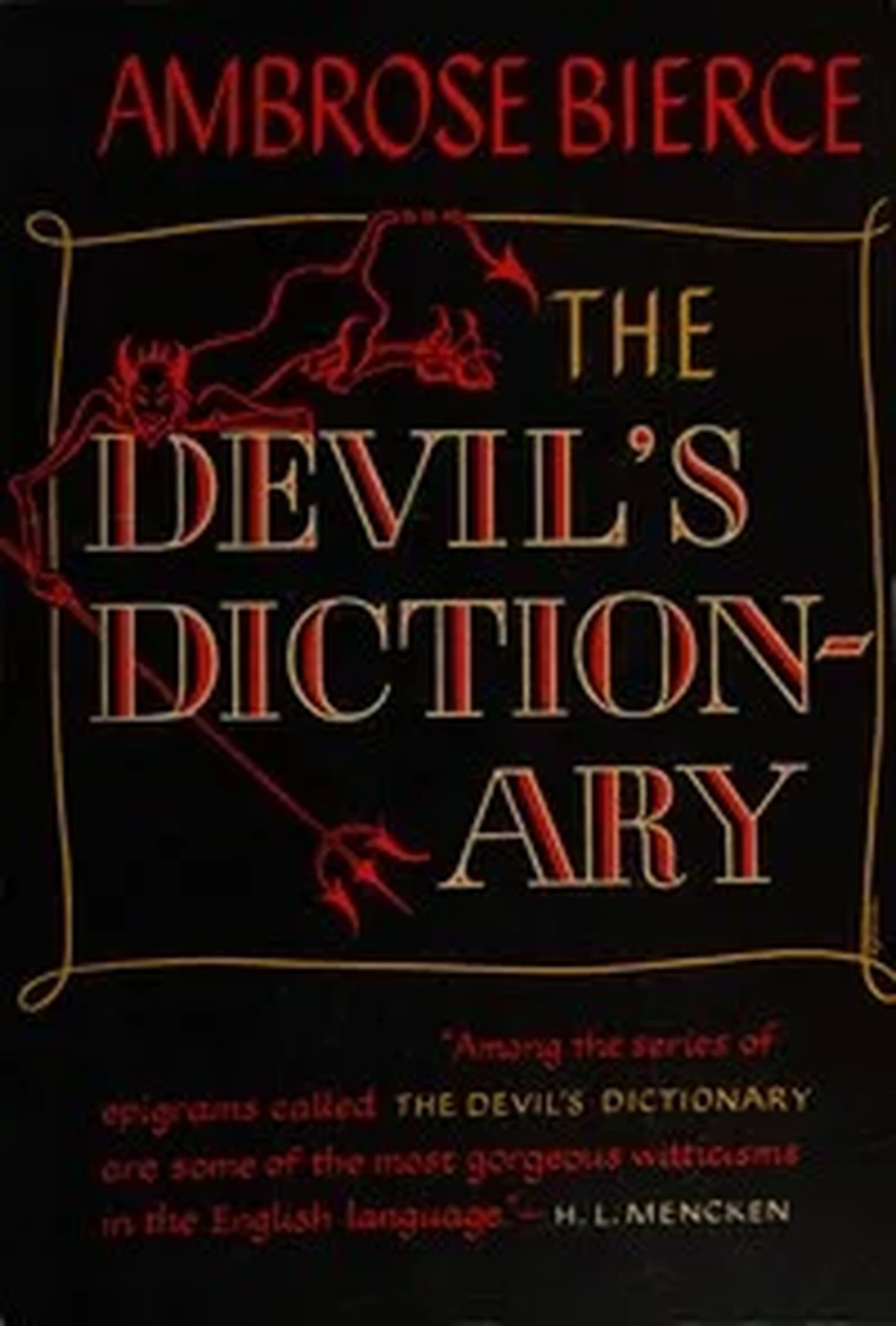
The Devil's Dictionary
Ambrose Bierce's *The Devil's Dictionary* functions less as a lexicon and more as a sustained act of philosophical vandalism against the English language and the institutions it cloaks. Its enduring appeal lies in its relentless, often brutal, honesty, particularly its dissection of concepts like "Law" as "a compilation of rules that protect property and punish theft." This is not a book for the faint of heart, nor for those seeking comfort in platitudes. Its primary strength is its unwavering commitment to exposing hypocrisy, a quality that remains bracingly relevant. A limitation, however, is that its sheer cynicism can, at times, become monotonous, offering little in the way of positive affirmation. Bierce's definition of "Hope" as "A pneumatic appliance by which we fill the void of the future with the gas of the present" exemplifies its sharp, if bleak, observational power. It is a vital, if discomfiting, addition to any collection that values critical thought.
📝 Description
82
Ambrose Bierce's satirical lexicon first appeared in full in 1925, long after his 1913 disappearance.
Ambrose Bierce's *The Devil's Dictionary* is a collection of satirical definitions that reworks common words with sharp wit and social criticism. Published posthumously, it offers a dark and humorous view of human nature, morality, and societal customs. Each entry functions as a brief essay, analyzing the perceived hypocrisy and absurdities found in language and life.
This work appeals to those who appreciate pointed satire, philosophical paradoxes, and a critical look at social norms. It is for readers who enjoy wordplay and do not shy away from a cynical perspective on life, politics, and religion. Those looking for an alternative to standard dictionaries will find an unusual intellectual challenge and a source of amusement. Bierce compiled the bulk of the dictionary over decades, but its complete form only reached readers in 1925, years after he vanished in Mexico around 1913. His writing emerged during a time when literary satire and social critique were becoming more prominent in American literature, with contemporaries like Mark Twain also examining American life, though Bierce's style was typically more biting and less sentimental.
While not strictly esoteric in the occult sense, *The Devil's Dictionary* engages with a tradition of skeptical inquiry and philosophical skepticism that questions established norms and language. Bierce's redefinitions often strip away polite euphemisms to reveal underlying self-interest or pragmatic motivations, aligning with a critical examination of received truths. His work shares a spirit with philosophical traditions that dissect conventional morality and expose the often unacknowledged forces shaping human behavior, even if it lacks explicit metaphysical or mystical content. The dictionary's focus on the power of language to both obscure and reveal reality also touches upon currents of thought concerned with the nature of meaning and perception.
💡 Why Read This Book?
• Gain a unique perspective on language's manipulative power, as seen in Bierce's redefinition of "Orthodoxy" as "A belief in the divine inspiration of the first man who said it." • Understand the historical roots of modern cynical social critique, exemplified by the dictionary's consistent lampooning of political and religious institutions prevalent in the late 19th and early 20th centuries. • Develop a sharper eye for hypocrisy through Bierce's precise, often humorous, redefinitions, such as "Diplomacy" being "the national art of spreading a thin layer of butter over a broad surface of toast."
⭐ Reader Reviews
Honest opinions from readers who have explored this book.
❓ Frequently Asked Questions
When was Ambrose Bierce's *The Devil's Dictionary* first published?
The full compilation of *The Devil's Dictionary* was first published in 1925, posthumously, long after Ambrose Bierce's disappearance around 1913.
Is *The Devil's Dictionary* considered a philosophical text?
Yes, it is widely regarded as a philosophical text, using satire and lexicography to explore themes of human nature, morality, and societal critique.
What is the primary tone of *The Devil's Dictionary*?
The primary tone is cynical, satirical, and darkly humorous, aiming to expose hypocrisy and challenge conventional definitions.
What kind of reader would enjoy *The Devil's Dictionary*?
Readers who appreciate sharp wit, social commentary, wordplay, and a critical, unsentimental view of the world would find this book engaging.
Does the book offer definitions for common words?
Yes, it offers definitions for a wide array of common words, but redefines them through Bierce's unique, often critical, lens.
Can *The Devil's Dictionary* be found online for free?
As a work published in 1925, *The Devil's Dictionary* is in the public domain and is widely available for free online from various sources.
🔮 Key Themes & Symbolism
Deconstruction of Language
Bierce systematically dismantles the perceived neutrality of language, revealing its inherent biases and manipulative potential. His redefinitions, such as "Conscience: a regrettable inner voice;" expose the subjective and often self-serving nature of moral pronouncements. The work illustrates how words are not mere descriptors but tools used to shape perception and enforce social norms, particularly in areas of governance and belief.
Critique of Institutions
The dictionary serves as a vehicle for scathing critiques of established institutions like government, religion, and law. Bierce's definition of "Politics: A strife of interests masquerading as a contest of principles;" exemplifies his view of public life as driven by self-interest rather than genuine ideals. He dissects the rhetoric used by these bodies to reveal the often unpalatable realities beneath the veneer of respectability.
Human Nature's Baser Aspects
A recurring theme is the exploration of human nature's less flattering attributes, including greed, hypocrisy, and self-deception. Bierce often defines abstract virtues by their perceived underlying motivations, suggesting that altruism frequently masks egoism. His entry for "Generosity:" "A showy flashing of money to distract the eye from the meanness of the motive" highlights this cynical perspective on human behavior.
Satire as Philosophical Tool
Bierce employs satire not merely for amusement but as a serious philosophical instrument to probe societal truths. By presenting absurd or contradictory definitions, he forces readers to question their assumptions and the conventional wisdom they accept. The entire work operates as a grand, satirical experiment in redefining reality, challenging readers to confront uncomfortable truths about themselves and their world.
💬 Memorable Quotes
Direct passages from the work, attributed to the author.
“Love: A temporary insanity curable by marriage.”
— This entry cynically redefines a universally cherished emotion, suggesting it is a fleeting mental disorder that finds its 'cure' in the institution of marriage, implying a loss of reason and individuality.
“Education: That which discloses to us how little we know.”
— This definition offers a paradoxical view of learning, positing that the true outcome of education is the realization of one's own ignorance, rather than the acquisition of knowledge.
“Faith: Belief that is not supported by evidence.”
— Bierce targets the very foundation of many belief systems, defining faith as a conscious rejection of empirical proof, thereby questioning its intellectual validity.
“Patriotism: The last refuge of a scoundrel.”
— A famous and often-cited definition, this suggests that appeals to nationalistic fervor are frequently a manipulative tactic used by those with nefarious intentions to mask their true motives.
“Compromise: An agreement reached by the two parties, each more dissatisfied than the other.”
— This definition humorously points to the inherent unsatisfactoriness of many agreements, where neither party fully achieves its goals, leading to mutual discontent.
🌙 Esoteric Significance
Tradition
While not explicitly belonging to a singular esoteric tradition like Hermeticism or Kabbalah, *The Devil's Dictionary* aligns with a philosophical current that prizes gnosis—knowledge—as a means of liberation from illusion. Its cynical redefinition of common concepts can be seen as a form of radical demystification, akin to Gnostic rejection of mundane reality and its perceived deceptions. Bierce's work encourages a critical, almost alchemical, transmutation of understanding, urging the reader to see beyond superficial appearances.
Symbolism
The primary symbolic act is the dictionary itself: a catalog of the world's perceived falsehoods. Words like "Truth" (defined as "an in-door amusement") become symbols of elusive or manipulated concepts. The act of redefinition symbolizes the power of perspective and the potential for language to both obscure and reveal. Bierce's consistent focus on the gap between appearance and reality serves as a recurring motif, symbolizing the hidden, often darker, forces that govern human affairs.
Modern Relevance
Contemporary practitioners of critical theory, radical skepticism, and certain strains of postmodern philosophy draw upon Bierce's method of deconstruction. His work is often cited in discussions about linguistic relativity and the social construction of reality. Furthermore, his cynical yet precise definitions resonate with modern online discourse and meme culture, where irony and the dissection of societal norms are prevalent, making his insights surprisingly applicable to contemporary communication and social commentary.
👥 Who Should Read This Book
• Students of American literature and satire seeking to understand the roots of critical social commentary in the late 19th and early 20th centuries. • Philosophically inclined readers who appreciate cynical wit and enjoy deconstructing conventional wisdom, particularly as it pertains to morality and human behavior. • Writers and word-smiths interested in the power of language and how definitions can be weaponized or subverted for critical effect, as demonstrated by Bierce's masterful recontextualization of common terms.
📜 Historical Context
Ambrose Bierce's *The Devil's Dictionary*, primarily compiled over decades but first fully published in 1925, emerged from a late 19th and early 20th-century America ripe for social satire. This era saw rapid industrialization, burgeoning urban centers, and significant shifts in social and political landscapes, providing fertile ground for Bierce's critical lens. His work participated in a broader literary movement that challenged Victorian sensibilities and exposed the hypocrisies of the Gilded Age. While contemporaries like Mark Twain offered a more folksy critique, Bierce's style was notably acerbic and philosophical. His relentless cynicism can be seen as a counterpoint to the prevailing optimism found in some Transcendentalist thought or the more earnest social reform movements of the time. The dictionary's posthumous publication in 1925 solidified its place as a key text in American satire, influencing later writers who sought to dissect societal norms with sharp wit.
📔 Journal Prompts
The definition of "Hope" as a pneumatic appliance for filling the void with gas prompts reflection on present comforts versus future realities.
Consider Bierce's redefinition of "Charity" and analyze instances where altruism might mask self-interest in contemporary society.
Analyze the impact of redefining "Education" as a disclosure of ignorance on your personal learning journey.
Reflect on the concept of "Patriotism" as the "last refuge of a scoundrel" and its implications for nationalistic rhetoric.
How does Bierce's definition of "Compromise" inform your understanding of negotiation and agreement?
🗂️ Glossary
Orthodoxy
Defined by Bierce as "A belief in the divine inspiration of the first man who said it." This highlights his view that established doctrines often gain authority through historical accident rather than inherent truth.
Conscience
Referred to as "A regrettable inner voice;" this definition frames conscience not as a moral guide, but as an annoying, perhaps irrational, internal censor.
Diplomacy
Described as "the national art of spreading a thin layer of butter over a broad surface of toast." This cynically portrays diplomacy as superficial and designed to obscure rather than address underlying issues.
Law
Defined as "a compilation of rules that protect property and punish theft." This suggests that legal systems primarily serve to safeguard wealth and possessions, rather than ensure justice for all.
Generosity
Characterized as "A showy flashing of money to distract the eye from the meanness of the motive." This entry implies that acts of generosity are often performative and driven by vanity or ulterior motives.
Marriage
Presented as "A community consisting of a master, a mistress, and two slaves, making in all, two." This definition offers a bleak, ironic view of marital dynamics, suggesting inequality and a reduction of individuals to subservient roles.
Truth
Defined as "An in-door amusement;" this suggests that the pursuit or declaration of truth is often a trivial, sheltered, or perhaps even fabricated activity, divorced from practical reality.
🔮 Readers Also Liked
Browse all →









More by Ambrose Bierce
All books →
More Free Spiritual Development Books
View all →