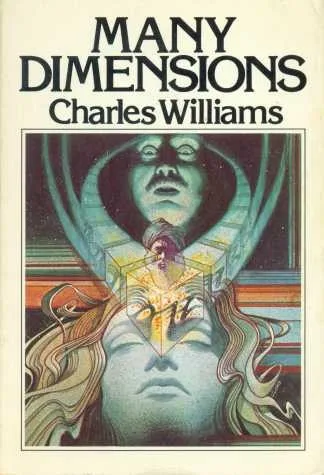
Many Dimensions
 79
79

Many Dimensions
Charles Williams’s "Many Dimensions" is less a conventional novel and more a theological engine disguised as narrative. Its strength lies in its audacious conceptual framework, particularly the depiction of the Stone of Transitus as a nexus of interdimensional possibility. The way Williams integrates abstract theological arguments about grace and power into the fabric of human interaction is remarkable. However, the characterization can sometimes feel secondary to the philosophical and theological machinations; figures like the Archdeacon are more archetypes than fully fleshed individuals. A particularly striking passage is the description of the Stone’s effect on the mundane landscape, suggesting a palpable spiritual invasion. The novel’s dense theological underpinnings, while intellectually stimulating, might prove challenging for readers seeking straightforward plot progression.
"Many Dimensions" offers a unique, spiritually charged speculative fiction experience for the dedicated reader.
📝 Description
79
Charles Williams's Many Dimensions, published in 1931, asks what happens when a power that bridges worlds enters ours.
Charles Williams's 1931 novel, Many Dimensions, explores the disruption that follows the introduction of an artifact capable of interdimensional passage into everyday life. The story concerns a powerful object, the "Stone of Transitus," which offers a way to move between different states of being. This introduction forces characters to confront the nature of power, its potential for corruption, and the possibility of redemption through love and sacrifice.
The narrative weaves theological inquiry with fantastical events, blurring the lines between the mundane and the spiritual. Williams examines how extraordinary occurrences can shatter ordinary existence and how individuals react when faced with forces beyond their comprehension. The novel is suited for those interested in speculative fiction that engages with metaphysical and theological questions, particularly concerning the balance of good and evil and the structure of reality itself.
Published in 1931, Many Dimensions emerged from a literary milieu influenced by esoteric traditions, including Theosophy. Williams, associated with the Inklings, was part of a group that sought to re-enchant the world through myth and imaginative literature, often drawing on Christian cosmology. This period saw intellectual ferment where modern physics questioned established ideas of space and time, and religious thought responded to secularism and the aftermath of war. The novel reflects this atmosphere by exploring concepts like the Stone of Transitus, an object facilitating passage between different states of being, and the idea of "correspondence" linking the physical and spiritual worlds.
💡 Why Read This Book?
• Gain insight into the theological underpinnings of the Inklings' literary project, understanding how Charles Williams, a contemporary of C.S. Lewis, explored concepts like divine intervention and the nature of reality through the "Stone of Transitus." • Experience a narrative that directly confronts the spiritual implications of power and possession, moving beyond simple fantasy to engage with profound questions of good and evil. • Appreciate the distinct literary style that blends intricate theological arguments with imaginative, often unsettling, supernatural events, offering a different perspective than more conventional fantasy works.
⭐ Reader Reviews
Honest opinions from readers who have explored this book.
❓ Frequently Asked Questions
What is the significance of the "Stone of Transitus" in Many Dimensions?
The "Stone of Transitus" is a powerful artifact in "Many Dimensions" that serves as a gateway between different planes of existence. Its presence disrupts the normal flow of reality, forcing characters to confront spiritual forces and the nature of being.
Who were Charles Williams's contemporaries and influences?
Charles Williams was a member of the Inklings, a literary group that included C.S. Lewis and J.R.R. Tolkien. His work often reflects Christian theological themes and explores metaphysical concepts, influenced by traditional Christian thought and esoteric traditions.
When was Many Dimensions first published?
Charles Williams's novel "Many Dimensions" was first published in 1931, placing it within a period of significant intellectual and cultural shifts in the early 20th century.
What kind of themes does Many Dimensions explore?
The novel explores themes of divine power, the corrupting influence of ambition, the nature of reality, and the redemptive power of love and sacrifice. It delves into the spiritual consequences of tampering with forces beyond human comprehension.
Is Many Dimensions a fantasy novel?
While "Many Dimensions" contains fantastical elements, it is often categorized as theological fantasy or metaphysical fiction. It uses speculative elements to explore profound spiritual and philosophical questions rather than for pure escapism.
What is the relationship between Many Dimensions and other works by Charles Williams?
Many Dimensions is considered one of Williams's "divine comedies," a series of novels that explore Christian theology through imaginative narratives. It shares thematic concerns and a metaphysical approach with works like "The Place of the Lion" and "Descent into Hell."
🔮 Key Themes & Symbolism
The Nature of Divine Power
The novel grapples with the concept of divine power as embodied by the "Stone of Transitus." This artifact is not merely a magical object but a conduit for forces that transcend human understanding. Williams presents power not as something to be controlled or wielded for personal gain, but as a force that demands respect, understanding, and ultimately, submission to a higher will. The characters’ attempts to possess or manipulate the Stone highlight the inherent danger and corrupting influence of unchecked ambition when confronted with the sacred.
Interdimensional Reality
"Many Dimensions" posits a universe where different realities and states of being coexist, and the boundaries between them are not absolute. The "Stone of Transitus" acts as a catalyst, revealing the permeability of these dimensional barriers. This concept challenges a purely materialistic worldview, suggesting that physical reality is but one layer of a much larger, interconnected existence. The narrative explores the implications of such a cosmos, where spiritual laws can manifest physically.
Sacrifice and Redemption
Central to the novel's theological framework is the theme of sacrifice as a path to redemption and understanding. Characters who engage with the Stone's power are forced into situations that test their faith, love, and willingness to give up worldly desires. Williams suggests that true spiritual progress and the avoidance of the Stone’s destructive potential lie in selfless action and love, echoing core Christian tenets of redemption through sacrifice.
The Peril of Ambition
The novel vividly illustrates how worldly ambition and the desire for control can lead to spiritual peril. The pursuit of the "Stone of Transitus" by various characters—each with their own motivations ranging from scientific curiosity to outright greed—demonstrates the destructive consequences of seeking power for its own sake. Williams contrasts this with the potential for grace and transformation available through humility and spiritual surrender.
💬 Memorable Quotes
“The Stone of Transitus permitted certain things to happen.”
— This understated statement encapsulates the novel's premise: the introduction of an extraordinary, possibly divine, artifact that alters the fabric of mundane reality and compels supernatural events, forcing characters to confront forces beyond their control.
“Love is the law of the universe.”
— A core tenet of Williams's theology, this concept suggests that ultimate reality and spiritual order are founded upon love. It implies that understanding and aligning oneself with this principle is key to navigating the profound forces at play in the novel.
“There are more things in heaven and earth than are dreamt of in your philosophy.”
— This paraphrased concept reflects the novel's exploration of realities and dimensions beyond ordinary human perception and scientific understanding, aligning with the metaphysical and theological inquiries Williams undertakes.
“Power is a terrible thing.”
— This observation highlights the central conflict of the novel, where the acquisition and misuse of power, represented by the "Stone of Transitus," lead to destruction and spiritual crisis for those who seek to control it.
“The world is a place of great mystery.”
— This sentiment underscores the novel's approach to reality, suggesting that the physical world is imbued with spiritual significance and hidden dimensions, a perspective central to Williams's theological fiction.
🌙 Esoteric Significance
Tradition
Williams’s work fits within the broader stream of Christian Hermeticism and mystical theology. While firmly grounded in orthodox Christianity, he engaged with concepts that resonate with Hermetic ideas of correspondence and the interconnectedness of all things. His "divine comedies" explore the spiritual drama of existence, viewing the material world as a manifestation of divine will and spiritual laws, a perspective shared by various mystical traditions that see the universe as a symbolic text.
Symbolism
The central symbol is the "Stone of Transitus," representing a nexus of divine power and a gateway between realities. It symbolizes the permeability of the spiritual and material worlds and the potential for transcendence or destruction. Another key motif is the city of London itself, depicted not just as a physical location but as a spiritual battleground where cosmic forces intersect and human souls are tested.
Modern Relevance
Contemporary thinkers and writers interested in theological fantasy, metaphysical explorations of reality, and the intersection of faith and imagination continue to draw from Williams. His unique blend of rigorous theological inquiry and high imaginative power influences authors exploring themes of divine action, spiritual warfare, and the nature of being within speculative fiction and philosophical literature.
👥 Who Should Read This Book
• Students of C.S. Lewis and J.R.R. Tolkien: Readers interested in the intellectual and spiritual influences behind the Inklings' work will find "Many Dimensions" offers a crucial perspective on Williams's theological fiction. • Metaphysical Fiction Enthusiasts: Those who enjoy speculative novels that engage deeply with philosophical and theological questions, exploring the nature of reality and divine power, will appreciate its unique approach. • Readers of Christian Mysticism: Individuals interested in how Christian doctrines and mystical concepts can be explored through imaginative narrative will find Williams's handling of grace, power, and sacrifice compelling.
📜 Historical Context
Charles Williams’s "Many Dimensions," published in 1931, emerged from a fertile intellectual landscape. The early 20th century witnessed profound shifts in physics, with theories like Einstein's relativity challenging classical notions of space and time, a backdrop against which Williams’s exploration of multiple dimensions felt particularly resonant. He was a key member of the Inklings, a literary group including C.S. Lewis and J.R.R. Tolkien, who sought to re-establish imaginative and theological depth in literature, often drawing from Christian cosmology. This era also saw the continued popularity of esoteric movements like Theosophy, which explored non-traditional spiritual and metaphysical concepts. While Williams’s work was deeply rooted in orthodox Christianity, its imaginative scope and engagement with the supernatural placed it in dialogue with, and sometimes in contrast to, both secularizing philosophical trends and more unorthodox spiritual inquiries of the time.
📔 Journal Prompts
The implications of the "Stone of Transitus" on mundane reality.
Reflections on the nature of divine power versus human ambition.
How does the novel depict the interplay between physical and spiritual dimensions?
The role of sacrifice in achieving spiritual understanding.
Consider the spiritual significance of ordinary places as depicted in the narrative.
🗂️ Glossary
Stone of Transitus
A mystical artifact in the novel that acts as a conduit between different dimensions or states of being. Its presence disrupts normal reality and signifies the intersection of the divine with the material world.
Divine Comedy
A term used to categorize several of Charles Williams's novels, including "Many Dimensions." These works explore profound theological and spiritual themes through imaginative narratives, often depicting a cosmic struggle between good and evil.
Interdimensional
Pertaining to or existing between different dimensions or planes of reality. In the context of the novel, it refers to the co-existence and potential interaction of various levels of existence beyond the purely physical.
Correspondence
A concept, particularly in Hermeticism, suggesting a sympathetic relationship between different levels of reality, where events or symbols in one realm mirror or influence another. The novel explores this idea through the Stone's effects.
Spiritual Warfare
The concept of conflict between spiritual forces, often involving good and evil. The novel depicts this through the characters' struggles and the impact of the Stone, representing a clash between divine will and human ambition.
The Inklings
A literary group of scholars, writers, and friends that included C.S. Lewis, J.R.R. Tolkien, and Charles Williams. They met primarily at Oxford University to discuss literature and ideas, often with a focus on mythology and Christian themes.
Theological Fantasy
A genre of fantasy fiction that incorporates theological concepts, Christian doctrine, or spiritual allegory into its narrative and world-building. Williams's novels are prime examples.