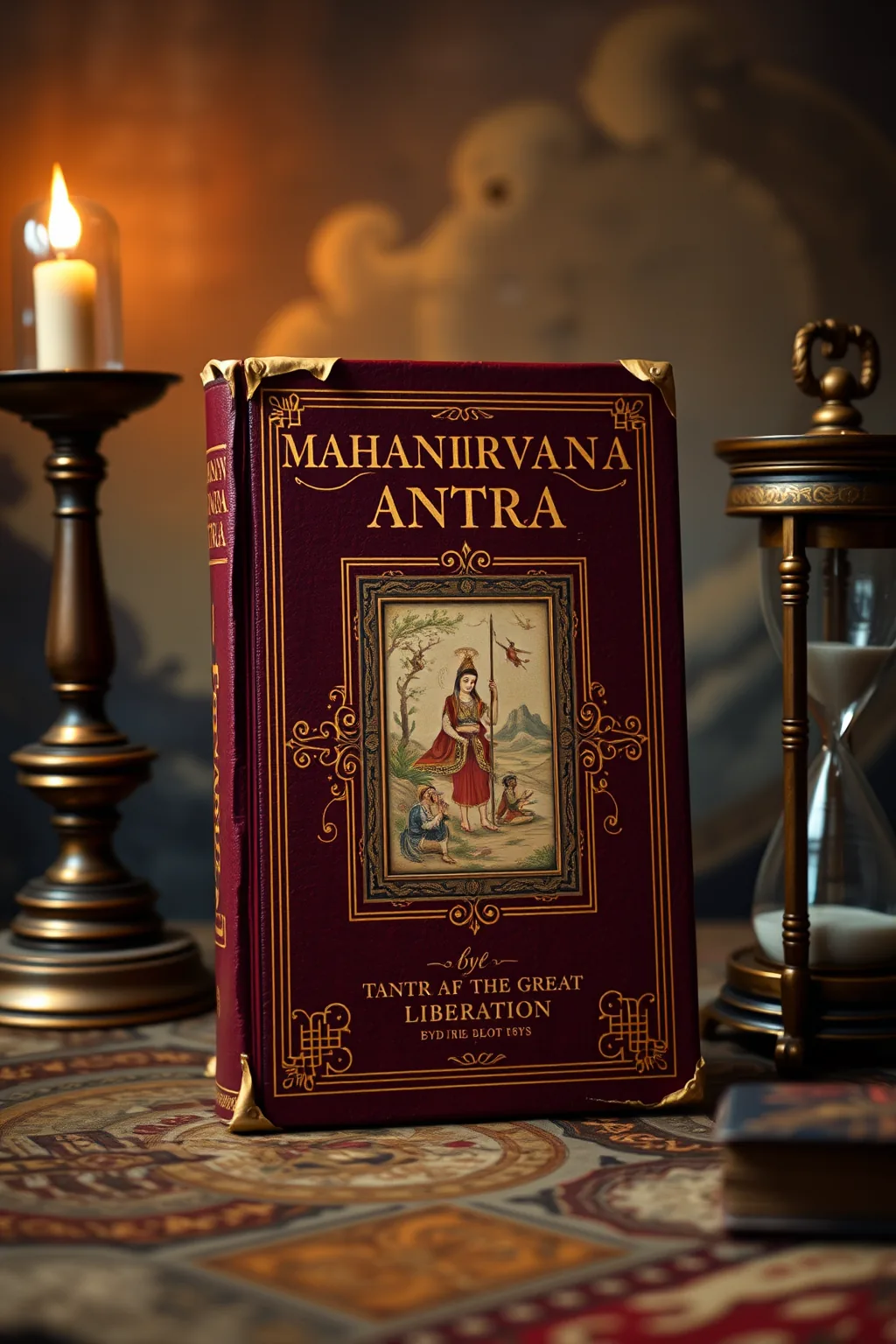
Mahanirvana Tantra
 75
75

Mahanirvana Tantra



Balthazar Finch (Senior Critic, Occult Philosophy) — The Mahanirvana Tantra stands as an indispensable pillar of Tantric literature, offering a comprehensive blueprint for spiritual advancement in the modern era. Its strength lies in its practical application, translating abstract metaphysical concepts into actionable yogic and ritualistic practices. This text is a vital resource for serious students of the esoteric, providing unparalleled insights into the Vaidika Karmakanda's evolution and its adaptation for the Kali Yuga. It demystifies complex rituals, empowering the dedicated practitioner with the knowledge to traverse the spiritual path with confidence and profound understanding. A truly transformative work.
📝 Description
75
The Mahanirvana Tantra, a key Tantric scripture, was compiled around the 18th century.
This text details practices and philosophies central to Tantra, particularly for the Kali Yuga. It covers rituals, yogic techniques, and philosophical concepts intended to guide spiritual practitioners. The book addresses the relationship between the material world and the divine, explaining how to work with energies for personal transformation.
It is more than a historical record; it transmits ancient knowledge for those seeking spiritual awakening. The Mahanirvana Tantra offers a framework for understanding and engaging with existence, aiming for clarity and spiritual attainment. Its teachings encourage self-reflection and change for individuals prepared to follow its path.
As a prominent Tantric text, the Mahanirvana Tantra is rooted in traditions that emerged in India. Tantra generally emphasizes the use of the body and senses as tools for spiritual realization, often involving complex rituals and visualizations. This particular scripture is significant for its focus on adapting these practices for the current age, the Kali Yuga, which is often seen as a period of spiritual decline. It provides a systematic approach to spiritual life within this challenging context.
💡 Why Read This Book?
Embark on a journey into the heart of Tantric practice and philosophy. The Mahanirvana Tantra offers a direct lineage to ancient yogic traditions and practical methods for spiritual growth. Ideal for seekers of liberation, scholars of Eastern mysticism, and practitioners aiming to deepen their understanding of sacred rites and esoteric energies.
⭐ Reader Reviews
Honest opinions from readers who have explored this book.
❓ Frequently Asked Questions
What is the primary purpose of the Mahanirvana Tantra?
Its primary purpose is to serve as the scripture for the Kali Yuga, offering practical methods for spiritual development and liberation in an age characterized by diminished spiritual energy and reliance on worldly existence.
How does the Mahanirvana Tantra relate to Vedic traditions?
It is presented as a development of the Vaidika Karmakanda (Vedic ritualistic action), adapted and promulgated to meet the specific needs and challenges of the Kali Yuga, offering a continuation and practical application of ancient wisdom.
Who is considered the primary deity or focus of worship in this Tantra?
While specific deities are invoked and revered, the Tantra broadly focuses on the divine feminine (Shakti) and the supreme consciousness (Shiva), representing the cosmic interplay of creation, preservation, and dissolution.
What kind of practices does the Mahanirvana Tantra detail?
It details a wide array of practices including rituals (puja), meditation (dhyana), mantra recitation, yogic postures (asana), and tantric ceremonies, all aimed at purification, spiritual awakening, and the attainment of liberation.
Is this text suitable for beginners in Tantra?
While profound, the Mahanirvana Tantra can be challenging for absolute beginners. It is best approached with guidance or prior foundational knowledge in spiritual disciplines, though its comprehensive nature can still offer significant insights.
🔮 Key Themes & Symbolism
The Scripture of the Kali Yuga
The Mahanirvana Tantra is posited as the essential scripture for the current age, the Kali Yuga. It addresses the unique spiritual challenges and limitations of this era, providing accessible yet potent methods for seekers to achieve liberation. Unlike earlier Vedic traditions that might be seen as less practical for the modern practitioner, this Tantra offers a direct and applicable path, emphasizing that spiritual attainment is still possible despite the perceived decline in spiritual potency and energy characteristic of this age.
Harnessing Primal Energies
A central theme is the understanding and manipulation of the subtle energies that govern the cosmos and the individual. The Tantra provides detailed instructions on how to awaken, direct, and utilize these potent forces through various practices. This includes the exploration of Kundalini, the divine feminine energy residing within, and its ascent through the chakras. By mastering these energies, practitioners can achieve purification, spiritual insight, and ultimately, transcendence over the limitations of the material world.
Ritual, Yoga, and Esoteric Practice
The text is rich with the practical application of esoteric knowledge, detailing specific rituals, mantras, and yogic disciplines designed for spiritual efficacy. It emphasizes the integration of inner and outer practices, bridging the gap between philosophical understanding and lived experience. These methods are not merely symbolic but are presented as powerful tools for transformation, offering a structured approach to self-realization and the attainment of divine consciousness, making it a vital manual for serious spiritual practitioners.
💬 Memorable Quotes
Direct passages from the work, attributed to the author.
“For the benefit of men of the Kali age, men bereft of energy...”
— Highlights the Tantra's specific relevance to our current era, acknowledging its perceived spiritual challenges and offering a solution.
“The Tantra Shastra is, in fact... a development of the Vaidika Karmakanda...”
— Positions the Tantras not as a separate or opposing tradition, but as a practical evolution and continuation of ancient Vedic practices.
“...promulgated to meet the needs of that age.”
— Emphasizes the adaptive and practical nature of the Tantric teachings, designed to be relevant and effective for contemporary spiritual seekers.
“...dependent for existence.”
— Points to the societal and spiritual conditions of the Kali Yuga that necessitate the specific guidance and empowerment offered by the Tantras.
“Shiva says: 'For the benefit of men...'”
— Attributes the promulgation of these teachings to the divine (Shiva), underscoring their sacred authority and benevolent intent for humanity.
🌙 Esoteric Significance
Tradition
The Mahanirvana Tantra is a central to the Tantric tradition within Hinduism, a lineage that seeks to achieve liberation (moksha) through the direct manipulation of cosmic and individual energies. It is particularly associated with the Shakta tradition, which emphasizes the divine feminine (Shakti) as the supreme creative force and the ultimate reality. The text offers a comprehensive system that bridges ritualistic worship, yogic discipline, and philosophical inquiry, aiming to empower the practitioner to realize their divine potential and achieve union with the Absolute.
Symbolism
Symbolism is paramount in the Mahanirvana Tantra, permeating its rituals, mantras, and philosophical concepts. Key symbols include the divine union of Shiva and Shakti, representing consciousness and energy; the chakras, as energetic centers within the body; and the Kundalini serpent, symbolizing primal spiritual power. Ritual objects and actions also carry deep symbolic weight, serving as microcosmic representations of macrocosmic processes, guiding the practitioner towards a profound understanding of universal principles and their connection to the divine.
Modern Relevance
Despite its ancient origins, the Mahanirvana Tantra retains profound relevance for contemporary spiritual seekers. In an age often marked by stress, disconnection, and a perceived lack of spiritual grounding, its emphasis on practical methods for self-empowerment and inner transformation resonates deeply. The text offers a systematic approach to cultivating inner strength, clarity, and spiritual awareness, making its teachings useful for those seeking to navigate modern life with greater purpose, resilience, and a deeper connection to the sacred.
👥 Who Should Read This Book
The Mahanirvana Tantra is a rich source for a diverse audience. **Seekers of Liberation** will find a direct and potent path to spiritual freedom, replete with practical techniques. **Scholars of Esotericism and Eastern Religions** will gain invaluable insights into the development and practice of Tantric traditions, particularly its role in the Kali Yuga. **Dedicated Practitioners of Yoga and Meditation** will discover advanced techniques and a deeper philosophical framework for their sadhana. While its depth can be challenging, even **Curious Beginners** with a serious interest in mysticism will find its foundational principles informative.
📜 Historical Context
The Mahanirvana Tantra emerges from a body of Indian spiritual thought, particularly during the Kali Yuga, an era often characterized by spiritual decline and societal upheaval. Its origins are deeply rooted in the evolution of Vedic traditions, specifically the Karmakanda (ritualistic action), which it adapts and expands upon. Unlike earlier Vedic texts, which might have been perceived as less accessible or relevant to the masses in later ages, the Tantras were promulgated to address the practical spiritual needs of individuals facing the challenges of the Kali Yuga. This period saw a demand for more direct, personalized, and potent methods for achieving spiritual goals, leading to the development of Tantric practices that integrated ritual, mantra, yoga, and esoteric philosophy. The Tantras, therefore, represent a significant stratum of Hindu scripture, offering a pathway to liberation and divine connection that is both ancient and remarkably relevant.
📔 Journal Prompts
Reflect on the concept of the Kali Yuga as presented in the Tantra. How does this description resonate with your perception of the current world?
What does the idea of 'men bereft of energy' mean to you, and what spiritual practices could help replenish or redirect this energy?
Consider the evolution of Vedic Karmakanda into Tantra. How might spiritual practices adapt to changing societal needs while retaining their core essence?
The Tantra offers practical methods for spiritual development. Identify one practice mentioned or implied in the preface that you feel drawn to explore further.
How does the Tantra's promise of benefit for the Kali Yuga offer hope or a new perspective on spiritual pursuits in challenging times?
🗂️ Glossary
Kali Yuga
The current cosmic age in Hindu cosmology, characterized by spiritual decline, materialism, and moral decay, yet also offering unique opportunities for spiritual advancement through specific practices.
Vaidika Karmakanda
The ritualistic and action-oriented aspect of Vedic tradition, focusing on performing prescribed duties and sacrifices to maintain cosmic order and achieve worldly or spiritual benefits.
Shastra
A sacred scripture or treatise in Hinduism, often referring to authoritative texts that guide various aspects of life, including spiritual practice, philosophy, and law.
Tantra
A complex spiritual tradition that utilizes rituals, mantras, yoga, and meditation to achieve spiritual liberation and divine realization, often focusing on harnessing subtle energies.
Moksha
The ultimate spiritual liberation or emancipation in Hinduism, characterized by freedom from the cycle of birth, death, and rebirth (samsara) and union with the divine.
This book appears in 9 collections
🔮 Readers Also Liked
Browse all →









From the “Transcendental Meditation” Collection
View all →





![An answer of a letter from a gentleman in Fife, to a nobleman, containing a brief acccount [sic] of the barbarous and illegal treatment, these poor women accused of witchcraft, met with from the baillies of Pittenweem and others, ... To which is adde](/img/thumb/an-answer-of-a-letter-from-a-gentleman-in-fife-to-a-nobleman-containing-a-brief-acccount-sic-of-the-barbarous-and-illegal-treatment-these-poor-women-accused-of-witchcraft-met-with-from-the-baillies-of.webp)
More Free Spiritual Development Books
View all →
![The History of Spiritualism. [With Plates, Including Portraits.]](/img/thumb/the-history-of-spiritualism-with-plates-including-portraits-arthur-conan-doyle-008182.webp)