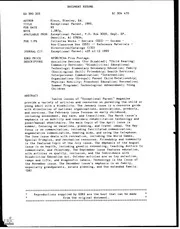
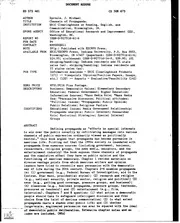
ERIC ED055395: The Taxonomic Instruction Project: An Introduction to Taxonomic Instruction.
 75
75

ERIC ED055395: The Taxonomic Instruction Project: An Introduction to Taxonomic Instruction.



Evander Ashcroft (Alchemy & Hermeticism Editor) — This volume, though presented in the guise of educational theory, resonates deeply with the principles of hermetic alchemy and the systematic pursuit of gnosis. The "Taxonomic Instruction Project" offers a rare glimpse into the alchemical process of transforming ignorance into wisdom, detailing the 'substances' and 'strategies' of teaching as akin to the manipulation of prima materia. The author's articulation of the teacher's four roles—facilitation, evocation, reinforcement, and transaction—mirrors the stages of the Great Work. It's a compelling read for those who perceive education as a sacred art, a disciplined path toward illumination, and a vital component of the Gnostic quest for self-knowledge. Its structured approach to understanding learning processes provides a framework for spiritual practitioners seeking to deepen their own pedagogical approaches or to better comprehend the transmission of esoteric knowledge.
📝 Description
75
Unveil the profound architecture of learning with "The Taxonomic Instruction Project," an esoteric blueprint for the alchemical transformation of the student mind. This foundational text transcends mere pedagogical methods, delving into the hidden currents that govern the interaction between teacher and pupil, akin to the intricate celestial mechanics or the subtle energies of the Kabbalistic Tree of Life. It presents a classified system for understanding the very essence of instruction, viewing it as a sacred transmission of knowledge and a carefully orchestrated dance of cognitive engagement. For the discerning seeker of wisdom, particularly those drawn to the arcane arts of Gnosticism and the structured pathways of spiritual development, this work offers a powerful lens. It illuminates the teacher’s role not as a mere dispenser of facts, but as a facilitator of inner awakening, a conjurer of productive thought, and a master manipulator of the energetic forces that shape understanding. The text whispers of the fundamental skills and competencies that form the bedrock of true gnosis, framing education as a sacred communications system where enlightenment is the ultimate prize. Dive into this illuminating discourse and discover the hidden taxonomy that unlocks the potential within every student, mirroring the divine order found in the cosmos.
✍️ Author
ERIC
The given name Eric, Erich, Erikk, Erik, Erick, Eirik, or Eiríkur is derived from the Old Norse name Eiríkr [ˈɛiˌriːkz̠] (or Eríkr [ˈeˌriːkz̠] in Old East Norse due to monophthongization). The first element, ei- may be derived from the older Proto-Norse *ai…
💡 Why Read This Book?
For seekers of hidden knowledge, this book offers a structured framework for understanding the alchemical process of education. It reveals the deeper, symbolic roles of the teacher and student, akin to esoteric initiations. Scholars of Gnosticism and classification systems will find parallels with ancient wisdom traditions. Practitioners seeking to refine their teaching methods will discover actionable insights into fostering productive thought and facilitating transformative learning experiences.
⭐ Reader Reviews
Honest opinions from readers who have explored this book.
❓ Frequently Asked Questions
What is 'Taxonomic Instruction' in this context?
In this esoteric framework, 'Taxonomic Instruction' refers to a sophisticated method of classifying both the 'substances' of knowledge and the strategic 'operations' a teacher employs to guide the student towards enlightenment, much like an alchemist categorizes elements and processes.
How does this relate to Gnosticism?
The text echoes Gnostic ideals by emphasizing the teacher's role in evoking inner understanding and facilitating the student's personal journey towards gnosis, viewing education as a path to liberation from ignorance, mirroring the search for divine spark within.
What are the four main roles of the teacher described?
The teacher is presented as a facilitator of healthy interaction (harmonizing energies), an evoker of productive thinking (sparking inner light), a manipulator of reinforcement systems (guiding energetic flows), and a transactional agent of foundational skills (building the vessel for knowledge).
Is this book suitable for beginners in esoteric studies?
Yes, while its language is precise, the underlying principles of understanding and guiding intellectual and spiritual growth make it accessible. It provides a foundational 'taxonomy' for those beginning their exploration of teaching as a sacred art.
What kind of 'handicapped children' are referenced?
The term 'handicapped children' in this original context refers to individuals facing challenges in learning or emotional development. The text's approach is to provide a systematic, empowering method to address these unique needs, seeing them as opportunities for specialized, profound instruction.
🔮 Key Themes & Symbolism
The Alchemical Art of Instruction
This theme explores the profound parallels between pedagogical methods and alchemical processes. Just as an alchemist transforms base metals into gold, the "Taxonomic Instruction Project" posits that a skilled educator can transmute ignorance into wisdom. It delves into the 'substances' of knowledge and the 'strategies' of teaching as distinct but interconnected elements, emphasizing the importance of precise classification and methodical application. The text frames the educational journey as a Great Work, where the teacher acts as the guiding adept, orchestrating the transformation of the student's consciousness through a series of carefully designed interactions and intellectual distillations. This perspective elevates teaching from a mundane task to a sacred science, deeply rooted in the principles of transformation and purification.
The Teacher as Gnostic Initiate
Within the framework of "The Taxonomic Instruction Project," the teacher is not merely an instructor but a spiritual guide, a Gnostic initiate tasked with awakening the latent divine spark within the student. The four primary roles described—facilitation of interaction, evocation of thought, manipulation of reinforcement, and transaction of skills—are not just pedagogical techniques but esoteric functions. They represent the teacher's ability to harmonize energetic fields, stimulate the inner light of understanding, channel and direct the student's vital forces, and transmit the foundational 'keys' to higher knowledge. This perspective imbues the teaching role with a profound sense of responsibility and sacred duty, aligning it with the Gnostic pursuit of liberation through knowledge and self-awareness.
The Taxonomy of Understanding
This work presents a 'Taxonomic Instruction' as a system for classifying the very architecture of human understanding and the methods by which it can be cultivated. It suggests that just as ancient mystics charted the heavens or mapped the subtle body, educators can create a classification system for learning processes. By defining distinct roles for the teacher and categorizing the essential components of instruction, the text offers a structured approach to unlocking potential, particularly for those facing unique challenges. This methodical approach mirrors the ordered universes found in esoteric traditions, where understanding the underlying structure is the first step towards mastery and enlightenment. It provides a blueprint for discerning the 'elements' of learning and the 'operations' that lead to profound comprehension.
💬 Memorable Quotes
“The teacher is the facilitator of healthy interaction processes.”
— This highlights the teacher's role in creating harmonious energetic and intellectual environments, fostering connections that lead to deeper understanding, akin to balancing the humors in ancient medicine.
“The teacher is the evoker of productive thinking processes.”
— This speaks to the teacher's ability to spark the inner light of reason and insight within the student, igniting the fires of curiosity and critical analysis that lead to true gnosis.
“The teacher is the manipulator of reinforcement systems.”
— In an esoteric sense, this refers to the teacher's skillful guidance of the student's energies and motivations, shaping them towards productive learning outcomes, much like an alchemist controls the heat and catalysts.
“The teacher is the transactional agent of basic skills and competencies.”
— This emphasizes the transmission of foundational knowledge and abilities, the essential 'building blocks' that empower the student to embark on more complex intellectual and spiritual journeys.
“Instruction as part of a communications system among teacher a”
— This suggests that teaching is a sacred dialogue, a flow of energy and information, where the teacher and student are interconnected nodes in a network of knowledge transmission, leading towards collective enlightenment.
🌙 Esoteric Significance
Tradition
While framed as educational research, the text's emphasis on classification, structured roles, and the transformative potential of instruction aligns with the principles of Hermeticism and Gnosticism. The meticulous categorization of teaching strategies and the defined roles of the educator echo the ordered systems found in Kabbalistic diagrams and the alchemical process of separating, purifying, and recombining elements. The concept of evoking 'productive thinking' and facilitating 'healthy interaction' can be interpreted through the lens of energetic manipulation and spiritual alignment, key concerns in many esoteric traditions seeking to cultivate inner wisdom and divine connection.
Symbolism
The 'taxonomy' itself acts as a powerful symbol, representing the desire to bring order to the chaotic potential of the mind, akin to the creation myths found in various spiritual texts. The teacher's four roles can be seen as symbolic representations of archetypal energies: the Harmonizer (facilitation), the Illuminator (evocation), the Alchemist (reinforcement), and the Scribe (transaction). 'Substances' and 'strategies' become symbolic of the raw material of consciousness and the methods used to refine it. The 'handicapped child' becomes a symbol of the unawakened soul, whose inherent potential needs specialized guidance to manifest.
Modern Relevance
In an age saturated with information but often lacking deep understanding, the 'Taxonomic Instruction Project' offers a timeless model for intentional learning. Its focus on the teacher's active, almost shamanic role in guiding cognitive and emotional development remains profoundly relevant. For esoteric practitioners, the text provides a practical framework for understanding how to effectively transmit complex ideas and facilitate spiritual growth in others. Its emphasis on classification and strategic intervention can be applied to personal development, helping individuals categorize their own strengths and weaknesses and devise effective 'instructional' plans for self-mastery.
👥 Who Should Read This Book
This work is a treasure for the discerning reader. **Beginners** in esoteric studies will find a clear, structured introduction to the principles of guiding intellectual and spiritual growth, presented through the accessible metaphor of education. **Scholars** of Gnosticism, Hermeticism, and comparative philosophy will discover intriguing parallels between ancient wisdom and modern pedagogical theory. **Seekers** of deeper knowledge will appreciate the text's evocation of the teacher's role as a catalyst for inner transformation and self-discovery. **Practitioners** involved in teaching, mentoring, or spiritual guidance will gain invaluable insights into optimizing their methods, fostering productive thought, and facilitating profound learning experiences for their students.
📜 Historical Context
Presented as a report within the ERIC archive, "The Taxonomic Instruction Project" likely emerged during the latter half of the 20th century, a period marked by significant advancements and evolving theories in educational psychology and special education. This era saw a burgeoning interest in structured approaches to teaching, including the development of classification systems and models for understanding child development and learning disabilities. The emphasis on 'diagnostic teaching' and 'models' reflects the scientific and analytical trends of the time. While the language may appear clinical, the underlying principles of understanding and addressing the unique needs of exceptional children resonate with a deeper, almost alchemical desire to unlock potential. The text's focus on classification and systematic instruction can be seen as a reflection of a broader cultural inclination towards order and categorization, a tendency also mirrored in various esoteric traditions seeking to map the unseen realms of consciousness and spirit.
📔 Journal Prompts
Reflect on the 'substances' and 'strategies' of your own learning journey. How were they classified and applied?
Consider the four roles of the teacher presented. Which role do you embody most strongly, and how can you cultivate the others?
How does the concept of 'instruction as a communications system' relate to your understanding of spiritual transmission or energetic exchange?
If you were to create your own 'taxonomy of understanding' for a specific esoteric concept, what would be its main categories?
In what ways can the principles of 'diagnostic teaching' be applied to understanding and nurturing your own inner development?
🗂️ Glossary
Taxonomic Instruction
A method of classifying and structuring the elements (substances) and approaches (strategies) employed in teaching, particularly for individuals with learning challenges, viewed as a systematic pathway to knowledge.
Evocation of Productive Thinking
The act of stimulating and drawing forth the student's innate capacity for insightful and creative thought, akin to awakening dormant spiritual faculties.
Reinforcement Systems
The deliberate manipulation of factors that strengthen desired learning behaviors and cognitive processes, viewed as guiding the flow of energetic and intellectual momentum.
Transaction of Basic Skills
The direct transmission and integration of foundational knowledge and competencies, forming the essential building blocks for higher understanding.
Handicapped Children
Individuals facing specific learning or developmental challenges, seen within this context as possessing unique potentials that require specialized, refined instructional methodologies for their unlocking.