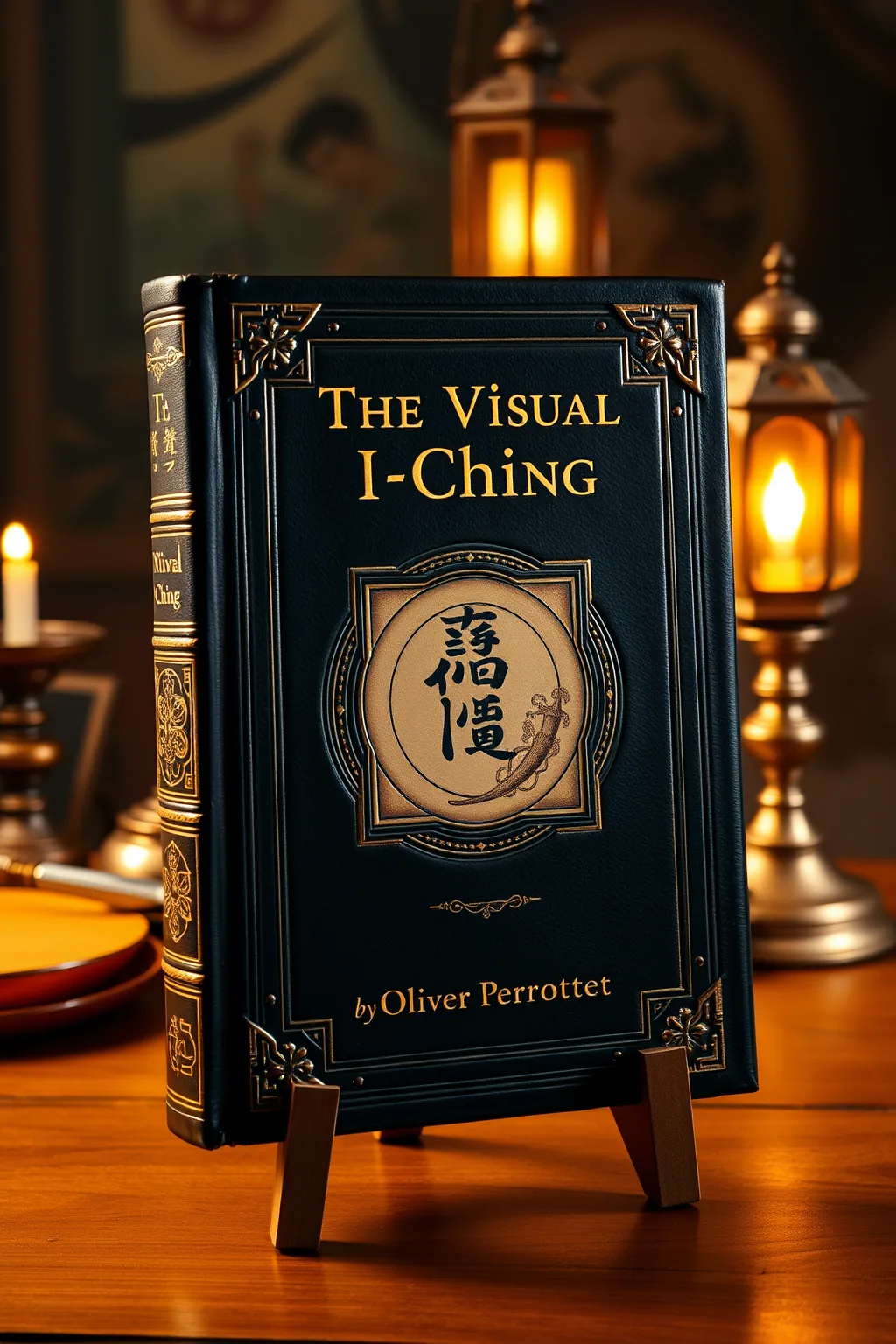
The Visual I Ching
 84
84

The Visual I Ching
Oliver Perrottet’s *The Visual I Ching* attempts a commendable feat: to translate the abstract principles of the *Book of Changes* into a visual lexicon. The strength of this approach lies in its potential to bypass intellectual barriers, allowing for a more immediate, intuitive grasp of the hexagrams' meanings. The accompanying artwork, while subjective, offers a fresh perspective on familiar symbols, prompting new associations. However, this very subjectivity can also be a limitation. The interpretive leap from visual representation to divinatory meaning is not always clearly articulated, leaving the reader to bridge significant gaps. For instance, the visual depiction of Hexagram 1, Qian (The Creative), while striking, may not inherently convey the dynamic force of pure yang energy as directly as traditional textual explanations. Perrottet’s work is best approached not as a definitive guide, but as a complementary tool for those already familiar with the I Ching’s foundational concepts. It is a visual aid, not a replacement for rigorous study.
📝 Description
84
Oliver Perrottet's *The Visual I Ching* was first published in 1987.
This book offers a visual approach to the ancient Chinese divination text, the I Ching. It moves beyond relying solely on textual interpretations, highlighting the symbolic and visual aspects of the 64 hexagrams. Each hexagram is presented with accompanying images, intended to reveal deeper meanings through aesthetic and intuitive connection. Perrottet's work aims to connect the I Ching's philosophical depth with its graphic structure, appealing to those who learn best through imagery. It makes the complex philosophy and divinatory practices of the I Ching more approachable for visual thinkers.
The book is suited for anyone interested in a different way to study the I Ching. Students of Eastern philosophy, especially those interested in symbolic systems and comparative mythology, will find it valuable. Artists, designers, and visual learners seeking inspiration from older traditions may find its approach particularly interesting. It also serves individuals who struggle with traditional textual study of the I Ching and want a more visual path into its philosophy and divination.
Published in 1987, *The Visual I Ching* appeared during a time of growing Western interest in Eastern philosophies. This period saw figures like Joseph Campbell and the ongoing influence of Carl Jung's work on archetypes shape popular understanding of esoteric traditions. While the I Ching had already been studied by scholars such as Richard Wilhelm and Western occultists, Perrottet's emphasis on visual interpretation provided a distinct perspective. The book fits within a tradition of scholarship that views the I Ching not merely as a text, but as a dynamic system of symbolic representation with lasting significance.
💡 Why Read This Book?
• Learn to interpret the I Ching through visual intuition, engaging with the 64 hexagrams as distinct symbolic images rather than solely abstract line combinations, a method distinct from traditional textual analyses. • Discover the philosophical underpinnings of each hexagram by examining Perrottet's original visual interpretations, gaining a new aesthetic dimension to concepts like The Creative (Qian) and The Receptive (Kun). • Explore the I Ching as a system of visual language, understanding how the arrangement and form of yin and yang lines can be perceived as holistic symbolic patterns, offering a unique perspective on this ancient Chinese text.
⭐ Reader Reviews
Honest opinions from readers who have explored this book.
❓ Frequently Asked Questions
What makes 'The Visual I Ching' different from other I Ching books?
Unlike most I Ching texts that focus on textual commentary and divinatory meanings, 'The Visual I Ching' prioritizes visual representations of the 64 hexagrams. It uses artwork to unlock deeper symbolic and intuitive understanding, offering a different pathway to engagement.
Is this book suitable for beginners to the I Ching?
It can be a helpful supplement for beginners, especially those who are visually oriented. However, it is best used alongside more traditional texts that explain the foundational principles and divinatory methods of the I Ching.
When was 'The Visual I Ching' first published?
The original publication date for Oliver Perrottet's 'The Visual I Ching' was 1987, positioning it within a wave of renewed interest in esoteric and Eastern philosophies in the late 20th century.
What kind of artwork is used in the book?
The book features original artistic interpretations of the 64 I Ching hexagrams. These visuals are designed to represent the essence and symbolic meaning of each hexagram in a distinct, often abstract, manner.
Can this book be used for actual I Ching divination?
While it offers a unique interpretive lens, 'The Visual I Ching' is primarily an exploration of the hexagrams' visual symbolism. Readers may integrate these visual insights into their practice, but it does not replace standard divination methods or interpretations.
Who is Oliver Perrottet?
Oliver Perrottet is the author and artist behind 'The Visual I Ching'. His work focuses on presenting the ancient Chinese text through a distinct visual and symbolic framework, aiming to enhance understanding through art.
🔮 Key Themes & Symbolism
Hexagram as Image
The core of Perrottet's work is the conceptualization of the 64 hexagrams not merely as sequences of lines, but as potent visual symbols. Each hexagram, formed by combinations of solid (yang) and broken (yin) lines, is rendered with an accompanying artistic interpretation. This theme posits that the visual form itself carries intrinsic meaning, offering a different access point to the I Ching's wisdom beyond linguistic interpretation. The book encourages readers to perceive the dynamic interplay and inherent archetypal qualities within these graphic structures, treating the I Ching as a form of proto-visual language.
Intuitive Understanding
This theme explores how visual art can foster intuitive comprehension of complex philosophical concepts. By presenting the hexagrams through art, Perrottet aims to bypass the analytical mind and engage a more direct, feeling-based understanding. The visual representations are intended to evoke specific moods, energies, and situational archetypes associated with each hexagram. This approach is particularly relevant for individuals who find traditional textual study challenging or who possess a stronger affinity for symbolic and aesthetic learning, suggesting that true insight can arise from contemplative observation of form.
Symbolic Resonance
Perrottet's work taps into the universal principle of symbolic resonance, suggesting that the visual patterns of the I Ching echo fundamental aspects of the human experience and the natural world. Each artwork is designed to resonate with the underlying philosophical principles of its corresponding hexagram, inviting the reader to find personal connections and deeper meaning. This theme highlights the I Ching as a system that reflects cosmic order and human psychology through its structured symbolism, with the visual aspect serving as a catalyst for recognizing these profound connections.
Bridging East and West
The book represents an effort to translate the profound wisdom of an ancient Eastern text into a format accessible and resonant for a Western audience. By focusing on visual art, Perrottet bridges cultural and intellectual divides. The I Ching, originating from Chinese cosmology and philosophy, is presented through an artistic lens that can be appreciated across different cultural backgrounds. This theme underscores the universal nature of archetypal symbols and the potential for art to serve as a common language for exploring profound spiritual and philosophical ideas.
💬 Memorable Quotes
Direct passages from the work, attributed to the author.
“The arrangement of lines in a hexagram forms a visual statement.”
— This concept emphasizes that the I Ching's structure is not merely arbitrary but communicates meaning through its graphic form. It suggests that by observing the patterns of yin and yang lines, one can derive insight akin to reading an image.
“Each hexagram's image suggests its inherent nature.”
— This highlights the book's central premise: that the visual representation of a hexagram possesses an intrinsic quality that directly relates to its meaning and divinatory significance, encouraging a visual rather than purely textual approach.
“Beyond text, the I Ching speaks through form.”
— This suggests that the I Ching's wisdom is multi-layered, accessible not only through its written components but also through its fundamental structure and visual representation, advocating for a holistic engagement with the text.
“Visual patterns mirror universal forces.”
— This interpretation posits that the graphic structures of the I Ching, as depicted visually, correspond to fundamental energies and principles found throughout nature and human experience, making the text a symbolic map of reality.
💡 Key Ideas
Editorial paraphrase of the work's core concepts — not direct quotes.
Art provides an intuitive entry into the I Ching's philosophy.
This paraphrased idea points to the book's methodology, suggesting that artistic interpretations can bypass intellectual barriers, offering a more direct and felt understanding of the I Ching's complex ideas and principles.
🌙 Esoteric Significance
Tradition
While not strictly adhering to a single esoteric lineage like Kabbalah or Hermeticism, *The Visual I Ching* draws upon the universal principles of symbolic interpretation common in many Western esoteric traditions. Its approach aligns with the idea that cosmic order and human consciousness can be understood through symbolic patterns. It speaks to the Theosophical interest in cross-cultural wisdom and the Gnostic emphasis on intuitive understanding of divine patterns. Perrottet's work can be seen as an extension of the broader Western esoteric project of finding unifying symbolic languages across diverse cultural origins.
Symbolism
The primary symbols are the yin (broken) and yang (solid) lines, which form the 64 hexagrams. Perrottet's unique contribution is his artistic rendering of these hexagrams, imbuing them with specific visual motifs that aim to convey their inherent meaning. For instance, the visual representation of Hexagram 1, Qian (The Creative), might use dynamic, upward-sweeping lines to evoke its masculine, active energy, while Hexagram 2, Kun (The Receptive), could employ softer, grounded forms to represent its feminine, passive nature. These artistic interpretations serve as visual keys to the philosophical concepts.
Modern Relevance
Contemporary practitioners of Western esotericism, particularly those interested in visual meditation, Jungian psychology, and symbolic systems, often find value in Perrottet's approach. Artists and designers seeking inspiration from ancient wisdom traditions also draw upon its visual nature. Its focus on intuitive understanding through imagery aligns with modern mindfulness practices and the growing interest in non-traditional methods of spiritual inquiry, making it relevant for those exploring the intersection of art, psychology, and ancient philosophy.
👥 Who Should Read This Book
• Students of Chinese philosophy and comparative religion seeking alternative interpretive frameworks for the I Ching beyond traditional textual analysis. • Artists, designers, and visual thinkers interested in exploring how ancient symbolic systems can inform creative practice and offer new perspectives on form and meaning. • Individuals drawn to intuitive and symbolic learning methods who find traditional academic or divinatory approaches to the I Ching less accessible.
📜 Historical Context
Published in 1987, *The Visual I Ching* emerged in a Western intellectual climate increasingly receptive to Eastern thought and esoteric traditions. The late 20th century saw significant interest in systems of divination and philosophy, partly influenced by post-Jungian psychology and a growing counter-cultural appreciation for non-Western wisdom. While translations by Richard Wilhelm and others had long made the I Ching available, Perrottet’s approach offered a novel visual dimension. This period also saw thinkers like Joseph Campbell popularizing comparative mythology and archetypal studies, creating fertile ground for works that interpreted ancient texts through symbolic and artistic lenses. The book’s emphasis on visual interpretation can be seen as a response to, or parallel with, the broader interest in iconography and symbolic language prevalent in art and academia, contrasting with more purely philosophical or text-centric interpretations dominant in earlier scholarship.
📔 Journal Prompts
The visual representation of Hexagram 12, Standstill (Xian), and its associated artwork.
Contemplating the visual metaphor presented for Hexagram 26, Great Taming Power (Da Chu).
Reflecting on how the visual style of Perrottet's hexagrams differs from textual descriptions.
Connecting the artistic interpretation of Hexagram 34, Great Vigour (Da You), to personal experiences of power.
Considering the symbolic language of yin and yang lines as depicted visually.
🗂️ Glossary
Yin
In the I Ching, the broken line (--) representing feminine, passive, dark, and yielding qualities. It is one of the two fundamental components of the hexagrams.
Yang
In the I Ching, the solid line (—) representing masculine, active, light, and assertive qualities. It is the other fundamental component of the hexagrams.
Hexagram
A figure composed of six stacked horizontal lines, each line being either yin or yang. There are 64 unique hexagrams in the I Ching, representing fundamental archetypes and situations.
Trigram
A figure composed of three stacked horizontal lines, either yin or yang. The eight basic trigrams are combined to form the 64 hexagrams.
Qian
The first hexagram of the I Ching, composed of six yang lines (☰☰). It represents Heaven, the Creative, strength, and initiative. Often depicted with dynamic imagery.
Kun
The second hexagram of the I Ching, composed of six yin lines (☷☷). It represents Earth, the Receptive, devotion, and nurturing. Typically associated with grounded and yielding visual forms.
Divination
The practice of seeking knowledge of the future or the unknown by supernatural means. In the context of the I Ching, it involves casting coins or yarrow stalks to determine a hexagram for guidance.
🔮 Readers Also Liked
Browse all →









More by Oliver Perrottet
All books →


More Free Occult Philosophy Books
View all →