Percy Jackson's Greek Gods
 77
77

Percy Jackson's Greek Gods
Rick Riordan’s *Percy Jackson's Greek Gods* succeeds where many modern retellings falter: it captures the essential character and drama of the ancient myths while making them digestible for a contemporary audience. Riordan’s voice, familiar to fans of his demigod protagonist, imbues the Olympian narratives with a playful, often irreverent, energy. The strength lies in its accessibility; complex genealogies and ancient conflicts become straightforward, entertaining tales. For instance, the origin of Athena’s birth, sprung fully armed from Zeus’s head, is rendered with a vivid, almost slapstick, quality that simplifies a potentially bewildering event. However, this very accessibility can sometimes feel like a limitation. The profound, often dark, philosophical underpinnings of some myths—the existential dread, the sheer cosmic indifference—are naturally softened to fit the target demographic. While effective as an introduction, it might leave seasoned mythologists yearning for deeper exploration of the more challenging themes. Nevertheless, for its intended purpose, the book is a remarkably coherent and enjoyable distillation of foundational Western myths.
📝 Description
77
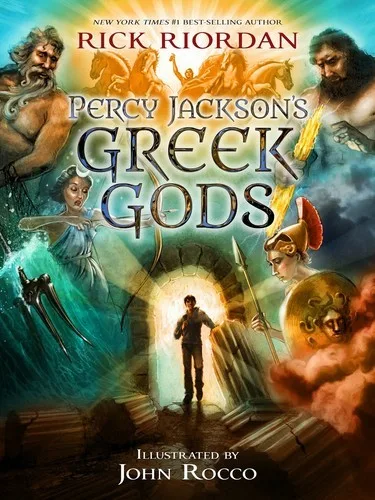
Rick Riordan retells Greek myths from the gods' own perspectives in his 2016 book, Percy Jackson's Greek Gods.
Published in 2016, Percy Jackson's Greek Gods presents ancient Greek mythology through the voices of the Olympian deities themselves. This is not a scholarly text but a lively account of the gods' beginnings, their conflicts, and their roles in the world's creation and human lives. Riordan uses modern language and humor to make these complex stories accessible while keeping the core myths intact. The book is written for young adults and middle-grade readers, including those familiar with Riordan's other works and newcomers to Greek myths. Adults who enjoy witty narratives and new takes on old stories will also find it appealing. It serves as an introduction for anyone interested in the myths that influenced Western literature and culture.
This book arrives during a time of renewed public interest in Greek mythology, much of it sparked by Riordan's popular series and various media adaptations. It follows a long line of myth collections, from Hesiod's *Theogony* to contemporary retellings. Riordan's method differs from purely academic or literal interpretations of ancient writings. Instead, he synthesizes the narratives for a wide audience. The core concepts covered include the universe's origin from Chaos, the age of the Titans, the rise of Zeus, and the establishment of the Olympian gods. It details the powers and personalities of figures like Zeus, Poseidon, Hades, and Hera.
This book engages with the tradition of mythography, the collection and interpretation of myths. It draws from ancient sources like Hesiod's *Theogony*, which sought to organize the divine family tree and creation stories. Riordan's approach, while aimed at a popular audience, echoes the historical practice of making these foundational narratives accessible. It continues a lineage of presenting mythological systems, not as historical fact, but as a framework for understanding the world and human nature, a common thread in esoteric traditions that draw from symbolic and allegorical interpretations of ancient stories.
💡 Why Read This Book?
• Gain an engaging introduction to the Olympian pantheon and their relationships, learning about figures like Zeus and Hera through Riordan's witty storytelling, a perspective distinct from academic translations. • Understand the core creation myths and the succession of divine power, from Chaos to the reign of the Olympians, as detailed in narratives like the Titanomachy. • Appreciate the historical lineage of myth retellings, seeing how Riordan’s 2016 work connects to ancient sources like Hesiod's *Theogony* while offering a modern, accessible interpretation.
⭐ Reader Reviews
Honest opinions from readers who have explored this book.
❓ Frequently Asked Questions
Is Percy Jackson's Greek Gods a direct retelling of Homer's Odyssey?
No, this book focuses on the origins and stories of the Greek gods themselves, rather than a specific hero's journey like Homer's Odyssey. It predates and provides context for many myths featured in the Percy Jackson series.
What is the primary source material for Rick Riordan's Greek Gods?
Riordan draws from a wide range of ancient Greek myths and epic poems, including Hesiod's *Theogony* for divine origins and genealogies, and various other Hellenistic and Roman accounts of the gods' exploits.
Does this book explain the relationships between the Greek gods?
Yes, a central theme is the complex and often tumultuous relationships between the Olympian gods, their parents (the Titans), and their children, detailing their rivalries, alliances, and divine dramas.
Is Percy Jackson's Greek Gods suitable for young children?
While accessible, the book deals with mature themes like divine conflict, infidelity, and power struggles. It is generally recommended for middle-grade readers (ages 8-12) and up, depending on the child's maturity.
How does this book differ from traditional academic studies of Greek mythology?
Unlike academic texts, Riordan's work prioritizes narrative engagement and humor, adapting ancient stories for a modern, younger audience. It focuses on storytelling rather than linguistic analysis or historical debate.
When was Percy Jackson's Greek Gods first published?
Percy Jackson's Greek Gods was first published in 2016, expanding the universe introduced in Riordan's popular Percy Jackson & the Olympians series.
🔮 Key Themes & Symbolism
Divine Power and Succession
The narrative charts the violent, power-driven succession within the Greek pantheon, from the primordial Chaos to the rise of Cronus and the eventual triumph of Zeus and the Olympians. This theme explores the often brutal nature of authority and the cyclical struggle for dominance among divine beings. It highlights how power is seized, maintained, and challenged, providing a framework for understanding the gods' often capricious actions and their impact on the mortal world. The concept of divine right and the inherent instability of absolute power are central to these origin stories.
Family Dynamics and Betrayal
At its heart, Percy Jackson's Greek Gods illuminates the deeply dysfunctional family structures of the Olympians. Stories of patricide (Cronus devouring his children), fratricide (Zeus overthrowing Cronus), and constant sibling rivalry are not mere plot points but reveal the gods' flawed natures. Betrayal, jealousy, and vengeance are recurring motifs, showing that even immortal beings are driven by base emotions. This exploration of divine family feuds offers a mythological lens through which to examine human relational complexities, albeit on a grand, cosmic scale.
Mythic Archetypes and Domains
Each god is presented with distinct personality traits and a defined domain, acting as archetypes that represent fundamental aspects of existence and human experience. Zeus embodies sovereignty and order (or chaos), Poseidon rules the unpredictable seas, Hades governs the underworld and mortality, and Athena represents wisdom and strategic warfare. Riordan effectively distills these complex figures into relatable, albeit often exaggerated, characters, making their symbolic significance accessible and highlighting their enduring influence on Western thought and storytelling.
The Creation of the Cosmos
The book begins with the very genesis of the universe, tracing its formation from the formless void of Chaos. It details the emergence of primordial deities like Gaia (Earth) and Uranus (Sky), followed by the Titans and then the Olympians. This foundational narrative explains the ancient Greek cosmology – how the world, its landscapes, and its natural phenomena were believed to have come into being through divine will and conflict. Understanding this creation myth provides essential context for the gods' roles and their relationship with the physical world.
💬 Memorable Quotes
Direct passages from the work, attributed to the author.
“Cronus ate his kids because he was afraid of a prophecy.”
— This concisely explains the important event driving the conflict between the Titans and the Olympians. It highlights the theme of fear of succession and how prophetic anxieties can lead to extreme, self-defeating actions, even among deities.
“Zeus wasn't exactly a family man.”
— This wry observation understates the numerous affairs and illegitimate children attributed to Zeus. It points to his complex character, balancing his role as king with his less-than-ideal personal conduct, a recurring theme in his mythology.
“Athena sprang from Zeus’s head, fully armed.”
— This iconic origin story emphasizes Athena's unique birth and her inherent association with wisdom and warfare. It signifies her immediate readiness and prowess, bypassing traditional maternal lineage.
“The gods were basically superpowered, dramatic teenagers.”
— This interpretation captures the essence of Riordan's approach: portraying the gods with relatable, albeit amplified, adolescent emotions like jealousy, anger, and impulsivity, making their ancient stories more accessible.
💡 Key Ideas
Editorial paraphrase of the work's core concepts — not direct quotes.
Hades got the short straw with the Underworld.
This paraphrase captures the perceived disadvantage of Hades's lot compared to his brothers' domains of sky and sea. It reflects the ancient Greek view of death and the afterlife as a grim, undesirable realm.
🌙 Esoteric Significance
Tradition
While not strictly an esoteric text in the vein of Hermeticism or Kabbalah, Percy Jackson's Greek Gods functions as a modern gateway to the archetypal and symbolic dimensions inherent in Western mythology, a precursor to many esoteric traditions. The Greek pantheon's structure, their domains, and their interactions with fate and humanity form a foundational layer upon which later Western esoteric thought, particularly Neoplatonism and Renaissance magical philosophies, would build. Riordan’s work, though secular in intent, presents these myths in a manner that highlights their symbolic weight, making them accessible for readers who might later explore more formalized esoteric systems that draw upon these ancient deities.
Symbolism
Key symbols abound, notably the thunderbolt of Zeus, representing supreme power and divine authority, often wielded with arbitrary force. Poseidon's trident symbolizes his dominion over the chaotic seas and earthquakes, reflecting the unpredictable nature of primal forces. The pomegranate seeds associated with Persephone and Hades represent the inescapable bonds of the underworld and the cyclical nature of life, death, and rebirth—a concept central to many mystery traditions and later Gnostic ideas about descent and ascent.
Modern Relevance
Contemporary practitioners of Hellenistic polytheism, or Hellenic Reconstructionism, engage directly with these myths as living traditions, often using retellings like Riordan's as introductory material. Furthermore, modern depth psychology, particularly Jungian analysis, finds resonance in the archetypal figures presented—Athena as the wise woman, Hades as the shadow self, Zeus as the divine masculine. The book’s simplified presentation of these powerful archetypes makes them accessible for individuals exploring personal mythology and psychological integration through symbolic narratives.
👥 Who Should Read This Book
• Young readers (ages 8-12) and their parents seeking an entertaining and accessible introduction to Greek mythology, moving beyond basic character names to understand core stories and relationships. • Fans of the Percy Jackson series looking to explore the origins of the gods and the world that Camp Half-Blood inhabits, gaining deeper context for the main saga. • Educators and librarians searching for engaging, age-appropriate resources that introduce foundational Western myths in a way that sparks curiosity for further learning.
📜 Historical Context
Published in 2016, Rick Riordan's *Percy Jackson's Greek Gods* arrived amidst a sustained cultural fascination with Greek mythology, significantly boosted by his own successful series. This work stands in dialogue with centuries of myth-telling, from Hesiod's foundational *Theogony* (circa 700 BCE), which meticulously cataloged the gods' genealogies and origins, to Ovid's *Metamorphoses* (8 CE), which fluidly retold numerous myths. Riordan’s approach diverges sharply from purely academic interpretations that emerged prominently in the 19th and 20th centuries, such as those by scholars like Walter Burkert. While academic circles focused on comparative mythology, ritualistic origins, and historical context, Riordan prioritizes narrative engagement and humor for a younger audience. The book's reception was largely positive, praised for its accessibility, though some critics noted its simplification of complex mythological nuances. It faced no significant censorship issues, unlike some earlier, more literal translations of classical texts that were deemed inappropriate for younger readers.
📔 Journal Prompts
The chaotic birth of Athena from Zeus's head and its implications for wisdom.
Cronus's fear of prophecy and its self-fulfilling nature.
The symbolic meaning of Poseidon's trident and his dominion over the seas.
Zeus's complex character as king, husband, and father.
The establishment of the Olympian order after the Titanomachy.
🗂️ Glossary
Chaos
In Greek cosmology, the primordial void or state of nothingness from which the universe and the first deities emerged. It represents formlessness and potential before creation.
Titans
The generation of deities who preceded the Olympians, children of Gaia (Earth) and Uranus (Sky). Notable Titans include Cronus, Rhea, Oceanus, and Themis.
Olympians
The twelve principal deities of the Greek pantheon, ruling from Mount Olympus. Key figures include Zeus, Hera, Poseidon, Hades, Athena, Apollo, Artemis, Ares, Aphrodite, Hephaestus, Hermes, and either Hestia or Dionysus.
Titanomachy
The great war fought between the Titans, led by Cronus, and their children, the Olympians, led by Zeus. The Olympians' victory established their rule over the cosmos.
Hesiod
An ancient Greek poet, traditionally dated to around 700 BCE. His works, particularly the *Theogony*, are primary sources for Greek creation myths and the genealogies of the gods.
Cronus
The leader of the Titans and father of Zeus, Poseidon, Hades, Hera, Demeter, and Hestia. He famously swallowed his children to prevent a prophecy that he would be overthrown by them.
Gaia
The primordial goddess of the Earth, considered the mother of the Titans and, through them, many other divine and monstrous beings. She plays a role in the prophecies against Uranus and Cronus.
🔮 Readers Also Liked
Browse all →









More by Rick Riordan
All books →




More Free Occult Philosophy Books
View all →