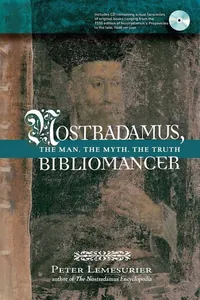
Nostradamus?
 77
77

Nostradamus?
Peter Lemesurier’s ‘Nostradamus?’ approaches its subject with a commendable degree of scholarly rigor, a refreshing departure from the usual hagiography or sensationalism. He effectively dismantles the more outlandish claims by focusing on the linguistic and historical scaffolding that underpins them. A particular strength lies in his methodical deconstruction of specific quatrains, demonstrating how easily they can be made to fit events through creative interpretation, a process he details with surgical precision. However, the book occasionally leans into a dryness that might deter readers accustomed to more narrative-driven accounts of prophecy. While Lemesurier’s analysis of the 'Nostradamus mythos' is sharp, the practical implications for understanding historical belief systems could have been explored with greater depth. Ultimately, it serves as a vital corrective, reminding us that the power of prophecy often resides more in the interpreter than the oracle.
📝 Description
77
Peter Lemesurier's 2014 book critically examines how Nostradamus's prophecies have been interpreted.
Published in 2014, Peter Lemesurier's "Nostradamus?" offers a critical look at how Michel de Nostredame's prophecies have been understood over time. Instead of accepting common interpretations, Lemesurier examines the historical background, language, and the myths that have grown around the 16th-century physician and astrologer. The book seeks to clarify how Nostradamus's four-line poems, or quatrains, have been applied to major historical events.
This work is for those interested in esoteric history and for skeptics who question prophetic claims. It is especially useful for readers familiar with popular stories about Nostradamus but who want to see scholarly viewpoints that question these common beliefs. Readers who prefer an approach based on facts and evidence regarding historical prophecy will find this book valuable. It serves as a counterpoint to the continuous spread of unverified claims about Nostradamus's accuracy, which persist on internet forums and in speculative books.
Lemesurier's work engages with the long tradition of interpreting prophetic texts, a practice that has seen renewed interest with the rise of occultism and speculative history. His analysis of Nostradamus fits within a broader scholarly examination of Hermeticism and esoteric traditions, particularly noting the influence of figures like Frances Yates. The book addresses how such traditions are often viewed through a lens of retrospective prophecy, where events are mapped onto predictions after they occur, a common feature in the study of esoteric movements and their historical reception.
💡 Why Read This Book?
• Gain a critical understanding of how Nostradamus's prophecies have been interpreted and applied over centuries, moving beyond popular myths. You will learn specific methods of retrospective prophecy analysis, as detailed in the book's examination of quatrains. • Understand the historical and linguistic context of Nostradamus's original writings, distinguishing between the man and the legend. You will gain insight into the challenges of translating 16th-century French verse, a key aspect of Lemesurier's argument. • Develop a more nuanced perspective on the phenomenon of predictive belief and the construction of esoteric narratives. You will feel equipped to critically assess claims of historical prophecy, informed by Lemesurier's approach to the 'Nostradamus mythos'.
⭐ Reader Reviews
Honest opinions from readers who have explored this book.
❓ Frequently Asked Questions
What is the primary argument of Peter Lemesurier's 'Nostradamus?'?
The book's central argument is that the widespread belief in Nostradamus's accurate foresight is largely a product of retrospective interpretation and mythologizing, rather than inherent predictive accuracy. Lemesurier scrutinizes the historical context and linguistic ambiguities.
When was 'Nostradamus?' by Peter Lemesurier first published?
'Nostradamus?' by Peter Lemesurier was first published in 2014. This places its critical examination within the context of contemporary digital-age speculation about prophecy.
Does the book offer new translations of Nostradamus's quatrains?
While the book extensively analyzes existing translations and the original French, its primary focus is on the interpretive framework and historical context, rather than presenting novel translations of the quatrains themselves.
Is 'Nostradamus?' a book for believers or skeptics?
The book is primarily for those with a critical or skeptical inclination towards claims of historical prophecy, though believers interested in a scholarly perspective might also find it illuminating. It aims to demystify rather than confirm.
What historical period does Lemesurier focus on when discussing Nostradamus?
Lemesurier focuses on the 16th century, the period when Michel de Nostredame lived and composed his prophecies, and the subsequent centuries during which his work gained renown and was interpreted.
How does the book address the 'Nostradamus mythos'?
The book explores the 'Nostradamus mythos' by examining how the figure of Nostradamus has been amplified and transformed over time, often detached from historical reality, through popular culture and speculative analysis.
🔮 Key Themes & Symbolism
Retrospective Prophecy
This theme examines how predictions attributed to Nostradamus are often identified and validated only after historical events have occurred. Lemesurier illustrates how linguistic flexibility and selective application allow quatrains to be 'matched' to virtually any significant occurrence, creating an illusion of foresight. The book scrutinizes the mechanisms by which these retrospective connections are forged, often involving creative interpretations of ambiguous phrasing and historical context, thereby deconstructing the perceived accuracy of the prophecies.
The Nostradamus Mythos
Lemesurier delves into the construction and perpetuation of the 'Nostradamus mythos,' exploring how the historical figure of Michel de Nostredame has been mythologized into an almost superhuman seer. This section analyzes the cultural forces, media portrayals, and speculative analyses that have contributed to his enduring fame, often overshadowing the man and his actual writings. The book contrasts the popular image with the historical reality of a 16th-century physician and astrologer.
Hermeneutic Challenges
A significant focus is placed on the hermeneutic challenges inherent in interpreting Nostradamus's quatrains. This includes the difficulties of translating 16th-century French, the potential influence of astrological and alchemical symbolism, and the inherent ambiguity of poetic language. Lemesurier highlights how these factors provide fertile ground for varied and often contradictory interpretations, contributing to the prophecies' adaptability and enduring mystique.
Historical Context of Prophecy
The work situates Nostradamus within the broader historical context of prophecy and divination prevalent in Renaissance Europe. It examines the intellectual climate that accepted such practices and contrasts this with modern critical methodologies. By grounding the analysis in the specific socio-political and intellectual environment of 16th-century France, Lemesurier provides a framework for understanding the origins and initial reception of the prophecies, distinct from later accretions.
💬 Memorable Quotes
“The quatrains are so vague they can be made to fit almost anything.”
— This paraphrased concept highlights Lemesurier's central argument: the prophecies' perceived accuracy stems from their inherent ambiguity, allowing them to be retrospectively applied to events with considerable interpretive latitude.
“Nostradamus's fame is more about the myth than the man.”
— This interpretation emphasizes the book's exploration of the 'Nostradamus mythos,' suggesting that the enduring legend and popular perception of Nostradamus often overshadow the historical reality of his life and work.
“Interpreting Nostradamus requires understanding 16th-century French and astrological conventions.”
— This paraphrased concept points to the book's focus on the linguistic and cultural barriers to accurate interpretation, stressing that a deep knowledge of the era's language and symbolic systems is crucial for any serious analysis.
“We often see what we want to see in the quatrains.”
— This interpretation speaks to the psychological aspect of prophecy interpretation, suggesting that confirmation bias plays a significant role in how readers perceive Nostradamus's predictions, aligning them with their own expectations or beliefs.
“The historical context of 16th-century France is key to demystifying the prophecies.”
— This interpretation underscores Lemesurier's methodological approach: grounding the analysis in the specific time and place of Nostradamus's life is essential for a critical and objective understanding of his writings, moving away from anachronistic readings.
🌙 Esoteric Significance
Tradition
While Nostradamus's work is often categorized loosely under esoteric traditions, 'Nostradamus?' positions it as a fascinating case study in the popularization and manipulation of prophetic texts rather than a direct transmission of a specific esoteric lineage like Kabbalah or Theosophy. Lemesurier's critical approach examines how the *idea* of Nostradamus has been integrated into various occult subcultures, often detached from its original 16th-century context and the specific astrological and medical practices of the time. The book dissects this phenomenon of 'esoteric adoption' and mythologizing.
Symbolism
The quatrains themselves are replete with symbolic language drawn from astrology, biblical imagery, and classical mythology, though Lemesurier's work focuses more on the interpretive challenges than decoding specific symbols. Motifs such as celestial events (comets, eclipses), animal imagery (lions, eagles), and geographical references are frequently cited. The book, however, emphasizes how these symbolic elements are often abstracted and recontextualized by interpreters to fit contemporary events, rendering their original esoteric or astrological significance secondary to the desired predictive outcome.
Modern Relevance
In contemporary esoteric circles, Nostradamus remains a figure of intense interest, albeit often viewed through the lens of critical scholarship. Modern practitioners of divination or those interested in historical prophecy may engage with Lemesurier's work to understand the historical construction of prophetic narratives. Thinkers exploring the psychology of belief, the sociology of conspiracy theories, and the impact of media on esoteric traditions find 'Nostradamus?' a valuable resource for understanding how figures like Nostradamus are kept alive and relevant in the digital age.
👥 Who Should Read This Book
• Skeptical researchers of historical prophecy: You will gain a robust framework for critically analyzing claims of predictive accuracy, informed by Lemesurier's detailed examination of linguistic and historical evidence. • Students of Renaissance history and esotericism: You will understand the context of 16th-century prophetic traditions and how Nostradamus fits within, or diverges from, contemporary practices, moving beyond simplistic mythologizing. • Enthusiasts of popular occultism seeking depth: You will learn to differentiate between the historical figure and the enduring myth of Nostradamus, developing a more nuanced appreciation for the complexities of prophetic interpretation.
📜 Historical Context
Peter Lemesurier's 'Nostradamus?', published in 2014, enters a long-standing discourse that gained significant momentum in the 20th century. The 16th century, when Michel de Nostredame (Nostradamus) lived and penned his *Propheties*, was a period deeply steeped in astrological lore and prophetic traditions, influenced by Hermeticism and Renaissance esotericism. While Nostradamus was a physician and astrologer in his time, his prophecies gained widespread notoriety and underwent significant reinterpretation in later centuries. The mid-20th century, particularly the post-World War II era, saw a surge in interest in Nostradamus, fueled by figures like Erika Cheetham and the broader rise of occult studies and speculative history. Competing with scholarly analyses were countless popular books and media interpretations that often presented Nostradamus as an infallible predictor of future events, a trend Lemesurier directly challenges. The historical reception is marked by this dichotomy: academic scrutiny versus popular myth-making, with reception often depending on whether one approached the quatrains with a critical or credulous eye.
📔 Journal Prompts
The concept of 'retrospective prophecy' and its application to Nostradamus's quatrains.
Nostradamus's historical context versus the modern 'Nostradamus mythos'.
Ambiguity in language as a tool for prophecy interpretation.
The psychological appeal of believing in prophetic accuracy.
How historical figures become enduring legends through interpretation.
🗂️ Glossary
Quatrain
A stanza of four lines, especially one having a specific rhyme scheme. Nostradamus's prophecies are primarily composed of these four-line verses, which are central to their interpretation and analysis.
Retrospective Prophecy
The practice of interpreting a prophecy or prediction only after a historical event has occurred, fitting the prophecy to the event after the fact, rather than predicting it beforehand.
Nostradamus Mythos
The collection of legends, popular beliefs, and cultural interpretations surrounding Nostradamus that often extend beyond the historical reality of his life and writings.
Hermeneutics
The theory of interpretation, especially the interpretation of texts. In this context, it refers to the methods and principles used to understand the meaning of Nostradamus's prophecies.
16th-Century French
The language spoken and written in France during the 1500s. Understanding this specific dialect and its nuances is crucial for accurately interpreting Nostradamus's original writings.
Astrological Conventions
The established principles, symbols, and interpretations used in astrology. Nostradamus's work is understood to incorporate these conventions, influencing how his prophecies are read.
Esoteric
Intended for or likely to be understood by only a small number of people with a specialized knowledge or interest. Often refers to mystical, occult, or hidden knowledge.