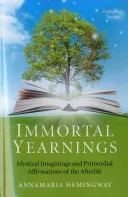
Immortal Yearnings
 79
79

Immortal Yearnings
Annamaria Hemingway’s *Immortal Yearnings* grapples with the elusive nature of mystical experience, focusing on the symbolic language that arises from these altered states. The book's strength lies in its persistent attempt to articulate the ineffable, drawing connections between subjective encounters with unity and the objective reality of mortality. Hemingway posits that these symbolic resonances can serve as vital conduits to a perceived eternal realm, offering solace and expanded awareness in the face of life's inevitable conclusion. A particularly resonant section discusses the archetypal 'Pilgrim' motif, suggesting its recurrence across cultures signifies a shared human yearning for transcendence. However, the work occasionally falters in its abstraction; while it identifies the 'ineffable' and 'fleeting' qualities of mystical states, it sometimes struggles to provide concrete analytical frameworks beyond the symbolic itself. Hemingway's exploration of 'universal imaginings' could benefit from more direct engagement with specific symbolic traditions or mythological structures, rather than treating them as a monolithic entity. Despite this, *Immortal Yearnings* offers a thoughtful contemplation on consciousness, symbolism, and the human condition, making it a valuable addition for those who ponder life's ultimate questions.
📝 Description
79
Annamaria Hemingway's 2012 book, Immortal Yearnings, argues mystical states reveal truths through universal symbols.
Immortal Yearnings examines the nature of mystical consciousness and the archetypal symbols that appear within it. Hemingway suggests these symbols provide insight into a unified reality that exists beyond ordinary perception. The book acknowledges that life ends in mortality, but argues that engaging with these universal symbolic patterns can deepen our understanding of existence itself. It is written for individuals interested in the connections between consciousness, symbolism, and metaphysics. Those who study comparative mysticism, the psychology of altered states, or the philosophy of transcendent experiences will find relevant material.
Hemingway's central idea is that fleeting mystical states uncover deep truths via shared symbols. She proposes these symbols are not just psychological artifacts but indicators of an underlying unity. The book discusses how death, often viewed as a finality, can be reconsidered when we grasp our link to this enduring reality. By articulating these universal imaginings, she believes, we can improve our perception of life's more significant meaning.
Published in 2012, Immortal Yearnings engages with contemporary consciousness studies and non-dual philosophies. It enters a conversation alongside thinkers like Ken Wilber and scholars of Jungian psychology, who also mapped consciousness and archetypes. The work implicitly connects to the perennial philosophy, the idea that diverse religious traditions share a common source of wisdom.
💡 Why Read This Book?
• Gain a framework for understanding the symbolic echoes of mystical states, as Hemingway explores how symbols like the 'unified eternal reality' offer conceptual anchors beyond fleeting experiences, referencing the 2012 publication date. • Reframe your perspective on mortality by examining how the work invites engagement with 'universal imaginings' and their potential to enrich perception, moving beyond a singular focus on death as an endpoint. • Develop a deeper appreciation for the perennial philosophy by exploring how Hemingway connects archetypal symbolism to a perceived underlying unity, a concept echoed in Aldous Huxley's mid-20th century popularization of the idea.
⭐ Reader Reviews
Honest opinions from readers who have explored this book.
❓ Frequently Asked Questions
What is the central thesis of Annamaria Hemingway's Immortal Yearnings?
The book posits that mystical states of consciousness, though fleeting, communicate profound truths through archetypal symbols. Hemingway suggests these symbols reveal our connection to a unified, eternal reality, offering a means to enrich our perception of life and death.
When was Immortal Yearnings first published?
Immortal Yearnings was first published on October 26, 2012.
What kind of reader would appreciate Immortal Yearnings?
This book is suited for readers interested in mysticism, consciousness studies, symbolism, and comparative religion. It appeals to those who ponder the relationship between subjective spiritual experiences and the broader human condition.
Does the book offer practical exercises for achieving mystical states?
While the book focuses on the interpretation and significance of mystical states and their symbolism, it does not primarily offer practical techniques for inducing such states. Its emphasis is on understanding their meaning and symbolic content.
How does Immortal Yearnings approach the concept of death?
Instead of viewing death as a definitive end, the book suggests that by understanding the symbolism of mystical states and our connection to an eternal reality, we can perceive death as part of a larger, unified existence.
What is the relationship between symbols and mystical states in the book?
Hemingway argues that symbols are the primary language through which mystical states communicate. These symbols, arising from 'universal imaginings,' are presented as powerful indicators of a reality that transcends ordinary human comprehension.
🔮 Key Themes & Symbolism
Archetypes and Universal Symbols
The work looks at how archetypal symbols emerge from mystical states of consciousness. Hemingway posits these are not random but expressions of a shared human psyche, pointing towards a fundamental unity. These symbols act as a bridge, allowing us to perceive aspects of reality that lie beyond our everyday sensory experience, offering a glimpse into what the book calls a 'unified eternal reality'.
Consciousness and Transcendent Reality
A core theme is the exploration of states of consciousness that transcend ordinary perception. The book suggests that these ephemeral experiences, often characterized by feelings of unity and timelessness, are crucial indicators of a deeper, underlying reality of which we are an intrinsic part. It challenges the limitations of our usual cognitive frameworks.
Mortality and Eternal Perspective
Immortal Yearnings confronts the inevitability of death but reframes it through the lens of transcendent awareness. By engaging with the symbolism found in mystical states and 'universal imaginings,' the book proposes that we can cultivate a perception that enriches our understanding of life's pilgrimage. This perspective shifts the focus from death as an absolute end to an event within a larger, ongoing existence.
Symbolism as Perception Enrichment
The book argues for the power of symbolism to expand human perception. By consciously engaging with and giving voice to the symbolic language arising from profound states of consciousness, readers are encouraged to see beyond superficial appearances. This symbolic engagement is presented as a method for enriching our lived experience and our grasp of existence's deeper currents.
💬 Memorable Quotes
Direct passages from the work, attributed to the author.
“they act as powerful reminders that it is possible to transcend our limited understanding to glimpse a unified eternal reality, which we are part of.”
— This highlights the book's optimistic view of mystical experiences, positioning them not as mere illusions but as verifiable glimpses into a more fundamental, interconnected existence.
“The pilgrimage of life ends in death--there is no denial of this fact.”
— This acknowledges the stark reality of mortality, setting the stage for the book's exploration of how symbolic understanding can offer a different perspective on this universal human experience.
“we are asked to consider whether by giving the symbolism from universal imaginings a voice, we can use our perception to enrich our myt[hical understanding]”
— This highlights the book's invitation to the reader, suggesting a proactive role in interpreting symbolic language derived from the collective unconscious to enhance one's worldview.
💡 Key Ideas
Editorial paraphrase of the work's core concepts — not direct quotes.
The archetypal and symbolic qualities of mystical states of consciousness are ineffable, timeless, and fleeting.
This quote captures the book's central challenge: how to discuss experiences that are inherently difficult to describe and transient, yet hold profound meaning.
by giving the symbolism from universal imaginings a voice, we can use our perception to enrich our myt[hical understanding]
This paraphrased concept emphasizes the book's core thesis: actively engaging with symbolic content from deep within consciousness can fundamentally alter and deepen our understanding of reality and our place within it.
🌙 Esoteric Significance
Tradition
The work draws implicitly from the perennial philosophy, suggesting a universal wellspring of wisdom accessible through various spiritual paths. It aligns with Jungian psychology's exploration of archetypes as universal psychic structures. While not strictly Hermetic or Gnostic, it shares with these traditions an emphasis on inner knowledge and the uncovering of hidden realities through symbolic interpretation.
Symbolism
Key symbols explored include the concept of a 'unified eternal reality,' representing a state of interconnectedness beyond individual existence. The 'pilgrimage of life' ending in death is also a central symbolic motif, reframed by the possibility of transcendence. The work references 'universal imaginings,' suggesting a collective symbolic reservoir accessible through mystical states.
Modern Relevance
Contemporary thinkers in consciousness studies and depth psychology continue to explore the implications of non-ordinary states. Writers focusing on the intersection of spirituality and neuroscience, or those seeking to integrate symbolic understanding into therapeutic practices, might find Hemingway's framework relevant for understanding the language of the psyche and its potential for insight.
👥 Who Should Read This Book
• Students of Jungian psychology: Gain insight into how archetypal symbolism functions within mystical experiences and its connection to the collective unconscious. • Explorers of comparative mysticism: Understand how the book connects diverse spiritual yearnings through a focus on universal symbolic language and the concept of an eternal reality. • Philosophically inclined readers: Engage with a text that contemplates the nature of consciousness, perception, and the human confrontation with mortality.
📜 Historical Context
Annamaria Hemingway's *Immortal Yearnings*, published in 2012, entered a discourse already rich with explorations of consciousness and spirituality. The early 21st century saw continued academic and popular interest in Jungian psychology, particularly its concepts of archetypes and the collective unconscious, which heavily influence Hemingway's approach. This period also witnessed a resurgence of interest in comparative mysticism and perennial philosophy, building on the work of figures like Aldous Huxley, who championed the idea of a unified spiritual truth underlying diverse traditions. Hemingway's work implicitly engages with this lineage. While not directly engaging with censorship, the book operates within a broader cultural context where explorations of non-ordinary states and esoteric symbolism gained traction through New Age movements and academic inquiries into altered consciousness, contrasting with more materialist philosophical viewpoints prevalent in some academic circles.
📔 Journal Prompts
The 'unified eternal reality' as a concept: how does it contrast with your daily experience?
Reflect on symbols that have appeared in dreams or heightened states; what might they signify?
Consider the 'pilgrimage of life' – what symbolic representations resonate with your journey?
How does giving 'universal imaginings' a voice alter your perception of the ineffable?
Explore the relationship between acknowledging death and glimpsing eternal reality.
🗂️ Glossary
Mystical States of Consciousness
Experiences characterized by profound feelings of unity, timelessness, transcendence, and altered perception, often associated with spiritual or contemplative practices.
Archetypal Qualities
Fundamental patterns of thought, behavior, or imagery that are believed to be innate and universal, often manifesting in myths, dreams, and religious symbolism.
Unified Eternal Reality
A concept suggesting an underlying, interconnected existence that is perceived as timeless and beyond the limitations of ordinary human consciousness and the physical world.
Universal Imaginings
Refers to the symbolic content and imagery that are thought to arise from a collective human psyche, accessible through states of heightened awareness or intuition.
Pilgrimage of Life
A metaphor for the human journey through life, emphasizing its transient nature and eventual culmination in death, viewed as a path with inherent meaning and symbolic significance.
Symbolism
The practice or interpretation of using symbols – images, objects, or concepts – to represent deeper meanings, ideas, or spiritual realities.
Perception
The way in which something is regarded, understood, or interpreted; in this context, it refers to how we understand and experience reality, particularly through symbolic engagement.