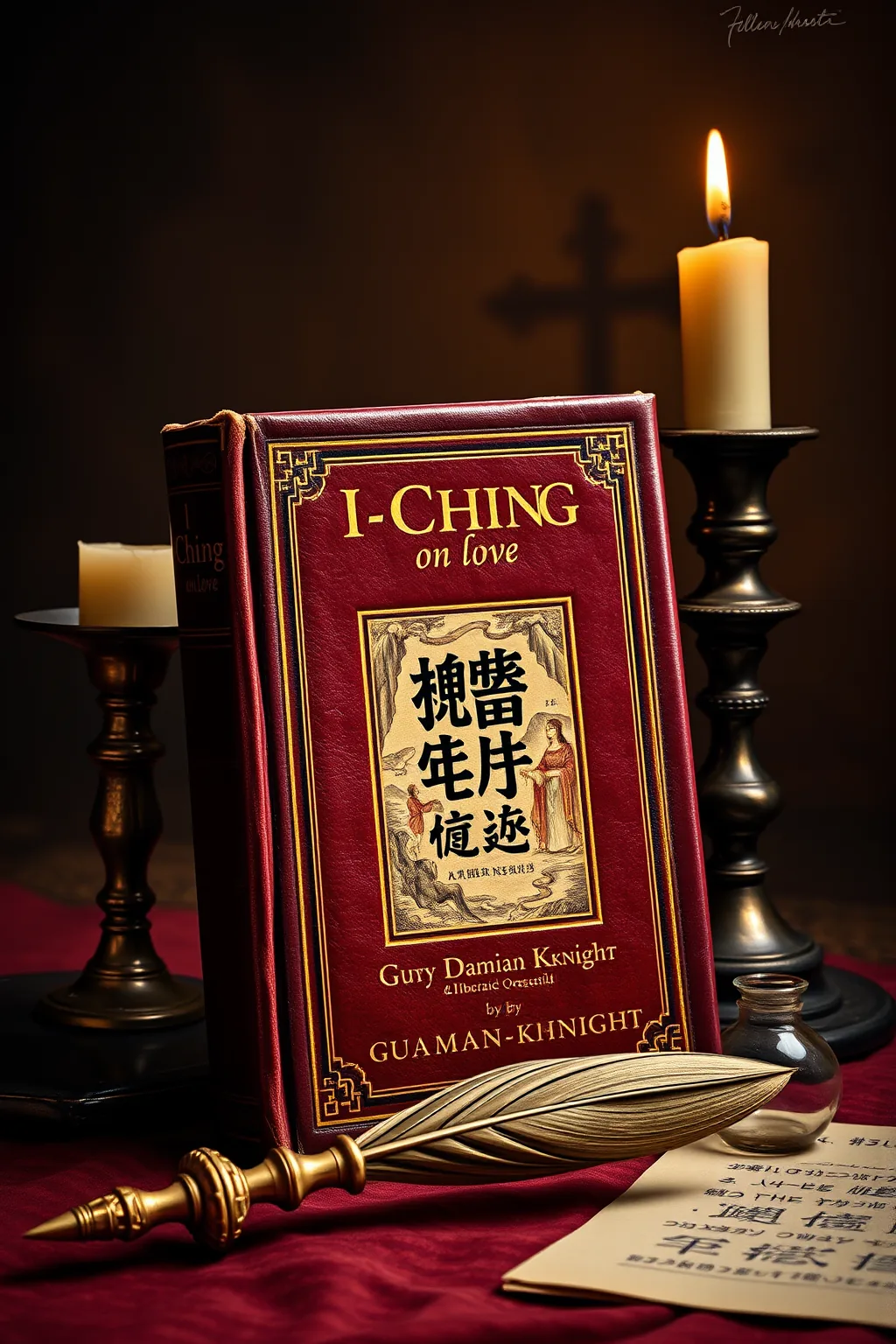
I Ching on love
 71
71

I Ching on love
Damian-Knight's attempt to map the profound, millennia-old wisdom of the I Ching onto the often messy terrain of human affection is an ambitious undertaking. The strength of "I Ching on Love" lies in its earnest effort to bridge these seemingly disparate worlds. Its most compelling aspect is the re-framing of hexagrammatic change as relational evolution, offering a structured yet flexible lens through which to view the ebb and flow of partnerships. However, the work occasionally falters under the weight of its own interpretive leaps. While the 1984 publication date explains some of the era's psychological framing, the direct correlation of certain hexagrams to specific romantic scenarios can feel forced, lacking the subtle ambiguity that makes the original I Ching so potent. A passage discussing Hexagram 28, "Great Exceeding," as solely representing overwhelming romantic pressure, for instance, might overlook its broader applications of structural excess. Ultimately, "I Ching on Love" provides an intriguing, if sometimes overly literal, framework for contemplating relationships through an ancient oracle.
📝 Description
71
Guy Damian-Knight's 1984 book applies the I Ching to romantic relationships.
Guy Damian-Knight's "I Ching on Love" was published in 1984. It adapts the ancient Chinese oracle, the I Ching, to examine romantic relationships and interpersonal dynamics. The book maps the I Ching's hexagrams and their texts onto the cycles and challenges inherent in love. It aims to help readers interpret relationship patterns and find wisdom within the I Ching's philosophical structure.
This work is for individuals interested in using Eastern wisdom traditions to understand Western relationship concerns. It will appeal to practitioners of esoteric studies who wish to combine different symbolic systems. Those already familiar with the I Ching may find its application to romantic psychology a novel direction. Readers seeking a mix of philosophical thought and practical advice for personal development will find value here.
Published in 1984, "I Ching on Love" appeared during a period of increasing Western interest in Eastern philosophies. The New Age movement was popularizing concepts from various spiritual traditions, including Chinese thought. While the I Ching itself is an ancient text, its specific application to romantic psychology in this manner reflects a mid-20th-century esoteric trend. This trend involved blending ancient texts with modern psychological concerns, seeking symbolic interpretations for personal growth.
💡 Why Read This Book?
• Gain a novel framework for understanding relationship dynamics by mapping the 64 I Ching hexagrams onto stages of romantic connection, offering insights beyond typical psychological models. • Explore the philosophical underpinnings of love through the lens of Yin and Yang principles as applied to interpersonal harmony, as presented in the book's interpretations. • Discover practical applications for the I Ching's wisdom in personal growth and relationship guidance, moving beyond standard divination to a more integrated approach to life's challenges.
⭐ Reader Reviews
Honest opinions from readers who have explored this book.
❓ Frequently Asked Questions
What is the core philosophy behind using the I Ching for love?
The core philosophy applies the I Ching's ancient Chinese principles of change, Yin and Yang, and cosmic balance to interpret the dynamics of romantic relationships and personal connections.
When was 'I Ching on Love' first published?
'I Ching on Love' by Guy Damian-Knight was first published in 1984, reflecting esoteric trends of the late 20th century.
Does the book offer specific advice for different relationship problems?
Yes, the book maps the I Ching's hexagrams and their associated texts to various relationship scenarios, offering guidance for interpreting and navigating them.
Is this book suitable for beginners to the I Ching?
It can be, particularly for those interested in applying its principles to relationships, though some familiarity with the I Ching's structure might enhance the reading experience.
What esoteric tradition primarily influences this work?
The work primarily draws from the ancient Chinese tradition of the I Ching, reinterpreting its concepts through a Western esoteric and psychological lens.
How does the book differ from standard I Ching interpretations?
It specifically focuses on romantic and interpersonal relationships, applying the oracle's wisdom to the unique challenges and cycles found within human connection.
🔮 Key Themes & Symbolism
Hexagrammatic Relationship Mapping
The central theme is the systematic application of the I Ching's 64 hexagrams to represent distinct phases and archetypal patterns within romantic relationships. Each hexagram, from the initial creative impulse to eventual dissolution or transformation, is posited as a potential state of a partnership. This approach provides a structured, symbolic language for understanding relational dynamics, moving beyond simple fortune-telling to a deeper analysis of interpersonal energies and their shifts over time.
The Cycles of Love
This theme explores love not as a static state but as a dynamic process governed by cyclical forces, mirroring the philosophical underpinnings of the I Ching. The book interprets the changing lines of the hexagrams as indicators of progression, regression, or transformation within a relationship. It emphasizes understanding these cycles to foster growth, navigate conflict constructively, and appreciate the natural unfolding of connection, aligning with Taoist concepts of natural order.
Yin and Yang in Partnership
Damian-Knight utilizes the fundamental Taoist concepts of Yin (feminine, receptive, passive) and Yang (masculine, active, creative) to analyze the interplay of energies between partners. The balance, imbalance, and interaction of these forces, as represented by the trigrams within the hexagrams, are explored as key determinants of relational health and harmony. This provides a framework for understanding compatibility and complementarity in relationships.
Applied Divination for Intimacy
Beyond mere prediction, the book positions the I Ching as a tool for conscious self-reflection and relational wisdom. It encourages readers to consult the oracle not just for answers but for perspectives that illuminate their own roles and behaviors within relationships. This theme highlights the practical, therapeutic potential of applying ancient divination systems to modern emotional and interpersonal challenges.
💬 Memorable Quotes
Direct passages from the work, attributed to the author.
“The changing lines of the hexagrams mirror the shifting dynamics within a love affair.”
— This highlights the book's core thesis: that the dynamic, sequential nature of the I Ching's transformations can be directly correlated with the evolution and challenges experienced in romantic relationships over time.
“Understanding the interplay of Yin and Yang is crucial for relational harmony.”
— This emphasizes the foundational role of Taoist principles in the book's approach, suggesting that the balance between complementary energies is key to successful and fulfilling partnerships.
“Each hexagram offers a distinct perspective on the state of connection.”
— This points to the book's method of using the 64 archetypal symbols of the I Ching as specific diagnostic tools for analyzing the various conditions and challenges present in relationships.
“Love, like the Tao, flows through cycles of growth and stillness.”
— This interpretation connects the experience of love to broader cosmological principles found in Taoism, framing relationships as part of a natural, cyclical order that can be understood and worked with.
“Consulting the oracle provides insight into relational patterns.”
— This speaks to the practical application of the I Ching as presented in the book, suggesting it serves as a guide for self-awareness and understanding recurring themes within one's romantic life.
🌙 Esoteric Significance
Tradition
The work draws primarily from the ancient Chinese philosophical and divinatory tradition of the I Ching. However, it reinterprets and applies these principles through a Western esoteric and psychological lens, characteristic of mid-to-late 20th-century esoteric movements. It bridges the gap between Taoist cosmology and contemporary Western concepts of relationship dynamics and personal development, offering a syncretic approach.
Symbolism
Key symbols include the 64 hexagrams, each representing a specific archetypal situation or pattern in human affairs, here applied to love. The trigrams, composed of Yin and Yang lines, symbolize the fundamental interplay of complementary forces (e.g., masculine/feminine, active/receptive) within relationships. The concept of 'change' (Bian) itself is a central symbolic motif, representing the dynamic, evolving nature of both the cosmos and human connection.
Modern Relevance
Contemporary thinkers and practitioners in fields like transpersonal psychology, modern Hermeticism, and relationship coaching may find value in its structured approach to relational archetypes. Its blend of ancient symbolism with psychological application speaks to modern efforts to integrate spiritual wisdom into everyday life, offering a unique perspective for those exploring diverse methods of self-understanding and interpersonal growth.
👥 Who Should Read This Book
• Individuals familiar with the I Ching seeking to expand its application beyond traditional divination into relational analysis and personal growth. • Practitioners of Western esotericism interested in exploring cross-cultural symbolic systems and their relevance to modern psychological concerns. • Readers seeking a philosophical framework for understanding the cycles and dynamics of love and intimacy, presented through an ancient oracle's wisdom.
📜 Historical Context
Published in 1984, Guy Damian-Knight's "I Ching on Love" emerged during a period of significant interest in synthesizing Eastern spiritual traditions with Western psychological and esoteric frameworks. The late 20th century saw a proliferation of New Age literature that sought to integrate ancient wisdom with contemporary concerns. While the I Ching itself has a history spanning over three millennia, its specific application to romantic psychology reflected a trend that gained traction from figures like Carl Jung, who explored archetypal patterns in the I Ching, and continued through various esoteric authors. This era also saw a burgeoning interest in self-help and personal growth, making texts that offered practical guidance for relationships particularly appealing. Damian-Knight's work can be seen as contributing to a broader esoteric discourse that sought to explain and adapt ancient oracles for modern sensibilities, diverging from purely academic or traditional Chinese interpretations.
📔 Journal Prompts
The Hexagram 28, Great Exceeding, and its implications for relationship pressure.
Reflecting on the Yin and Yang balance within a significant past or present relationship.
How the concept of 'change' as presented in the I Ching applies to your romantic journey.
Interpreting a specific relationship challenge through the lens of a chosen hexagram.
The cyclical nature of love as mirrored by the I Ching's sequential transformations.
🗂️ Glossary
I Ching
An ancient Chinese divination text and philosophical classic, also known as the Book of Changes. It comprises 64 hexagrams, each formed by six stacked horizontal lines, which can be either solid (Yang) or broken (Yin).
Hexagram
A figure composed of six stacked horizontal lines, representing a specific situation or archetypal state. Each hexagram is formed by combining two trigrams and has a unique name and associated text.
Trigram
A figure composed of three stacked horizontal lines, each either solid (Yang) or broken (Yin). The eight trigrams are fundamental building blocks of the hexagrams and represent basic natural forces and concepts.
Yin
In Taoist philosophy, Yin represents the passive, dark, feminine, and receptive principles of the universe. It is often symbolized by broken lines in the I Ching.
Yang
In Taoist philosophy, Yang represents the active, light, masculine, and creative principles of the universe. It is often symbolized by solid lines in the I Ching.
Tao
The fundamental principle of the universe in Taoism; the 'Way.' It represents the natural order, the source, and the driving force behind all existence, characterized by constant change and balance.
Change (Bian)
A core concept in the I Ching, signifying the dynamic, ever-evolving nature of reality. The text emphasizes understanding and adapting to continuous transformation as a fundamental aspect of existence.
🔮 Readers Also Liked
Browse all →








More by Guy Damian-Knight
All books →





More Free Occult Philosophy Books
View all →