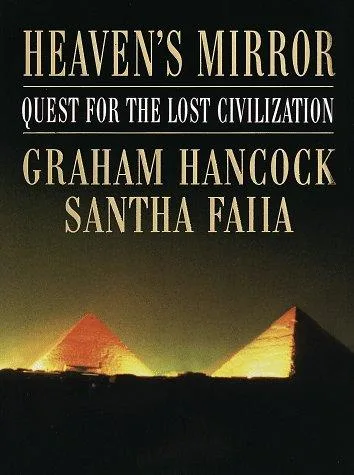
Heaven's Mirror
 71
71

Heaven's Mirror
The ambitious scope of "Heaven's Mirror" is its most striking feature, attempting to link disparate ancient cultures through a narrative of a lost Ice Age civilization. Hancock and Faiia marshal an impressive array of evidence, from the astronomical alignments of megalithic sites to flood myths found across continents, painting a vivid picture of a forgotten past. Their exploration of the Pleiades constellation's significance in numerous myths, for instance, is particularly compelling.
However, the work's speculative leaps can sometimes strain credulity. While the authors effectively highlight anomalies and unanswered questions in mainstream archaeology, their conclusions often rely on interpretations that are not universally accepted within academic circles. The sheer volume of information presented, while thorough, occasionally feels like an accumulation of suggestive coincidences rather than definitive proof.
Read more ↓
Despite these reservations, "Heaven's Mirror" offers a valuable challenge to established historical paradigms, encouraging readers to look beyond conventional explanations for humanity's ancient origins. It remains a significant work for those investigating alternative histories.
📝 Description
71
### What It Is Heaven's Mirror, co-authored by Graham Hancock and Santha Faiia, presents a detailed investigation into ancient civilizations, their astronomical knowledge, and potential global cataclysms. Published initially in 2000, the work posits that a sophisticated global culture existed during the last Ice Age, a civilization whose memory has been deliberately suppressed or lost to subsequent ages. The book examines archaeological evidence, myths, and sacred texts from disparate cultures, seeking common threads of a forgotten history.
### Who It's For This volume is geared toward readers interested in alternative historical narratives, ancient mysteries, and the potential for lost civilizations to have influenced human development. It will appeal to those who question mainstream archaeological timelines and seek evidence for advanced ancient societies predating accepted historical records. Individuals intrigued by comparative mythology and the interpretation of celestial alignments in ancient structures will find material to consider.
### Historical Context Hancock and Faiia's work emerged within a milieu of renewed interest in ancient astronaut theories and non-mainstream archaeology, following figures like Erich von Däniken. The late 20th century saw a growing academic and popular fascination with pre-diluvian myths and the possibility of advanced ancient technologies. This book arrived after Hancock's earlier success with "Fingerprints of the Gods" (1995), which similarly challenged conventional historical chronologies and archaeological consensus. The reception was polarized, with critics often dismissing its speculative nature, while proponents found its synthesis of disparate evidence compelling.
### Key Concepts The core of "Heaven's Mirror" revolves around the concept of a highly advanced, pan-global civilization that flourished before the end of the last glacial period, approximately 12,000 years ago. This civilization, according to the authors, possessed advanced astronomical understanding and was responsible for monumental constructions across the globe. They argue that the memory of this epoch survived in the form of global flood myths and astronomical allegories embedded in sacred sites and texts, serving as a "mirror" to a lost golden age. The book also explores the idea of cyclical cataclysms, such as comet impacts, as agents of historical disruption.
💡 Why Read This Book?
• Gain a new perspective on the origins of civilization by examining evidence for advanced societies existing before the last Ice Age, challenging conventional timelines of human development. • Understand the author's theory of a global cataclysm around 12,000 BCE and its potential impact on recorded history and subsequent myths. • Explore the authors' interpretation of astronomical alignments in ancient sites, such as those discussed concerning the Pleiades, as remnants of sophisticated ancient knowledge.
⭐ Reader Reviews
Honest opinions from readers who have explored this book.
❓ Frequently Asked Questions
What is the central argument of Graham Hancock's "Heaven's Mirror"?
The book argues for the existence of a sophisticated global civilization that flourished during the last Ice Age, approximately 12,000 years ago, which was subsequently destroyed by a cataclysm.
What kind of evidence does "Heaven's Mirror" present?
It draws on archaeological findings, comparative mythology, ancient astronomical observations, and interpretations of sacred texts from various cultures worldwide.
When was "Heaven's Mirror" first published?
The book was first published in the year 2000.
Who are the authors of "Heaven's Mirror"?
The book is authored by Graham Hancock and Santha Faiia.
Does "Heaven's Mirror" discuss specific ancient sites?
Yes, the work examines numerous ancient sites, including megalithic structures and astronomical observatories, to support its thesis about a lost global civilization.
What is the significance of the 'mirror' in the book's title?
The title refers to the idea that myths and sacred sites act as a 'mirror' reflecting a lost golden age or a forgotten history of advanced civilizations from the distant past.
🔮 Key Themes & Symbolism
Lost Ice Age Civilization
The central thesis posits a highly advanced global society that existed before the end of the last glacial period, around 12,000 BCE. Hancock and Faiia contend that this civilization possessed sophisticated knowledge of astronomy and engineering, capable of constructing monumental structures. They argue that evidence for this society has been overlooked or suppressed by mainstream archaeology, which favors a more linear progression of human development. The book presents a compelling case for re-evaluating our understanding of prehistoric human capabilities and the true origins of civilization.
Global Cataclysm and Flood Myths
A significant portion of the book is dedicated to the theory that a catastrophic event, possibly a comet impact or massive flooding, occurred around the end of the last Ice Age, wiping out this advanced civilization. The authors meticulously trace parallels between flood narratives found in disparate cultures worldwide, suggesting a shared memory of this cataclysm. These myths, they argue, are not mere folklore but fragmented historical accounts of a world-altering disaster that reset human civilization.
Ancient Astronomical Knowledge
The work emphasizes the profound astronomical understanding of ancient peoples. Hancock and Faiia explore how numerous ancient sites, from the pyramids of Giza to Gobekli Tepe, are aligned with celestial bodies and events, such as the precession of the equinoxes. They propose that this knowledge was passed down from the lost civilization and was crucial for the development of subsequent cultures, serving as a guide and a record of a forgotten epoch.
Suppressed History and Alternative Archaeology
"Heaven's Mirror" champions the idea that mainstream historical and archaeological narratives have either consciously or unconsciously ignored evidence that contradicts established timelines. The authors position their work as a challenge to orthodoxies, encouraging readers to consider alternative interpretations of ancient artifacts, myths, and ruins. They suggest a hidden history waiting to be uncovered, one that reveals a much older and more complex human past than commonly accepted.
💬 Memorable Quotes
“The myths of the world speak of a golden age, a time of gods on Earth, which was drowned in a great flood.”
— This statement encapsulates the core argument that global flood myths are not allegorical but represent a collective memory of a real, devastating event that ended a prior advanced civilization.
“Ancient sites across the globe are aligned with celestial events, indicating a shared astronomical heritage.”
— This highlights the authors' focus on the precision of ancient builders' knowledge of the cosmos, suggesting that such sophisticated understanding points to a common, advanced origin.
“We are the inheritors of a forgotten epoch.”
— This phrase suggests that current humanity is unknowingly descended from or influenced by a technologically and culturally advanced civilization that predates recorded history.
“The memory of a lost world persists in our sacred traditions and monuments.”
— This interpretation emphasizes the book's premise that ancient myths and the architecture of megalithic sites serve as enduring, albeit cryptic, testaments to a civilization that otherwise vanished.
“The evidence points towards a global civilization that existed before the last Ice Age.”
— This is a direct assertion of the book's central thesis, framing the subsequent arguments as evidence supporting a radical reinterpretation of human prehistory.
🌙 Esoteric Significance
Tradition
While not strictly adhering to a single esoteric lineage, "Heaven's Mirror" draws heavily from the Gnostic and Hermetic traditions' concept of lost golden ages and cyclical epochs of destruction and rebirth. It echoes the Theosophical ideas of ancient root races and cataclysmic events that reshaped the world. The work engages with the Hermetic principle of "As Above, So Below" by linking terrestrial history and human civilization to celestial patterns and cosmic cycles.
Symbolism
The Pleiades constellation features prominently as a recurring symbol, interpreted by Hancock and Faiia as a celestial marker of a lost civilization and a key to understanding ancient astronomical calendars. Another significant motif is the 'World Tree' or axis mundi, found in numerous mythologies, which they suggest represents a connection between the earthly realm and a higher, possibly divine, intelligence or civilization from which humanity originated or received knowledge.
Modern Relevance
Contemporary thinkers in fields like archaeoastronomy, ancient astronaut theory, and alternative history continue to cite and build upon Hancock's theories presented in "Heaven's Mirror." The book's exploration of lost knowledge and ancient wisdom resonates with modern spiritual movements and proponents of 'New Age' philosophies that seek ancient roots for contemporary spiritual practices and consciousness. It remains a foundational text for those exploring non-mainstream interpretations of human origins and ancient global connections.
👥 Who Should Read This Book
• Enthusiasts of ancient mysteries and alternative history seeking a comprehensive overview of theories regarding lost civilizations and global cataclysms. • Students of comparative mythology interested in the authors' analysis of flood myths and celestial allegories across diverse cultures. • Readers questioning mainstream archaeological timelines who are open to speculative interpretations of evidence for prehistoric advanced societies.
📜 Historical Context
Published in 2000, "Heaven's Mirror" arrived at a time when Graham Hancock was already a prominent, albeit controversial, voice in alternative history circles, following the success of "Fingerprints of the Gods" in 1995. The late 20th century witnessed a resurgence of interest in ancient mysteries, pre-diluvian civilizations, and pseudoarchaeology, fueled by popular media and a growing distrust of established academic narratives. Hancock’s work tapped into this zeitgeist, proposing a radical revision of human history. It stood in stark contrast to the prevailing consensus in archaeology and anthropology, which emphasized a gradual, linear development of civilization from hunter-gatherer societies. While academics like Colin Renfrew were publishing works on the origins of culture that emphasized slow diffusion and innovation, Hancock and Faiia sought evidence for a sudden, globally disseminated advanced culture that was lost. The book's reception was largely polarized, with many academic reviews dismissing its speculative nature and reliance on anecdotal evidence, while popular audiences found its synthesis of myths and archaeology compelling.
📔 Journal Prompts
The memory of a lost world: how do global flood myths reflect a potential shared historical trauma?
Celestial alignments in ancient sites: what does the Pleiades' recurring significance suggest about ancient astronomical focus?
The concept of a lost Ice Age civilization: what evidence, if any, do you find most compelling or questionable?
Echoes of a forgotten epoch: reflect on how current societies might be unknowingly influenced by ancient knowledge.
The 'mirror' of myths: how do symbolic narratives of the past shape our understanding of the present?
🗂️ Glossary
Precession of the Equinoxes
A slow wobble in Earth's axis that causes the position of the stars to shift relative to the equinoxes over thousands of years, a phenomenon the authors believe ancient cultures understood and encoded in their monuments.
Megalithic
Relating to or constructed with large stones, typically referring to prehistoric structures such as Stonehenge or the pyramids.
Pleiades
A star cluster in the constellation Taurus, which the authors suggest holds significant meaning in the myths and astronomical observations of many ancient cultures.
Ice Age
A period of prolonged glaciation, the last of which, the Pleistocene epoch, ended around 11,700 years ago. The authors propose a sophisticated civilization existed during this time.
Cataclysm
A violent natural event, such as a flood or impact event, which the authors propose was responsible for the destruction of the hypothesized advanced prehistoric civilization.
Axis Mundi
A concept representing the center of the world or a connection between heaven and earth, often depicted as a cosmic tree or pillar, found in various mythologies.
Flood Myths
Stories from numerous cultures describing a great flood that destroyed humanity, which the authors interpret as literal accounts of a global cataclysm.