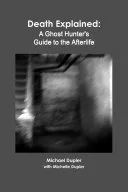
Death Explained: A Ghost Hunter's Guide to the Afterlife
 83
83

Death Explained: A Ghost Hunter's Guide to the Afterlife
Michael Dupler’s *Death Explained* tackles the perennial question of what happens after we die, not with pronouncements of faith, but with an ambitious synthesis of science, history, and personal experience. The book’s strength lies in its attempt to bridge the gap between ghost hunting anecdotes and rigorous theoretical speculation, drawing from physics and anthropology to offer a coherent, albeit speculative, model of post-mortem existence. Dupler’s exploration of "residual consciousness" as a potential explanation for hauntings is particularly compelling, moving beyond simple spectral apparitions to suggest an energetic imprint. However, the very breadth of its interdisciplinary approach occasionally leads to a diffusion of focus; at times, the physics discussions feel more illustrative than foundational. A passage where Dupler connects the scientific concept of entanglement to potential spiritual connections is illustrative of both the book's ambition and its occasional conceptual stretch. Ultimately, *Death Explained* provides a stimulating, if not definitive, perspective for those grappling with the mysteries of mortality and the spectral realm.
📝 Description
83
Michael Dupler's 2013 book argues consciousness persists beyond physical death.
Death Explained: A Ghost Hunter's Guide to the Afterlife puts forward a theoretical structure for understanding spectral events and what happens after death. Michael Dupler combines insights from various academic fields and his own paranormal investigations to build his case. The book suggests that consciousness might continue after the body ceases to function, with explanations drawn from physics, anthropology, history, philosophy, and religious studies. It attempts to create a coherent account of human existence and explore fundamental questions about life's continuation.
This book is for anyone interested in the overlap between the paranormal, philosophy, and scientific thought. Amateur and experienced ghost hunters who want a theoretical basis for their experiences may find it useful, as will skeptics willing to consider unusual ideas about consciousness and the afterlife. Readers interested in comparative religion, the history of consciousness studies, and speculative physics will also discover value. Those who question the ultimate fate of the soul and seek structured explanations beyond standard beliefs are especially suited for this work.
Published in 2013, this book engages with ongoing discussions about consciousness, parapsychology, and the philosophical questions surrounding life after death. It emerges from a period of renewed interest in spiritualism and near-death experiences, aiming for a more unified perspective. Dupler's work connects with a larger effort to bring legitimacy to paranormal research through varied academic approaches. It references concepts found in traditions from ancient Egyptian views on the soul to contemporary quantum theories, bridging historical beliefs with modern scientific speculation.
💡 Why Read This Book?
• Gain a structured theoretical model for understanding spectral phenomena, moving beyond anecdotal accounts to explore concepts like "residual consciousness," as detailed in Dupler's synthesis of physics and anthropology. • Understand the historical and cross-cultural significance of death rituals and beliefs about the afterlife, as Dupler examines these from an anthropological perspective. • Explore speculative connections between quantum physics and the persistence of consciousness, offering a unique lens through which to view post-mortem existence beyond traditional religious dogma.
⭐ Reader Reviews
Honest opinions from readers who have explored this book.
❓ Frequently Asked Questions
What is Michael Dupler's primary theory about ghosts in Death Explained?
Dupler proposes the concept of 'residual consciousness,' suggesting that strong emotional or experiential imprints can linger in environments after a person's death, manifesting as spectral phenomena.
Which academic fields does Death Explained draw upon?
The book integrates insights from physics, anthropology, history, philosophy, and religion to construct its theories about the afterlife and ghost phenomena.
When was Death Explained first published?
Michael Dupler's Death Explained was first published in July 2013.
What is the author's background related to the subject matter?
Michael Dupler brings personal experience as a ghost hunter in the Midwestern United States to the book, grounding his theoretical explorations in practical investigation.
Does the book offer practical advice for ghost hunters?
Yes, the book includes tips and advice for individuals engaged in ghost hunting, drawing from the author's experiences and theoretical framework.
What is the main question Death Explained attempts to answer?
The book primarily seeks to provide a possible answer to one of humanity's greatest questions: what happens to us after we die.
🔮 Key Themes & Symbolism
Residual Consciousness Theory
Dupler posits 'residual consciousness' as a key concept, theorizing that intense emotional or experiential energies can become imprinted on locations. This framework moves beyond traditional spirit communication, suggesting that what ghost hunters often encounter are echoes or energetic imprints rather than sentient entities. The theory attempts to reconcile paranormal observations with principles of physics, proposing that consciousness might leave a detectable trace, akin to an energetic signature or memory embedded in the environment.
Anthropological Significance of Death
The work examines how various cultures across history have approached death and the afterlife. Dupler analyzes death rituals and funerary practices as evidence of a persistent human intuition or need to believe in continuation beyond physical death. This cross-cultural survey serves to contextualize the universal human preoccupation with mortality and the desire for understanding what lies beyond, highlighting common threads in beliefs about the soul and spirit.
Physics and Consciousness
Dupler explores potential parallels between concepts in modern physics, such as quantum entanglement and energy fields, and the nature of consciousness and its potential persistence after death. The book looks at how these scientific principles might offer a non-supernatural explanation for phenomena attributed to ghosts or spirits. This approach seeks to provide a rational, scientifically-informed basis for discussing the afterlife, moving beyond purely metaphysical or religious doctrines.
Ghost Hunting as Investigation
The book reframes ghost hunting not merely as a pursuit of the paranormal, but as a form of empirical investigation into the nature of consciousness and existence. Drawing on his personal experiences in the Midwest, Dupler offers practical advice informed by his theoretical models. He encourages a systematic approach, integrating personal observation with interdisciplinary research to better understand the phenomena encountered.
💬 Memorable Quotes
Direct passages from the work, attributed to the author.
“Cross-cultural death rituals reveal a universal human intuition about post-mortem existence.”
— This highlights Dupler's anthropological approach, indicating that consistent patterns in how societies handle death suggest an innate human belief or understanding of a continued existence.
“Ghost hunting requires a blend of empirical observation and theoretical grounding.”
— This reflects Dupler's view of paranormal investigation, emphasizing the need for both practical experience and a solid conceptual understanding to interpret findings effectively.
“Our greatest questions about existence may find answers in unexpected scientific and historical connections.”
— This interpretation suggests the book's core methodology: seeking answers to profound existential queries by synthesizing diverse fields of knowledge rather than relying on a single discipline.
💡 Key Ideas
Editorial paraphrase of the work's core concepts — not direct quotes.
The lingering energy of strong emotions can create environmental echoes.
This paraphrase expresses Dupler's 'residual consciousness' theory, suggesting that intense emotional events leave a detectable energetic imprint on locations, which may be perceived as hauntings.
Quantum principles might offer a framework for understanding disembodied awareness.
This paraphrased concept points to Dupler's attempt to link physics, specifically quantum mechanics, to the possibility of consciousness persisting independently of a physical body.
🌙 Esoteric Significance
Tradition
While not strictly adhering to a single esoteric lineage like Hermeticism or Kabbalah, Dupler's work interfaces with the broader Western Esoteric Tradition's enduring fascination with the nature of the soul, consciousness, and survival after death. It echoes Gnostic concerns with the material world as a potential veil and seeks to understand non-physical realities through a lens that bridges empirical observation and speculative philosophy, similar to how some Theosophical concepts explore consciousness beyond the physical form.
Symbolism
The book frequently engages with the concept of the 'echo' or 'imprint' as a symbol for residual consciousness, representing the lingering energetic signature of past events or individuals. Another motif is the 'veil' between life and death, symbolizing the perceived barrier between our physical reality and the potential afterlife, which Dupler attempts to deconstruct through scientific analogy. The 'ghost hunter' themselves can be seen as a modern symbol for the seeker of hidden knowledge, venturing into liminal spaces.
Modern Relevance
Dupler's work finds relevance in contemporary discussions surrounding consciousness in fields like neuroscience and artificial intelligence, particularly regarding the nature of subjective experience and whether consciousness is purely emergent from the brain. His interdisciplinary approach is echoed in modern transpersonal psychology and philosophical inquiries into the mind-body problem, inspiring those who seek non-materialist explanations for consciousness and its potential persistence beyond physical demise.
👥 Who Should Read This Book
• Individuals actively engaged in ghost hunting or paranormal investigation who seek a theoretical framework to contextualize their experiences, moving beyond anecdotal evidence. • Students of comparative religion and anthropology interested in the cross-cultural expressions of beliefs surrounding death and the afterlife, and how these might relate to observable phenomena. • Skeptics and open-minded inquirers interested in speculative science and philosophy who wish to explore unconventional hypotheses about consciousness, physics, and the possibility of post-mortem existence.
📜 Historical Context
Published in 2013, Michael Dupler's *Death Explained* emerged during a period of renewed popular and academic interest in consciousness studies and parapsychology, building on trends from the late 20th century. It arrived in a landscape populated by both traditional spiritualist literature and more scientifically-oriented explorations of near-death experiences and quantum consciousness theories. Dupler’s interdisciplinary approach, drawing from physics and anthropology, sought to provide a novel synthesis, distinguishing itself from purely metaphysical or religious treatises. His work can be seen as a contemporary iteration of the late 19th and early 20th-century efforts, like those of the Society for Psychical Research, to apply scientific methodology to the study of phenomena associated with the afterlife. Unlike more recent popularizations that might focus on specific paranormal investigation techniques, Dupler’s 2013 book aimed for a deeper theoretical underpinning, engaging with philosophical questions about identity and existence.
📔 Journal Prompts
The concept of 'residual consciousness' and its environmental imprints.
Reflecting on anthropological evidence of death rituals and their implications.
Exploring the connection between quantum physics principles and potential non-physical consciousness.
Analyzing personal experiences through the lens of Dupler's integrated theory.
The philosophical implications of identity persistence beyond physical dissolution.
🗂️ Glossary
Residual Consciousness
Dupler's hypothetical concept that strong emotional or experiential energies can leave an 'imprint' or 'echo' in a location after death, manifesting as paranormal phenomena.
Energetic Imprint
A term used to describe the lasting energetic signature or trace left behind by intense emotional events or prolonged human presence in a specific location.
Anthropological Significance
The study of human societies and cultures, particularly in this context, examining the universal patterns and meanings behind death rituals and beliefs about the afterlife across different cultures.
Quantum Entanglement Analogy
A metaphorical comparison drawn between the physics principle of entangled particles influencing each other instantaneously regardless of distance, and potential non-physical connections related to consciousness.
Disembodied Awareness
The hypothetical state of consciousness existing or persisting independently of a physical body, a concept explored in relation to theories of the afterlife.
Environmental Echoes
Similar to residual consciousness, this term refers to phenomena perceived in a location that are believed to be replays or lingering effects of past events or energies.
Post-Mortem Existence
The state or condition of continuing to exist in some form after physical death, a central theme addressed by the book's theoretical framework.