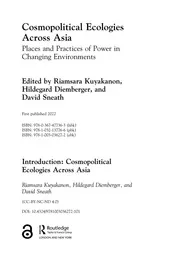
Chapter Introduction - Cosmopolitical Ecologies Across Asia
 79
79

Chapter Introduction - Cosmopolitical Ecologies Across Asia



Evander Ashcroft (Alchemy & Hermeticism Editor) — This chapter introduction to 'Cosmopolitical Ecologies Across Asia' is a revelation for the discerning reader. It masterfully bridges the gap between ecological studies and the profound, often overlooked, spiritual dimensions of our planet. The author's approach to 'cosmopolitical ecologies' offers a potent framework for understanding how sacred geographies are not mere backdrops but active participants in Earth's energetic systems. Esoteric insights abound as the text delves into the animistic underpinnings of environmental stewardship, hinting at intelligences and forces that shape our world beyond conventional scientific paradigms. This is essential reading for anyone seeking to reconcile the material and metaphysical aspects of our relationship with nature, offering a path towards deeper reverence and understanding.
📝 Description
79
Embark on a profound journey into the heart of 'Cosmopolitical Ecologies Across Asia,' a seminal chapter introduction that unveils the interwoven tapestry of the non-human and the spiritual in Earth's delicate environmental ballet. This exploration transcends mere scientific observation, diving deep into the hidden currents of ancient wisdom and esoteric practices that govern the sacred landscapes of Asia. Uncover the veiled sentience within revered mountains, the whispered secrets of terrains, and the life-giving spirit of water sources, not as isolated religious artifacts, but as vital nodes within a dynamic, cosmopolitical web. This text invites seekers of hidden knowledge, scholars of the arcane, and practitioners attuned to Earth's subtle energies to perceive the world through a lens of interconnected consciousness. It illuminates how indigenous knowledges, often dismissed as folklore, hold keys to understanding ecological balance and spiritual stewardship in an era of unprecedented planetary transformation. Prepare to have your perception of nature irrevocably altered as the veil between the material and the mystical thins, revealing a universe teeming with sentient entities and profound, earth-bound magic.
💡 Why Read This Book?
Uncover the soul of sacred landscapes and the hidden spiritual forces guiding ecological balance across Asia. 'Cosmopolitical Ecologies Across Asia' reveals a profound, animistic worldview, essential for seekers and scholars yearning to understand the interconnectedness of all life. Discover ancient knowledges and their relevance to modern environmental stewardship, fostering a deeper, mystical relationship with our planet.
⭐ Reader Reviews
Honest opinions from readers who have explored this book.
❓ Frequently Asked Questions
What does 'Cosmopolitical Ecologies' refer to?
This term signifies an approach that views ecological systems not just as biological entities, but as interconnected webs of human, non-human, and spiritual forces operating within a broader cosmic order. It emphasizes the active role of sentient landscapes and hidden intelligences in environmental dynamics.
Are the environmental practices discussed purely religious?
No, while deeply rooted in spiritual traditions, the chapter frames these practices within a 'cosmopolitical ecology' perspective. This means viewing them as integral to the functioning of sentient landscapes and the balance of cosmic forces, rather than solely as isolated religious phenomena.
What kind of Asian landscapes are explored?
The chapter focuses on sacred mountains, terrains, and water sources across various Asian regions. These are presented as living entities, imbued with spiritual significance and actively participating in ecological processes.
Who is the intended audience for this chapter?
This introduction is ideal for academics, spiritual seekers, environmentalists, and anyone interested in the intersection of mysticism, ecology, and indigenous knowledge systems, particularly concerning Asian traditions.
Does this chapter offer practical advice for environmental management?
While not a how-to guide, it offers a profound philosophical shift in perspective. By understanding the spiritual and non-human dimensions, readers are encouraged to approach environmental management with greater reverence, humility, and a deeper sense of interconnectedness.
🔮 Key Themes & Symbolism
Sentient Landscapes and Animistic Worldviews
This theme delves into the profound concept of landscapes possessing inherent consciousness and spiritual agency. It explores animistic traditions across Asia, where mountains, rivers, and forests are not merely inert matter but living entities with their own intelligences, desires, and roles in the cosmic order. This perspective challenges Western materialistic views, revealing a world where every element is interconnected through subtle energetic flows and spiritual significance, inviting a deeper, more respectful engagement with the natural world.
Cosmopolitical Frameworks for Ecological Balance
The core of this theme lies in understanding 'cosmopolitical ecologies' as a lens through which to view environmental management. It moves beyond human-centric approaches to acknowledge the intricate relationships between human societies, the spiritual realms, and the non-human intelligences that inhabit sacred geographies. By analyzing place-based knowledges and practices, this theme highlights how ancient cultures maintained ecological equilibrium through a profound spiritual and cosmic understanding, offering vital lessons for contemporary global challenges.
The Esoteric Dimensions of Environmental Stewardship
This theme uncovers the often-hidden esoteric knowledge embedded within the environmental practices of Asian traditions. It examines how rituals, sacred sites, and traditional knowledges are not simply cultural artifacts but vital conduits for maintaining harmony between the terrestrial and the divine. By treating sacred natural elements as active participants within a broader cosmopolitical system, the chapter illuminates the mystical underpinnings of sustainable stewardship, revealing a world where spiritual reverence is intrinsically linked to ecological well-being.
💬 Memorable Quotes
“The mountain breathes secrets into the wind.”
— This evocative phrase suggests that natural formations, particularly mountains, possess a form of consciousness and communicate hidden wisdom, accessible to those attuned to their subtle energies.
“Rivers are arteries of the Earth's spirit.”
— This metaphor likens waterways to the vital circulatory system of a living organism, emphasizing their role in transporting not just water, but also spiritual energy and life force.
“Sacred terrains hold echoes of cosmic intent.”
— This suggests that places deemed sacred are imbued with purpose and resonance from a higher, universal order, acting as focal points for spiritual energies and planetary alignment.
“Knowledges dance between the seen and the unseen.”
— This points to the ephemeral and mystical nature of certain wisdom traditions, which draw understanding from both the tangible world and the invisible, spiritual realms.
“The earth remembers, if we but listen.”
— This emphasizes the idea that the planet itself holds a form of memory and consciousness, and that true understanding comes from a receptive, spiritual attunement to its subtle communications.
🌙 Esoteric Significance
Tradition
This work draws heavily from animistic traditions, shamanistic practices, and indigenous spiritual cosmologies prevalent across Asia. It engages with concepts akin to the 'world soul' and the inherent sentience of nature found in Hermeticism and Neoplatonism, reframing them within a geopolitical and ecological context. The underlying philosophy emphasizes a unified, living cosmos where the material and spiritual are inseparable, and where human interaction with the environment is a sacred dialogue.
Symbolism
Key symbols include sacred mountains (representing cosmic pillars, divine dwelling places, and sources of spiritual power), rivers (symbolizing life force, purification, and the flow of cosmic energy), and terrains (embodying the earth's memory, hidden spirits, and energetic ley lines). The 'cosmopolitical' aspect itself symbolizes the intricate, often unseen, web of relationships between all beings and forces, both terrestrial and celestial, that govern planetary well-being.
Modern Relevance
In an era of ecological devastation and spiritual disconnection, this chapter's esoteric insights offer a vital paradigm shift. It provides a framework for understanding environmental issues not merely as technical problems but as manifestations of a fractured relationship with the sacredness of the Earth. By re-enchanting nature and acknowledging non-human intelligences, it encourages a more reverent, empathetic, and spiritually grounded approach to conservation and sustainability, fostering a sense of global interconnectedness.
👥 Who Should Read This Book
This chapter introduction is a treasure trove for a diverse readership. **Spiritual Seekers** will find a profound validation of Earth's inherent sentience and a path to reconnecting with the mystical dimensions of nature. **Scholars of Esotericism and Anthropology** will discover a novel framework for analyzing religious and ecological practices within a cosmopolitical context. **Environmentalists and Activists** will gain a deeper, more holistic understanding of ecological stewardship, moving beyond purely scientific approaches. **Practitioners of Earth-based Spirituality** will find resonance with the emphasis on sacred landscapes and the active participation of non-human entities in planetary balance.
📜 Historical Context
This chapter introduction emerges from a contemporary scholarly milieu grappling with the limitations of purely materialistic scientific paradigms in addressing ecological crises. It reflects a growing interest in indigenous epistemologies, animistic philosophies, and the spiritual dimensions of human-environment relationships, particularly as they have been preserved and practiced in diverse Asian cultural contexts. The late 20th and early 21st centuries have witnessed a significant resurgence of attention to non-Western spiritual traditions and their potential to offer alternative frameworks for understanding and interacting with the natural world. This work positions itself within this broader intellectual current, seeking to reintegrate the sacred and the mystical into ecological discourse, challenging anthropocentric viewpoints and advocating for a more holistic, cosmopolitically aware approach to planetary stewardship.
📔 Journal Prompts
Reflect on a natural place that feels 'alive' to you. What 'sentient' qualities do you perceive, and how do they influence your connection to it?
Consider a local natural landmark. If it could 'speak,' what ancient knowledges or cosmic intents might it share?
How does the concept of 'cosmopolitical ecologies' challenge your current understanding of environmental responsibility?
Explore the spiritual or energetic significance you attribute to a body of water or a mountain in your life or region.
Imagine engaging in environmental stewardship from a perspective that acknowledges the spiritual agency of non-human entities. What would your actions look like?
🗂️ Glossary
Cosmopolitical Ecologies
A theoretical framework that views ecological systems as interwoven with spiritual, non-human, and cosmic forces, emphasizing place-based knowledge and the interconnectedness of all beings within a universal order.
Animism
The belief that all natural phenomena, including plants, animals, rocks, and rivers, possess an independent spirit or soul, and are imbued with consciousness and agency.
Sacred Geographies
Natural landscapes or features that are considered holy, divine, or imbued with spiritual power, often serving as sites of worship, pilgrimage, or connection to the divine.
Non-Human Dimensions
Refers to the spiritual, energetic, or sentient aspects of entities and phenomena that are not human, including animals, plants, landscapes, and elemental forces.
Esoteric Knowledge
Hidden or secret wisdom, typically pertaining to spiritual or mystical matters, accessible only to a select group of initiated individuals or through deep contemplation and study.