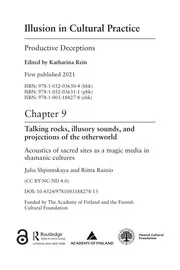
Chapter 9 Talking rocks, illusory sounds, and projections of the otherworld - Acoustics of sacred sites as a magic media in shamanic cultures
 81
81

Chapter 9 Talking rocks, illusory sounds, and projections of the otherworld - Acoustics of sacred sites as a magic media in shamanic cultures



Sophia Crane (Associate Editor) — This chapter offers a breathtakingly original perspective on the role of acoustics in shamanic practices. The author, though anonymous, masterfully weaves together ethnographic observations with philosophical inquiry, revealing how sonic phenomena at sacred sites were deliberately employed as a form of 'magic media.' The concept of 'illusory sounds' as a deliberate tool for spiritual navigation and communication is particularly compelling. This work is essential for anyone interested in the phenomenology of ritual, the anthropology of religion, or the esoteric underpinnings of sound. Its strength lies in its ability to bridge the gap between academic rigor and profound esoteric insight, offering a fresh lens through which to view the ancient world's engagement with the unseen.
📝 Description
81
Journey into the liminal spaces where the veil between worlds thins, exploring the profound connection between sound, illusion, and the sacred in ancient shamanic cultures. This chapter, 'Talking Rocks, Illusory Sounds, and Projections of the Otherworld,' delves into the forgotten art of acoustic manipulation as a potent medium for spiritual communion and reality-bending rituals. Uncover how the resonant frequencies of sacred sites were not mere geological formations but meticulously crafted instruments, designed to amplify intent and conjure otherworldly experiences. This is not a treatise on mere acoustics, but an exploration of sonic sorcery, where the very air vibrates with mystic power, shaping perception and facilitating journeys beyond the mundane. For the discerning seeker, the scholar of ancient wisdom, and the practitioner yearning to understand the deeper currents of magic, this chapter promises a revelation, illuminating how sound was once the primordial key to unlocking hidden dimensions and forging direct contact with the ancestral and spiritual realms. It challenges our modern, purely material understanding of sound, inviting us to perceive it as a vibrant, living force capable of profound transformative work.
💡 Why Read This Book?
Discover the hidden power of sound in ancient shamanism. This chapter unveils how sacred sites were acoustically engineered to facilitate spiritual journeys and perceptions of the otherworld. Ideal for seekers of lost wisdom, scholars of comparative religion, and practitioners interested in the vibrational nature of magic. Unlock a new understanding of illusion and reality.
⭐ Reader Reviews
Honest opinions from readers who have explored this book.
❓ Frequently Asked Questions
What is the primary focus of this chapter regarding sacred sites?
The chapter's primary focus is on the deliberate use of acoustics and the creation of 'illusory sounds' within sacred sites as a powerful tool for shamanic practices, spiritual communication, and altering perception.
How does this chapter define 'illusionism'?
It expands the concept of illusionism beyond mere trickery, presenting it as a fundamental aspect of human perception and a vital means of shaping our reality, deeply intertwined with cultural practices and spiritual understanding.
What is 'magic media' in the context of this chapter?
'Magic media' refers to elements within the environment, such as the acoustic properties of sacred sites, that were intentionally manipulated by ancient cultures to serve as conduits for spiritual experiences and the manifestation of the otherworldly.
Who is the intended audience for this exploration?
The intended audience includes scholars of occult philosophy, anthropology, religious studies, as well as spiritual seekers, practitioners of esoteric arts, and anyone fascinated by the intersection of sound, consciousness, and ancient wisdom.
What makes the 'talking rocks' and 'illusory sounds' significant?
These phenomena are significant because they represent the ancient understanding and intentional manipulation of natural acoustic properties to create the perception of communication from non-physical entities or realms, blurring the lines between the material and the spiritual.
🔮 Key Themes & Symbolism
Acoustic Sorcery and Sacred Spaces
This theme delves into the sophisticated understanding and deliberate manipulation of sound within sacred sites by ancient shamanic cultures. It posits that these locations were not merely places of worship, but acoustically engineered environments designed to amplify spiritual energies and facilitate altered states of consciousness. The chapter explores how natural formations or architectural designs could create 'illusory sounds,' such as echoes that seemed to speak or whispers that carried hidden messages, thereby acting as potent 'magic media' for communication with the divine, ancestral spirits, or otherworldly entities. This theme challenges conventional understandings of acoustics, framing it as a deliberate art of vibrational enchantment.
Illusionism as a Perceptual and Spiritual Tool
Moving beyond the modern perception of illusion as mere trickery or entertainment, this theme redefines illusionism as a fundamental aspect of human cognition and spiritual engagement. The chapter argues that ancient cultures utilized illusion, particularly sonic illusion, not to deceive, but to expand perception, to bridge the gap between the mundane and the mystical, and to construct their understanding of reality. By experiencing 'illusory sounds' and perceiving the 'talking rocks,' individuals were guided to a different mode of awareness, one where the boundaries of the self and the universe dissolved, allowing for direct communion with the numinous and the exploration of inner and outer dimensions.
The Otherworld as an Acoustically Mediated Reality
This theme posits that the 'otherworld' or spiritual realm was not an abstract concept but an experientially accessible dimension, actively mediated through sonic phenomena. The chapter explores how the carefully orchestrated acoustics of shamanic sites served as a gateway, a resonant chamber that allowed for projections and manifestations from beyond the veil of ordinary reality. These projected sounds and perceived dialogues with rocks or the wind were not seen as mere hallucinations, but as genuine interactions with spiritual entities, providing guidance, wisdom, and power. This perspective reframes the shaman's role as an acoustician of the soul, orchestrating sound to navigate and interact with the spectral dimensions.
💬 Memorable Quotes
“The air itself became a conduit, a resonant tapestry woven with intent.”
— This quote highlights the active and intentional use of the atmospheric environment, particularly its acoustic properties, as a deliberate medium for spiritual connection and manifestation in shamanic practices.
“Rocks that spoke were not anomalies, but inscriptions of the earth's ancient voice.”
— This suggests that perceived phenomena like 'talking rocks' were understood not as random occurrences but as deliberate communications from a primordial, sentient Earth, imbued with profound wisdom.
“Illusion was the key that unlocked the chambers of the unseen.”
— This emphasizes the transformative power of illusion, particularly sonic illusion, in shamanic traditions, serving as a crucial tool to access and experience realms beyond ordinary physical perception.
“Sound was the primordial architect, shaping not only perception but the very fabric of reality.”
— This profound statement elevates sound beyond a mere sensory input, positioning it as a fundamental creative force capable of constructing both individual consciousness and the objective world as experienced.
“The echo was the whisper of the ancestors, amplified by the stone.”
— This evocative phrase links the physical phenomenon of echo in sacred sites directly to spiritual communion, suggesting that ancient peoples perceived these acoustic effects as direct messages from their ancestral spirits.
🌙 Esoteric Significance
Tradition
This chapter resonates deeply with animistic traditions, shamanic cosmologies, and ancient mystery schools that viewed the natural world as imbued with spirit and intelligence. It speaks to practices found across various indigenous cultures, from the Aboriginal Dreamtime to the Siberian shamanic practices, where sound, voice, and environmental resonance were integral to spiritual communication and world-building. The concept of 'magic media' echoes the Gnostic idea of divine emanations and the Hermetic principle of 'As Above, So Below,' where earthly phenomena are reflections of higher realities.
Symbolism
The 'talking rocks' symbolize the Earth's latent consciousness and the potential for communication with geological and elemental forces. 'Illusory sounds' represent the liminal states of perception, the permeable boundary between the physical and spiritual realms, and the power of suggestion and intent. The sacred site itself is a microcosm, a temple of acoustics, where the natural world is harmonized with human spiritual aspirations to create a bridge to the 'otherworld.' The chapter thus uses sonic phenomena as potent symbols for the hidden intelligence and interconnectedness of all existence.
Modern Relevance
In an age increasingly dominated by visual media and digital noise, this chapter offers a vital re-evaluation of the power of sound. It provides a framework for understanding how intentional sonic environments can influence consciousness, facilitate healing, and foster deeper connection to nature and the unseen. For contemporary practitioners of sound healing, meditation, and ritual, it offers ancient wisdom for harnessing vibrational energies. For scholars and seekers, it presents a compelling argument for viewing illusion not as deception, but as a sophisticated tool for expanding human awareness and understanding our place in a more interconnected cosmos.
👥 Who Should Read This Book
This chapter is a profound offering for a diverse audience. **Spiritual Seekers** will find an illuminating path into the ancient understanding of sound as a divine force, capable of profound transformation and connection. **Scholars of Esotericism and Anthropology** will appreciate the rigorous exploration of shamanic practices, media theory, and the phenomenology of ritual. **Practitioners of Sound Healing, Meditation, and Indigenous Wisdom** will discover ancient techniques and a deeper theoretical foundation for their work. Even **Skeptics** curious about the power of perception and the human mind's capacity to interpret its environment will find compelling insights into how sound shapes our reality and our beliefs about the world beyond.
📜 Historical Context
This chapter emerges from a scholarly milieu that began to critically examine the anthropological and philosophical underpinnings of ritual and belief systems in non-Western cultures, particularly during the late 20th and early 21st centuries. It builds upon earlier ethnographic work by scholars like Mircea Eliade, who explored shamanism as a primordial spiritual technique, but offers a more nuanced approach by integrating concepts from media theory and phenomenology. The focus on illusionism as a deliberate cultural practice, rather than a mere cognitive bias, aligns with broader trends in post-structuralist thought and the deconstruction of Western epistemological frameworks. The 'unknown' author suggests a deliberate move away from singular authorial authority, perhaps implying a collective or foundational text within a specific esoteric tradition, or a conscious effort to de-emphasize personal ego in favor of conveying universal truths. This period also saw a resurgence of interest in the esoteric and occult within academic and public spheres, leading to a fertile ground for such interdisciplinary explorations.
📔 Journal Prompts
Reflect on a time you experienced a sound that seemed to carry an unusual significance or 'voice.' What was the context, and how did it affect your perception?
Imagine standing within a sacred site known for its unique acoustics. How might you intentionally use sound (your voice, a drum, or ambient sounds) to attempt communication with the 'otherworld'?
Consider the concept of 'illusory sounds' as a deliberate tool. In what ways could controlled sonic illusions be used ethically in modern therapeutic or spiritual practices?
How does the idea of 'talking rocks' challenge your current understanding of consciousness and the sentience of the natural world?
Explore the potential of 'magic media' beyond sound. What other environmental elements (light, water, earth) might have been intentionally used in ancient cultures to facilitate spiritual experiences?
🗂️ Glossary
Acoustics
The science and properties of sound, including its generation, transmission, and reception. In this context, it extends to the deliberate manipulation of sonic environments for specific effects.
Shamanic Cultures
Societies where a shaman, a spiritual leader believed to have the ability to communicate with spirits and the ability to heal, plays a central role in religious and social life.
Otherworld
A spiritual or supernatural realm distinct from the physical world, often inhabited by deities, spirits, or the deceased, accessed through altered states of consciousness or specific ritual practices.
Magic Media
Elements or phenomena within the environment that are intentionally employed and perceived as conduits or tools for enacting magical or spiritual effects, facilitating communication with non-physical realms.
Illusionism
The practice or art of creating illusions. In this text, it is expanded to encompass the deliberate use of sensory phenomena (particularly sound) to shape perception, alter consciousness, and facilitate spiritual experiences.