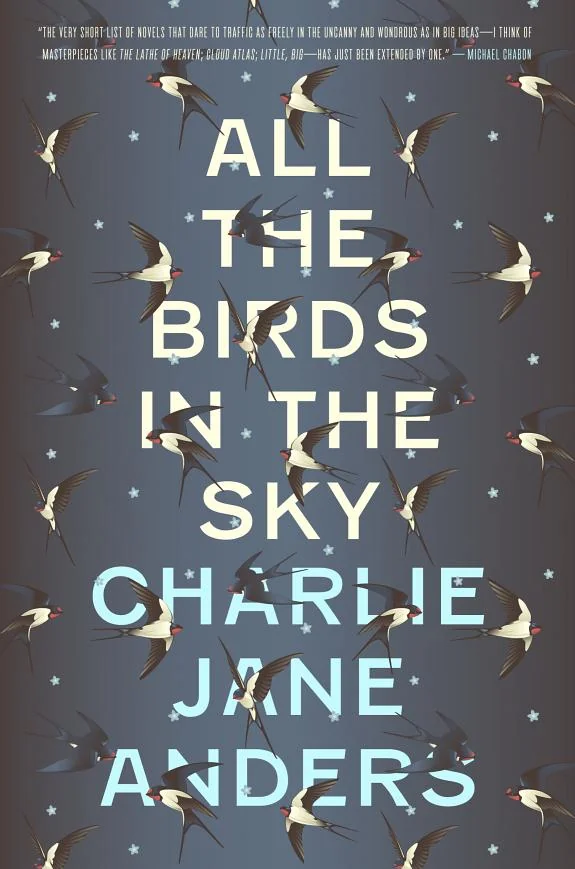
All the Birds in the Sky
 83
83

All the Birds in the Sky
Charlie Jane Anders' *All the Birds in the Sky* presents a compelling, if occasionally uneven, exploration of two fundamental human impulses: the drive to understand and control through science, and the urge to connect and heal through magic. The novel excels in its portrayal of Patricia and Laurence, whose intertwined destinies form the emotional core. Their adult lives, dedicated to opposing yet complementary forms of world-saving—Laurence’s frantic engineering against the planet’s decay, Patricia’s quiet coven’s restorative magic—are vividly rendered. A particularly strong passage involves Patricia’s initial struggles to master her powers, showcasing Anders’ knack for grounding the fantastical in relatable human effort. However, the narrative's pacing falters in the middle, at times feeling bogged down by exposition. The sheer scope of the world-ending threats, while effective in raising stakes, occasionally overshadows the intricate personal drama. Despite this, the book’s ultimate message about the necessity of both analytical and intuitive approaches to salvation offers a hopeful, albeit complex, conclusion.
📝 Description
83
In 2016, Charlie Jane Anders published *All the Birds in the Sky*, a novel about a witch and a scientist.
Patricia Delfine, a witch, and Laurence Armstead, a science prodigy, were friends in school. A difficult event separated them, and they meet again years later. San Francisco, their city, faces global crises. Patricia now works with a coven to heal the planet using magic. Laurence, a skilled engineer, develops technological answers.
The story contrasts magic and science as ways to fix the world. It asks if these different beliefs can exist together or if they must fight. Readers who like stories that mix genres, questioning the line between the mystical and the real, will find this book interesting. It is for people who think about how both magic and science might help with societal problems and big threats.
Those who enjoy stories focused on characters, with complicated relationships and a touch of the strange, will have much to consider. The book presents a distinct view on how different belief systems might interact or clash.
Published in 2016, the novel taps into a contemporary interest in occultism and esoteric practices. It engages with the idea that spiritual or magical methods might offer alternatives to purely scientific or technological solutions for global problems. The book reflects a cultural moment where discussions about ecological issues and the potential of both new technologies and older, rediscovered spiritual traditions were common. It places itself within speculative fiction that looks at combined realities, moving beyond strict genre boundaries.
💡 Why Read This Book?
• Understand the potential synergy between scientific innovation and esoteric practices, as demonstrated through Laurence's engineering and Patricia's witchcraft, offering a unique framework for problem-solving. • Experience a nuanced portrayal of how childhood trauma shapes adult identity and relationships, exemplified by Patricia and Laurence's complex bond forged in middle school, providing insight into personal resilience. • Engage with a speculative vision of near-future San Francisco facing ecological collapse, where magical and technological solutions collide, offering a fresh perspective on contemporary anxieties.
⭐ Reader Reviews
Honest opinions from readers who have explored this book.
❓ Frequently Asked Questions
What is the core conflict in All the Birds in the Sky?
The central conflict revolves around the opposing yet complementary approaches of science and magic to save a world on the brink of collapse, as embodied by the protagonists Laurence and Patricia.
When was All the Birds in the Sky first published?
All the Birds in the Sky was first published on January 26, 2016, by Tor Books.
Who are the main characters in the book?
The main characters are Patricia Delfine, a witch, and Laurence Armstead, a genius engineer. They were childhood friends whose lives take divergent paths before reuniting.
Does the book offer a definitive answer on whether magic or science is superior?
No, the book suggests that both magic and science have limitations and strengths, and that a true solution might involve a synthesis or understanding of both approaches.
What is the setting for All the Birds in the Sky?
The novel is primarily set in a near-future San Francisco that is experiencing severe ecological and societal problems.
What are some of the major themes explored in the novel?
Major themes include the nature of magic versus science, destiny versus free will, the impact of trauma, and the possibility of redemption or salvation for humanity.
🔮 Key Themes & Symbolism
Science vs. Magic
The novel posits a fundamental tension between scientific rationalism and magical intuition as methods for confronting global crises. Laurence embodies the scientific drive to build, fix, and control through empirical means, while Patricia represents the magical impulse to heal, connect, and influence through arcane forces. Their individual journeys and eventual reunion highlight the limitations of each approach when pursued in isolation, suggesting that true salvation might lie in a synthesis or at least a mutual understanding of these seemingly opposed systems.
Destiny and Choice
A significant undercurrent in *All the Birds in the Sky* is the interplay between predetermined fate and individual agency. Patricia and Laurence are both seemingly destined for roles of great importance, tasked with either saving or destroying the world. The narrative questions whether their actions are truly their own or dictated by larger forces. This theme is explored through their personal struggles, their attempts to alter prophecies, and the consequences of their choices, prompting reflection on the nature of free will within a seemingly fated trajectory.
The Nature of Monsters
The concept of 'monsters' is re-examined throughout the book, extending beyond simple antagonists. Characters who are ostracized or feared for their differences—whether through magical ability or scientific eccentricity—often become the very agents of change. The novel probes the societal tendency to label and demonize the 'other,' suggesting that what society perceives as monstrous may hold the key to survival or transformation. This redefinition challenges readers to consider their own perceptions of normalcy and monstrosity.
Repairing the World
At its heart, the book is about the profound and often desperate human desire to fix a broken world. Both protagonists are driven by a deep-seated need to mend the ecological and social damage surrounding them. Their methods differ drastically—one through technological innovation, the other through esoteric rituals—but the underlying motivation is the same. The narrative explores the immense difficulty, personal cost, and potential futility, as well as the necessity, of attempting to repair a world seemingly determined to self-destruct.
💬 Memorable Quotes
“Patricia and Laurence were childhood friends who found themselves estranged. Years later, they're still trying to save the world.”
— This encapsulates the core premise: the reunion of two protagonists whose shared past and divergent paths toward saving humanity define the narrative's central conflict and emotional arc.
“She was a witch, and he was a mad scientist.”
— A concise summary of the archetypal opposition at play. It highlights the fundamental clash between magic and science that drives the plot and character dynamics.
“The world was ending, and they were the only ones who could stop it.”
— This statement emphasizes the high stakes of the narrative and the extraordinary burden placed upon the main characters, suggesting a predestined or fated role in averting global catastrophe.
“Magic and science were just different ways of understanding the universe.”
— This interpretation suggests the novel's exploration of how seemingly opposite disciplines might be reconciled, hinting at a potential synthesis or shared underlying principles.
“They had to decide if they would destroy the world or save it.”
— This frames the ultimate choice facing the protagonists, underscoring the theme of destiny versus free will and the immense responsibility they carry.
🌙 Esoteric Significance
Tradition
While not strictly adhering to a single lineage, *All the Birds in the Sky* draws heavily from archetypal patterns found in Western esotericism, particularly the tension between Gnostic dualism (spirit vs. matter) and Hermetic synthesis. It engages with the idea of hidden forces (magic) influencing the material world, paralleling Hermetic principles like 'As Above, So Below.' The novel departs from traditional esotericism by directly confronting and integrating technological advancement, framing science itself as a potentially 'magical' force or a necessary counterpoint to arcane practices.
Symbolism
The 'birds' themselves can be interpreted symbolically as harbingers of change or messengers from unseen realms, reflecting ancient traditions where avian flight or forms carried divine or prophetic significance. Laurence's 'mad science' can symbolize the alchemical pursuit of transformation through material manipulation, albeit with modern technological tools. Patricia's witchcraft represents a connection to natural forces and intuitive knowledge, echoing earth-based spiritual practices and the archetype of the sorceress as a mediator between worlds.
Modern Relevance
Contemporary thinkers and practitioners interested in the intersection of technology, spirituality, and ecological consciousness find resonance in Anders' work. It speaks to modern trends in eco-spirituality, where a reconnection with nature is sought, and also to transhumanist or accelerationist philosophies that view technology as a means of overcoming human limitations. The novel's exploration of hybrid solutions—where magic and science are not mutually exclusive—is relevant to current discussions in fields like consciousness studies and parapsychology, which seek to bridge empirical and subjective experiences.
👥 Who Should Read This Book
• Speculative fiction enthusiasts seeking genre-bending narratives that explore the potential overlap between magic and science. • Readers interested in contemporary explorations of ecological collapse and humanity's response, particularly those who appreciate character-driven stories. • Individuals drawn to explorations of destiny, free will, and the profound impact of childhood experiences on adult identity.
📜 Historical Context
Published in 2016, *All the Birds in the Sky* arrived during a period of palpable global anxiety, marked by escalating climate change concerns and rapid technological advancement. The novel reflects this zeitgeist, exploring humanity's potential salvation through both esoteric means and scientific ingenuity. It emerged in a literary landscape where speculative fiction was increasingly pushing boundaries, with authors like Jeff VanderMeer and N.K. Jemisin similarly engaging with ecological themes and complex world-building. Anders' work can be seen as part of a contemporary trend to blend genres and explore the intersection of the magical and the mundane, a departure from earlier, more rigidly defined science fiction or fantasy. The novel's reception was generally positive, lauded for its imaginative scope and character development, and it was recognized with multiple awards, including the Nebula Award for Best Novel in 2017, solidifying its place within the speculative fiction canon.
📔 Journal Prompts
Laurence Armstead's engineering projects and Patricia Delfine's magical endeavors. How do their approaches reflect different ways of interacting with the world?
The concept of 'monsters' in the novel. What does the book suggest about societal definitions of monstrosity and otherness?
The childhood event that estranged Patricia and Laurence. How might unresolved trauma shape one's approach to saving the world?
The role of the coven and Laurence's scientific colleagues. What does the book say about community and collaboration in the face of crisis?
The ending's implication of synthesis between magic and science. What does this suggest about reconciling seemingly opposing forces in your own life?
🗂️ Glossary
Witch
In the context of the novel, a witch is an individual possessing innate magical abilities, capable of influencing the material world through arcane means, often connected to natural forces or spiritual energies.
Mad Scientist
A character archetype, here embodied by Laurence, who pursues scientific innovation with obsessive intensity, often pushing ethical or practical boundaries in their quest for knowledge or solutions.
Coven
A group of witches who practice magic together, often for mutual support and to amplify their collective power, as depicted with Patricia's associates.
Ecological Collapse
The state of severe environmental degradation where the planet's natural systems are critically damaged, leading to widespread societal disruption and existential threat, a central backdrop in the novel.
Near-future San Francisco
The primary setting of the novel, depicting a technologically advanced yet environmentally troubled version of the city in the not-too-distant future.
The Great Repair
The overarching, often seemingly impossible, goal pursued by both magical and scientific factions within the novel: to fix the world's escalating problems.
The End of the World
A pervasive threat looming over the narrative, representing the culmination of ecological disaster and societal breakdown that the protagonists strive to avert.