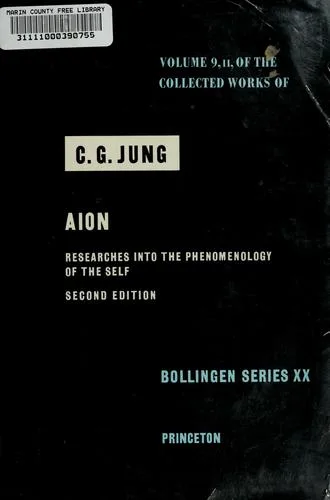
Aion
 75
75

Aion
Jung's Aion is less a narrative and more a dense cartography of the psyche as mapped onto religious history. The strength lies in Jung's unparalleled ability to connect disparate symbolic systems, particularly his detailed exegesis of alchemical texts and their resonance with Christian iconography. The chapter on the 'Psychological Aspects of the Christ-Myth' is particularly compelling, revealing how ancient archetypes manifest in foundational religious figures. However, the sheer volume of specialized knowledge required—from Gnosticism to alchemy—can present a significant barrier. A reader unfamiliar with Jung's earlier works on archetypes and the collective unconscious might struggle to grasp the overarching psychological framework supporting the historical and symbolic analysis. The book demands patience and a willingness to follow intricate threads of symbolic meaning. Ultimately, Aion offers a profound, albeit demanding, perspective on the evolution of consciousness through religious symbolism.
📝 Description
75
### What It Is Aion, a seminal work by Carl Gustav Jung first published in 1951, represents a profound exploration of the archetype of the Self and its manifestation in the figure of the divine child, the Puer Aeternus, and the historical development of Christian symbolism. Jung meticulously examines the evolution of religious concepts, particularly the Christ-figure, through the lens of alchemical symbolism and Gnostic thought. The text is not a simple historical survey but a psychological investigation into the collective unconscious and its recurring patterns.
### Who It's For This book is intended for serious students of Jungian psychology, comparative religion, and Western esotericism. It demands a degree of familiarity with Jung's broader theoretical framework and an interest in the intricate interplay between psychology, mythology, and religious history. Readers seeking a basic introduction to Jungian concepts may find Aion challenging. It is best suited for those prepared to engage with complex symbol analysis and historical religious ideas.
### Historical Context Published in the mid-20th century, Aion emerged during a period of intense intellectual ferment, following World War II. Jung's work engaged with and responded to prevailing psychological theories while also drawing heavily from his extensive studies in alchemy and Gnosticism, often overlooked by mainstream academia. His analysis of Christian symbolism, particularly the dual nature of Christ and the concept of the *imago Dei*, challenged traditional theological interpretations. Contemporaries like Mircea Eliade were similarly exploring comparative mythology, though Jung's focus remained distinctly psychological.
### Key Concepts The central concept is the archetype of the Self, which Jung posits as the totality of the psyche and the ordering principle of the unconscious. He traces its historical development, particularly through the figure of Christ, as a representation of divine wholeness. The book also extensively analyzes alchemical imagery, viewing it as a symbolic language for psychic transformation. Concepts like the Puer Aeternus (eternal child) and the integration of the anima/animus are explored in relation to the Self's emergence.
💡 Why Read This Book?
• Understand the development of the Christ archetype as a symbol of psychic wholeness, a concept explored through Jung's analysis of historical religious thought. • Gain insight into alchemical symbolism as a coded language for psychological transformation, a core theme linking ancient practices to modern individuation. • Examine the figure of the Puer Aeternus within the context of the Self archetype, offering a unique psychological lens on eternal youth and potential.
⭐ Reader Reviews
Honest opinions from readers who have explored this book.
❓ Frequently Asked Questions
What is the central archetype explored in Carl Jung's Aion?
The central archetype explored in Aion is the Self, representing the totality of the psyche and the ultimate goal of individuation. Jung connects its development to historical religious figures and symbols, particularly the Christ archetype.
How does Jung connect alchemy to psychology in Aion?
Jung interprets alchemical processes and imagery as symbolic representations of psychological transformation. In Aion, he uses these symbols to illustrate the unfolding of the Self and the integration of unconscious contents.
What is the significance of the Puer Aeternus in Aion?
The Puer Aeternus, or eternal child, is discussed as a manifestation of the Self archetype, representing potential, renewal, and a certain immaturity or one-sidedness that requires integration for psychic wholeness.
When was Carl Jung's Aion first published?
Carl Jung's Aion was first published in 1951. This marked a significant contribution to his later works on symbolism, religion, and the collective unconscious.
Does Aion require prior knowledge of Jungian psychology?
While not strictly mandatory, Aion significantly benefits from prior knowledge of Jungian concepts such as archetypes, the collective unconscious, and the process of individuation. It is considered an advanced text.
What historical religious traditions does Aion analyze?
Aion primarily analyzes Christian symbolism and Gnostic thought, exploring their psychological dimensions and connections to ancient archetypes and alchemical traditions.
🔮 Key Themes & Symbolism
The Self Archetype
Aion profoundly explores the Self as the central organizing archetype of the psyche, distinct from the ego. Jung traces its historical manifestation, particularly through the evolution of the Christ-figure in Christian theology and Gnostic thought. He posits the Self as the ultimate goal of individuation, a state of wholeness that encompasses both conscious and unconscious elements. The book examines how this archetype appears in various symbolic forms across history, reflecting humanity's innate drive towards psychic integration and completion.
Alchemical Symbolism
Jung's analysis of alchemy in Aion is crucial for understanding his psychological theories. He interprets alchemical processes—such as coniunctio (union) and the transformation of base metals into gold—as metaphors for inner psychic work. The symbols found in medieval alchemical texts are presented as a language of the unconscious, detailing the stages of individuation. This symbolic system provides a framework for understanding the integration of opposites within the psyche and the emergence of the Self.
Gnostic and Christian Mythos
Aion delves into the complex relationship between Gnosticism and early Christianity, viewing both as expressions of archetypal patterns. Jung focuses on the psychological implications of Gnostic cosmology and the dualistic nature of figures within these traditions. He examines the Christ-myth not merely as a historical event but as a profound symbolic representation of the Self archetype's journey and potential for redemption, highlighting the psychological resonance of these ancient narratives.
The Puer Aeternus
The archetype of the Puer Aeternus, or the eternal child, is explored in Aion as a significant manifestation related to the Self. Jung discusses this figure in terms of its potential for creativity and renewal, but also its potential for immaturity and one-sidedness. The development and integration of the Puer Aeternus archetype are presented as essential aspects of the individuation process, moving from a state of perpetual becoming towards psychic wholeness.
💬 Memorable Quotes
“The integration of the shadow, anima, and animus are preliminary stages for the emergence of the Self.”
— This paraphrased concept highlights Jung's view that before the totality of the Self can be realized, the individual must first confront and integrate the darker, unconscious aspects of the personality, including the shadow and contrasexual archetypes.
“The alchemical process mirrors the psychological process of individuation.”
— This interpretation emphasizes Jung's core argument that the symbolic language of alchemy, with its transformations and purifications, provides a historical and symbolic map for the internal journey of psychological development and self-realization.
“Christian symbolism, particularly the figure of Christ, can be understood as a manifestation of the Self archetype.”
— This paraphrased concept suggests that the divine-human duality and redemptive qualities of Christ represent, on a symbolic level, the psyche's own striving for wholeness and integration of opposing forces.
“The Gnostic worldview reflects a profound psychological tension between spirit and matter.”
— This interpretation points to Jung's analysis of Gnosticism as a system that articulates deep-seated psychological dualisms, revealing the unconscious mind's grappling with the perceived separation of the spiritual and material realms.
“The Puer Aeternus archetype embodies both creative potential and the danger of eternal deferral.”
— This paraphrased concept captures the dual nature of the eternal child archetype discussed in Aion: its capacity for inspiration and renewal, contrasted with a tendency to avoid commitment and mature integration.
🌙 Esoteric Significance
Tradition
Aion sits firmly within the Western Esoteric tradition, particularly drawing from Jung's unique synthesis of Gnosticism, Hermeticism, and alchemy. While not adhering strictly to any single historical lineage, Jung uses these traditions as symbolic languages to articulate his theories of the collective unconscious and individuation. He departs from purely theological or historical readings of these traditions, reinterpreting their myths and symbols through a psychological lens, thus offering a modern esoteric understanding of ancient spiritual quests.
Symbolism
Central to Aion's symbolism is the archetype of the Self, often represented by mandalas, divine children (like the Puer Aeternus), and the integrated figure of Christ. Jung also extensively analyzes alchemical symbols such as the Ouroboros (serpent eating its tail, representing eternity and cyclicality) and the Philosopher's Stone (symbolizing psychic wholeness and transformation). These symbols are not merely decorative but are seen as potent expressions of the unconscious psyche's drive towards integration and completion.
Modern Relevance
Contemporary Jungian analysts, depth psychologists, and scholars of comparative religion continue to draw heavily from Aion. Its exploration of archetypes, particularly the Self and the Puer Aeternus, remains relevant in therapeutic settings and academic research. Furthermore, modern esoteric practitioners and spiritual seekers often reference Aion for its insights into the psychological meaning of religious and alchemical symbolism, using it to inform their personal paths of development and understanding.
👥 Who Should Read This Book
• Students of Jungian psychology seeking to understand the development of the Self archetype and its historical manifestations. • Researchers in comparative religion and mythology interested in the psychological interpretation of Gnostic and Christian symbolism. • Practitioners of Western Esotericism looking for a deeper understanding of alchemical symbolism as a map for psychic transformation.
📜 Historical Context
Aion, first published in 1951, emerged from Carl Jung's deep engagement with Gnosticism and alchemy, fields often marginalized by mainstream academic discourse. The post-World War II era was a time of profound societal introspection, and Jung's work offered a psychological framework for understanding ancient mythologies and religious symbols. His exploration of the Christ-figure as a psychological archetype, particularly in contrast to purely historical or theological interpretations, challenged prevailing views. This approach placed him in intellectual dialogue with scholars like Mircea Eliade, who also studied comparative religion and mythology, though Jung's focus remained distinctly on the unconscious psyche. The reception of Aion, like much of Jung's work, was significant within psychological and esoteric circles, providing a bridge between ancient symbolic systems and modern psychological understanding.
📔 Journal Prompts
The symbolism of the Puer Aeternus in relation to your own life's unfolding.
Reflect on the alchemical concept of 'solve et coagula' as a metaphor for personal change.
Analyze the dual nature of the Christ archetype as depicted in Aion.
Consider the psychological significance of Gnostic dualism in contemporary experience.
Map the historical evolution of the Self archetype as presented in the text.
🗂️ Glossary
Self Archetype
In Jungian psychology, the archetype of the Self represents the totality of the psyche, encompassing both the conscious and unconscious. It is often symbolized by wholeness, such as mandalas or divine figures, and is the central organizing principle of individuation.
Puer Aeternus
Latin for 'eternal child.' In Jungian psychology, this archetype represents perpetual youth, creativity, and potential, but can also signify immaturity and an avoidance of full integration or responsibility.
Individuation
The lifelong psychological process of differentiation of the self, by which an individual integrates their conscious and unconscious aspects to achieve wholeness and realize their unique potential.
Gnosticism
A complex set of religious and philosophical movements that emerged in the early centuries CE, characterized by a belief in salvation through esoteric knowledge (gnosis) and a dualistic worldview separating the spiritual from the material.
Alchemy
An ancient tradition involving the study of matter, often focused on the transmutation of base metals into gold and the search for an elixir of life. Jung interpreted alchemical texts as symbolic representations of psychological processes.
Imago Dei
Latin for 'image of God.' In theology, it refers to the concept that humans are created in the likeness of God. Jung explored this concept through the lens of the Self archetype.
Collective Unconscious
A concept developed by Carl Jung, referring to a layer of the unconscious psyche shared by all humans, containing inherited archetypes and primordial images derived from our ancestral past.