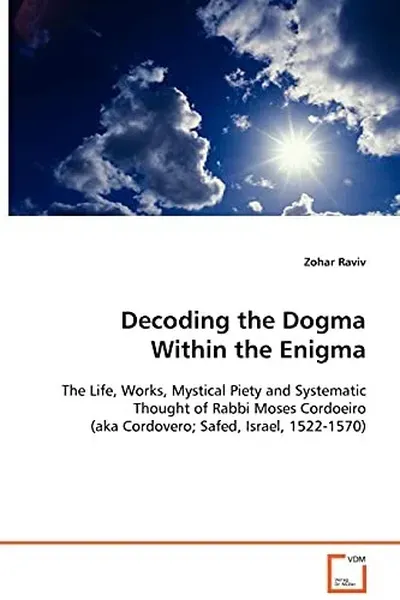
Decoding the dogma within the enigma

 74
74

Decoding the dogma within the enigma
Zohar Raviv’s "Decoding the Dogma Within the Enigma" offers a welcome, albeit dense, antidote to simplistic spiritual narratives. Raviv avoids easy answers, instead presenting a method for critical engagement with esoteric doctrines. The strength lies in its systematic deconstruction of dogma, particularly evident in the chapter analyzing the Gnostic concept of Sophia's fall. However, the prose can be exceptionally academic, at times bordering on impenetrable for those without a strong background in philosophy of religion. The section on 'hermeneutic keys' provides a valuable framework, but the practical application feels somewhat abstract. While it challenges readers, it demands significant intellectual investment. The book ultimately serves as a powerful tool for those willing to rigorously dissect their own belief systems.
📝 Description
74
### What It Is "Decoding the Dogma Within the Enigma" by Zohar Raviv, first published in 2008, offers a scholarly exploration of esoteric thought, challenging conventional interpretations of religious and mystical texts. It aims to uncover hidden layers of meaning often obscured by established doctrines and historical accretions. The book presents an analytical framework for dissecting complex belief systems, encouraging readers to question foundational assumptions and seek deeper, more personal understanding.
### Who It's For This work is intended for serious students of esotericism, comparative religion, and philosophy who possess a foundational knowledge of mystical traditions. It will appeal to those who are not content with surface-level explanations and are actively seeking to understand the underlying structures and symbolic languages of various spiritual paths. Readers interested in the history of ideas, intellectual history, and critical approaches to dogma will find substantial material for contemplation.
### Historical Context Published in 2008, "Decoding the Dogma Within the Enigma" emerged during a period of renewed academic and popular interest in esoteric studies, following decades where such topics were largely relegated to fringe scholarship. The early 21st century saw a proliferation of accessible literature on mysticism and occultism, yet Raviv's work distinguishes itself through its rigorous analytical approach, moving beyond mere descriptive accounts. It engages with, and implicitly critiques, the more dogmatic tendencies found within some New Age movements and established religious scholarship that may overlook nuanced interpretations.
### Key Concepts The book centers on the concept of 'dogmatic enclosure' – how established religious or philosophical systems can become rigid, preventing genuine inquiry. Raviv introduces methods for 'enigma deconstruction,' a process of breaking down complex symbolic narratives to reveal their core archetypal meanings. Another significant theme is the exploration of 'gnostic echoes' within various traditions, suggesting that suppressed or marginalized spiritual insights often resurface in different forms across history. The work also examines the role of 'hermeneutic keys' – specific interpretive tools or frameworks necessary for accessing deeper layers of meaning in sacred texts.
💡 Why Read This Book?
• Gain a structured method for analyzing religious and esoteric texts beyond their literal interpretations, by engaging with Raviv's concept of 'enigma deconstruction'. • Understand how established doctrines can function as 'dogmatic enclosures' and learn techniques to identify and bypass them, as explored in the book's critical framework. • Discover the recurring 'gnostic echoes' that appear across diverse spiritual traditions, providing a comparative lens for evaluating esoteric movements since the early 2000s.
⭐ Reader Reviews
Honest opinions from readers who have explored this book.
❓ Frequently Asked Questions
What is the primary aim of Zohar Raviv's 'Decoding the Dogma Within the Enigma'?
The book's primary aim is to equip readers with analytical tools to critically examine and deconstruct established religious and esoteric doctrines, revealing hidden meanings and challenging rigid interpretations of spiritual texts.
When was 'Decoding the Dogma Within the Enigma' first published?
The book was first published in 2008, a period marked by increasing academic and public interest in esoteric studies.
Who would benefit most from reading this book?
Students of esotericism, comparative religion, philosophy, and intellectual history seeking a rigorous, analytical approach to spiritual traditions would benefit most.
Does the book offer practical exercises for spiritual development?
While not a guide to practical spiritual exercises, the book offers intellectual frameworks and analytical methods that can inform personal spiritual inquiry and understanding.
What historical or philosophical movements does the book engage with?
The work engages with Gnosticism, Hermeticism, and broader philosophical discussions on dogma and interpretation, implicitly referencing intellectual currents from the late 20th and early 21st centuries.
Is 'Decoding the Dogma Within the Enigma' accessible to beginners in esoteric studies?
The book is best suited for those with some prior exposure to philosophical and esoteric concepts, due to its dense, academic style and analytical rigor.
🔮 Key Themes & Symbolism
Deconstruction of Dogma
Raviv meticulously dissects how religious and esoteric traditions develop rigid doctrines that can obscure deeper truths. The book presents 'enigma deconstruction' as a method to break down these intellectual barriers. It argues that by analyzing the symbolic language and historical development of dogma, one can access more authentic layers of meaning, moving beyond the confines of literalism and institutionalized belief systems. This approach encourages a personal, critical engagement with spiritual knowledge, challenging readers to question the very foundations of accepted wisdom since its 2008 publication.
Gnostic Echoes and Hermeneutic Keys
A significant focus is placed on identifying 'gnostic echoes'—elements of wisdom or spiritual insight that appear in varied forms across different traditions, often representing marginalized or suppressed knowledge. Raviv explores how these echoes can be understood through specific 'hermeneutic keys,' or interpretive frameworks. The book suggests that understanding these keys allows for a deeper apprehension of the underlying unity in diverse mystical expressions, offering a comparative perspective on spiritual history.
The Enigma as a Path
The book posits that the 'enigma' itself—the mysterious or paradoxical aspect of spiritual truth—is not an obstacle but a necessary component of genuine understanding. Raviv argues against systems that seek to eliminate all mystery, suggesting that embracing the enigmatic nature of existence is crucial for spiritual growth. This perspective challenges readers to find meaning not in definitive answers, but in the ongoing process of inquiry and exploration, a concept particularly relevant in contemporary spiritual discourse.
Intellectual History of Esotericism
Raviv situates his analysis within the broader intellectual history of esoteric thought, examining how certain ideas have evolved, been reinterpreted, or suppressed over centuries. The work implicitly engages with scholarly debates surrounding Gnosticism, Hermeticism, and Kabbalah, offering a framework for understanding these traditions critically. By tracing the lineage of certain dogmas and their deconstructive counterpoints, the book provides a valuable resource for scholars and practitioners interested in the evolution of Western esotericism.
💬 Memorable Quotes
“Dogma often serves as a shield, protecting adherents from the discomfort of the unknown by presenting certainty as truth.”
— This interpretation highlights the psychological function of dogma, suggesting it provides a sense of security by offering absolute answers, thereby preventing deeper exploration into existential or spiritual mysteries.
“The true enigma is not the absence of answers, but the refusal to engage with the questions themselves.”
— This concept emphasizes that spiritual or philosophical inquiry is more valuable than passive acceptance of doctrine. It suggests that the real mystery lies in avoiding the process of questioning and seeking.
“Gnostic echoes persist, whispering through the cracks of orthodox systems, reminding us of alternative paths to gnosis.”
— This highlights the enduring nature of suppressed or alternative spiritual knowledge, suggesting that insights from traditions like Gnosticism continue to influence thought even when marginalized.
“Hermeneutic keys are not static pronouncements, but dynamic lenses through which meaning is actively constructed.”
— This interpretation defines 'hermeneutic keys' not as fixed rules, but as adaptable tools for interpretation, emphasizing the reader's active role in creating understanding from texts.
“The scholar's task is to deconstruct the enclosure, not to replace it with another.”
— This suggests that the goal of critical analysis in esoteric studies should be liberation from rigid systems, rather than the establishment of a new, equally confining framework.
🌙 Esoteric Significance
Tradition
The work aligns with traditions that emphasize critical inquiry and intellectual rigor within esoteric studies, drawing implicitly from Hermetic and Gnostic lineages that value direct apprehension of knowledge (gnosis) over blind faith. It departs from more devotional or purely ritualistic approaches by focusing on the deconstruction of the conceptual frameworks that underpin spiritual beliefs. Raviv’s approach can be seen as a modern, philosophical extension of the critical spirit found in Renaissance Hermeticism and later esoteric revival movements.
Symbolism
Key symbols explored include the 'enigma' itself, representing the paradoxical nature of ultimate truth that resists simple definition, and 'dogmatic enclosures,' symbolizing the restrictive structures of belief systems. 'Gnostic echoes' function symbolically as persistent threads of wisdom that transcend specific doctrines, suggesting an underlying unity in spiritual experience. The 'hermeneutic key' symbolizes the critical tools and frameworks necessary for unlocking deeper layers of meaning within sacred or esoteric texts.
Modern Relevance
Contemporary thinkers and practitioners interested in critical theology, comparative mysticism, and philosophical approaches to spirituality find value in Raviv's methods. Schools of thought focusing on deconstructing religious language and exploring post-traditional spirituality often cite or implicitly engage with the analytical rigor presented. His work is relevant to those seeking to understand the evolution of esoteric ideas in the 21st century and the challenges of maintaining intellectual honesty within spiritual pursuits.
👥 Who Should Read This Book
• Advanced students of comparative religion and esoteric philosophy seeking to understand the mechanics of doctrinal formation and critique. • Intellectual historians interested in the evolution of mystical thought and the impact of dogma from the early 2000s onwards. • Practitioners of contemplative or philosophical spirituality who wish to refine their analytical skills for personal inquiry and deeper textual understanding.
📜 Historical Context
Published in 2008, "Decoding the Dogma Within the Enigma" emerged in an era characterized by a resurgence of interest in esoteric and mystical traditions, fueled by increased internet access and a growing dissatisfaction with purely materialist worldviews. The academic landscape for such studies had begun to shift from niche subfields to more mainstream attention. Raviv’s work engaged with, and implicitly critiqued, both the sometimes overly simplistic popularizations of spirituality common in the New Age movement and the rigid interpretations often found within traditional religious scholarship. It offered a counterpoint to the flood of accessible, but often superficial, books on mysticism by providing a rigorously analytical approach. Contemporaries like Carl Raschke were also exploring the intersections of religion, culture, and esoteric thought during this period, though Raviv’s focus remained distinctly on textual deconstruction and the history of ideas.
📔 Journal Prompts
The concept of 'dogmatic enclosure' and its influence on your understanding.
Identifying 'gnostic echoes' within familiar spiritual narratives.
Applying 'hermeneutic keys' to a personal text or belief.
The role of the 'enigma' in your personal spiritual journey.
Reflecting on the structure of 'enigma deconstruction' as presented by Raviv.
🗂️ Glossary
Dogmatic Enclosure
A conceptual or institutional framework within a belief system that limits inquiry and discourages deviation from established doctrines, often creating a closed loop of interpretation.
Enigma Deconstruction
A method of critically analyzing complex symbolic narratives or doctrines to reveal underlying structures, archetypes, and potential hidden meanings, moving beyond superficial or accepted interpretations.
Gnostic Echoes
Elements of spiritual knowledge, insight, or perspective reminiscent of Gnosticism that appear and reappear across diverse religious and philosophical traditions throughout history.
Hermeneutic Keys
Specific interpretive frameworks, conceptual tools, or methodologies used to unlock deeper or esoteric meanings within texts, symbols, or spiritual traditions.
Gnosis
Direct spiritual knowledge or insight, often understood as a form of intuitive apprehension of ultimate truth, particularly central in Gnostic traditions.
Esotericism
Systems of thought and practice concerned with hidden or inner knowledge, often involving spiritual disciplines, mystical experiences, and symbolic interpretation, typically distinct from exoteric or public teachings.
Orthodoxy
Adherence to established or traditional beliefs and doctrines within a religion or philosophical system, often contrasted with heterodoxy or alternative interpretations.