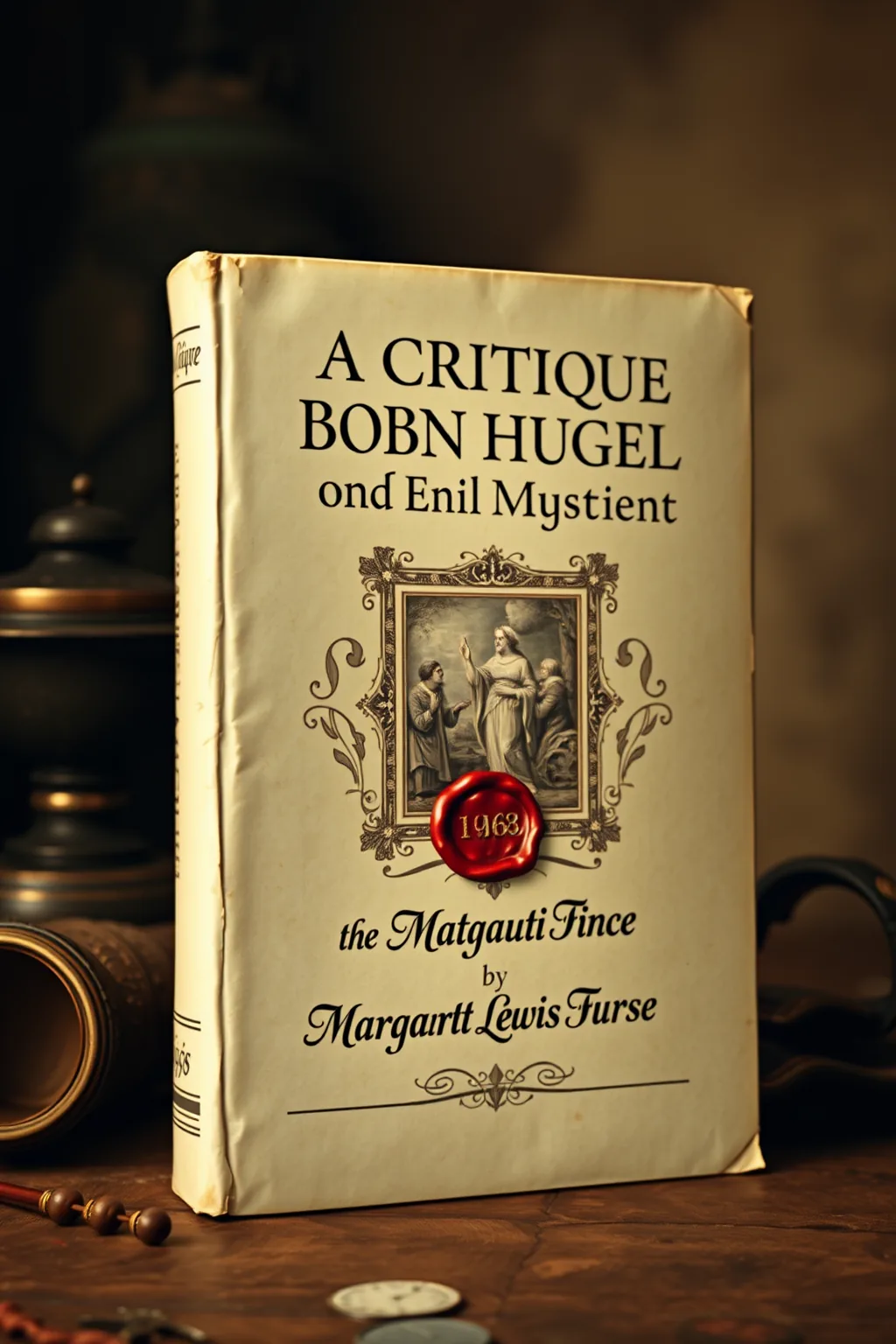
A Critique of Baron von Hugel and Emil Brunner on Mysticism 1968
 73
73

A Critique of Baron von Hugel and Emil Brunner on Mysticism 1968



Margaret Lewis Furse's "A Critique of Baron von Hugel and Emil Brunner on Mysticism" is a masterful dissection of spiritual thought. Furse's incisive analysis reveals the nuanced distinctions and shared horizons between these two influential thinkers, offering esoteric insights into the very fabric of mystical experience. She deftly unpacks complex theological arguments, illuminating the hidden currents of divine communion and the human capacity to perceive it. This work is essential reading for scholars of comparative religion and theology, as well as dedicated practitioners seeking a deeper intellectual framework for their contemplative lives. Its strengths lie in its scholarly precision and its profound respect for the sacred mystery it explores.
📝 Description
73
Margaret Lewis Furse published "A Critique of Baron von Hugel and Emil Brunner on Mysticism" in 1968.
Margaret Lewis Furse's 1968 book examines the mystical theories of Baron von Hugel and Emil Brunner. Furse scrutinizes their views on spiritual experience, looking at the philosophical and theological ideas behind their thoughts on encountering the divine. The work considers how faith and reason interact in inner revelation and the ongoing search for transcendent understanding.
This study addresses how these two figures approached the spiritual journey. It questions the nature of ultimate reality and humanity's role within it. Furse's writing combines academic seriousness with respect for mystical experience. The book is for readers interested in detailed analysis of spiritual thought.
Published in 1968, Furse's work engages with theological and philosophical discussions of mysticism that were current in mid-20th century religious scholarship. While not strictly an esoteric text itself, it analyzes figures who explored the more subjective and experiential aspects of faith, often considered a bridge between mainstream theology and more overtly esoteric traditions. The book's focus on the "inner revelation" and "divine encounter" places it within a broader intellectual current that sought to understand the deeper currents of spiritual life, a pursuit common in various esoteric lineages.
💡 Why Read This Book?
Unravel the intricate dialogues surrounding spiritual transcendence. This book offers a critical lens through which to examine the concepts of divine encounter as articulated by Baron von Hugel and Emil Brunner. It is ideal for scholars of theology, comparative mysticism, and philosophy, as well as serious seekers who wish to deepen their understanding of the architecture of contemplative experience and the intellectual traditions that have shaped its expression.
⭐ Reader Reviews
Honest opinions from readers who have explored this book.
❓ Frequently Asked Questions
What is the primary focus of this critique?
The book critically examines the theological and philosophical perspectives of Baron von Hugel and Emil Brunner regarding the nature and experience of mysticism, exploring their contributions to understanding divine communion and spiritual apprehension.
Who are Baron von Hugel and Emil Brunner?
Baron Friedrich von Hugel was an Austrian Catholic theologian and writer, known for his profound insights into mysticism and religious experience. Emil Brunner was a Swiss Reformed theologian, recognized for his dialectical theology and his engagement with existentialism and the philosophy of religion.
What makes this book relevant to esoteric studies?
It delves into the core concepts of mystical experience, which are foundational to many esoteric traditions. By critiquing influential theological interpretations, the book sheds light on the underlying principles of spiritual perception and the pursuit of higher consciousness.
Is this book suitable for beginners in mysticism?
While scholarly, the book offers foundational insights into key figures and concepts. Beginners interested in the intellectual underpinnings of mysticism may find it challenging but rewarding with dedicated study and supplementary resources.
What historical period does this critique engage with?
The book engages with theological and philosophical discourse primarily from the late 19th and early to mid-20th centuries, a period of significant development and re-evaluation in the study of mysticism and religious thought.
🔮 Key Themes & Symbolism
The Architecture of Divine Encounter
This theme explores how Furse deconstructs the conceptual frameworks that Baron von Hugel and Emil Brunner developed to articulate the human experience of the divine. It looks at their methodologies for understanding the 'numinous,' the ineffable moment of spiritual revelation, and the ways in which consciousness apprehends transcendent realities. The discussion highlights how their differing theological stances shape their interpretations of mystical phenomena, from ecstatic visions to quiet contemplation, offering readers a nuanced understanding of the spiritual journey's intellectual landscape.
Bridging Faith and Reason in Contemplation
Furse meticulously examines the delicate balance between rational inquiry and intuitive faith within the mystical traditions as represented by Hugel and Brunner. This theme investigates how each thinker reconciled intellectual doubt with profound spiritual conviction, and how they posited that reason can serve as a gateway, rather than a barrier, to mystical insight. It illuminates the scholarly approach to the sacred, demonstrating that the pursuit of esoteric knowledge often involves a rigorous engagement with both the mind and the heart.
The Enduring Quest for Transcendent Knowledge
This exploration focuses on the persistent human drive to connect with a reality beyond the mundane, as reflected in the works of Hugel and Brunner. Furse traces the historical lineage of mystical thought and its contemporary relevance, underscoring the timeless nature of spiritual yearning. The theme emphasizes how the critique serves as a guide for contemporary seekers, providing intellectual tools to work through the complex terrain of spiritual philosophy and to deepen their personal understanding of ultimate truths and hidden wisdom.
💬 Memorable Quotes
Direct passages from the work, attributed to the author.
“In the crucible of doubt, faith finds its truest form.”
— This highlights the idea that genuine spiritual conviction is often forged through intellectual struggle and the questioning of established beliefs, leading to a more robust and resilient faith.
“The language of the mystics whispers secrets to the attuned spirit.”
— This emphasizes the symbolic and often non-literal nature of mystical discourse, suggesting that its profound truths are revealed not through direct exposition, but through intuitive understanding and spiritual resonance.
“Contemplation is the art of listening to the silence within.”
— This posits that the practice of deep meditation or contemplation is an active, receptive process, focused on discerning subtle inner truths that emerge from stillness and quietude.
“The immanent God is found in the transcendent quest.”
— This paradoxical statement suggests that the divine presence, often perceived as distant, is simultaneously discovered within the very act of seeking and striving for higher spiritual states.
💡 Key Ideas
Editorial paraphrase of the work's core concepts — not direct quotes.
The veil between the seen and the unseen is thin for the prepared soul.
This quote suggests that mystical perception is not solely a matter of divine grace, but also of inner readiness and cultivation, implying that spiritual insights are accessible through diligent practice and an open heart.
🌙 Esoteric Significance
Tradition
This work engages with the broad tradition of Christian mysticism, but its critical approach to theological interpretation opens avenues for understanding universal principles of spiritual development applicable across various esoteric paths. By dissecting the language and concepts used to describe divine union, Furse provides a framework for appreciating the common threads in the human quest for higher consciousness, regardless of specific religious dogma.
Symbolism
The critique implicitly addresses the symbolic language inherent in mystical discourse. It examines how thinkers like Hugel and Brunner interpret symbols of divine encounter—light, darkness, union, separation—as representations of profound spiritual states. Furse's analysis encourages readers to look beyond literal meanings to grasp the deeper, archetypal significance of these symbols, which are central to unlocking esoteric wisdom and understanding the subconscious field of the spiritual journey.
Modern Relevance
In an age increasingly seeking authentic spiritual experience beyond rigid dogma, Furse's critique remains profoundly relevant. It offers intellectual tools to discern genuine mystical insight from mere speculation, providing a solid foundation for understanding contemplative practices. For modern seekers, it illuminates the historical dialogue surrounding spiritual direct experience, enabling a more informed and critical engagement with contemporary spiritual movements and personal paths toward enlightenment.
👥 Who Should Read This Book
This volume is essential for academic scholars of theology, comparative religion, and philosophy, particularly those focusing on mysticism and spiritual phenomenology. It will deeply resonate with contemplative practitioners and spiritual seekers who desire a rigorous intellectual grounding for their personal journeys, offering insights into the philosophical architecture of divine apprehension. While demanding, it is also important for students of esoteric traditions seeking to understand the historical and conceptual roots of spiritual exploration, providing a critical lens through which to evaluate diverse claims about transcendent knowledge.
📜 Historical Context
Published in 1968, "A Critique of Baron von Hugel and Emil Brunner on Mysticism" emerged during a period of significant intellectual ferment. The mid-20th century witnessed a resurgence of interest in existentialism, phenomenology, and the philosophy of religion, prompting deeper theological and philosophical engagement with subjective spiritual experience. This era saw scholars grappling with the legacy of figures like Karl Barth and the rise of new interpretations of tradition. Furse's work fits within this milieu, offering a critical analysis that both acknowledges the established theological frameworks of Hugel and Brunner and subtly probes their limitations from a perspective attuned to the subtler currents of mystical thought, potentially influenced by broader esoteric inquiries gaining traction.
📔 Journal Prompts
Reflect on a moment in your spiritual journey where doubt led to deeper faith. How did this process shape your understanding of the divine?
Consider the 'language of the mystics.' What symbols or metaphors have you encountered that speak to you on a deeper, intuitive level?
How does the concept of 'listening to the silence within' resonate with your own contemplative practices or aspirations?
Analyze a personal experience of seeking higher truth. Did it feel like a 'transcendent quest,' and what did you discover about the 'immanent God' within it?
If the veil between the seen and unseen is thin for the prepared soul, what steps can you take to cultivate that preparedness in your daily life?
🗂️ Glossary
Mysticism
The pursuit of spiritual truth and divine knowledge through direct experience, intuition, and contemplation, often transcending rational or empirical understanding. It emphasizes inner communion with the divine or ultimate reality.
Theology
The systematic study of the nature of the divine and, more broadly, of religious belief. It involves reasoning about God, religious doctrines, and the relationship between humanity and the divine.
Contemplation
A deep, reflective, and often prolonged state of spiritual or intellectual focus, aimed at achieving understanding, insight, or union with the divine. It is a passive yet active engagement of the mind and spirit.
Numenous
A term coined by Rudolf Otto, describing the mysterious, awe-inspiring, and sometimes terrifying quality of the divine or sacred. It evokes a sense of the utterly other and fascinates the human spirit.
Esoteric
Intended for or likely to be understood by only a small number of people with a specialized knowledge or interest. In spiritual contexts, it refers to hidden teachings, inner doctrines, or secret wisdom traditions.
This book appears in 1 collection
🔮 Readers Also Liked
Browse all →








More by Margaret Lewis Furse
All books →
From the “Christian Mysticism” Collection
View all →



More Free Mysticism & Contemplation Books
View all →