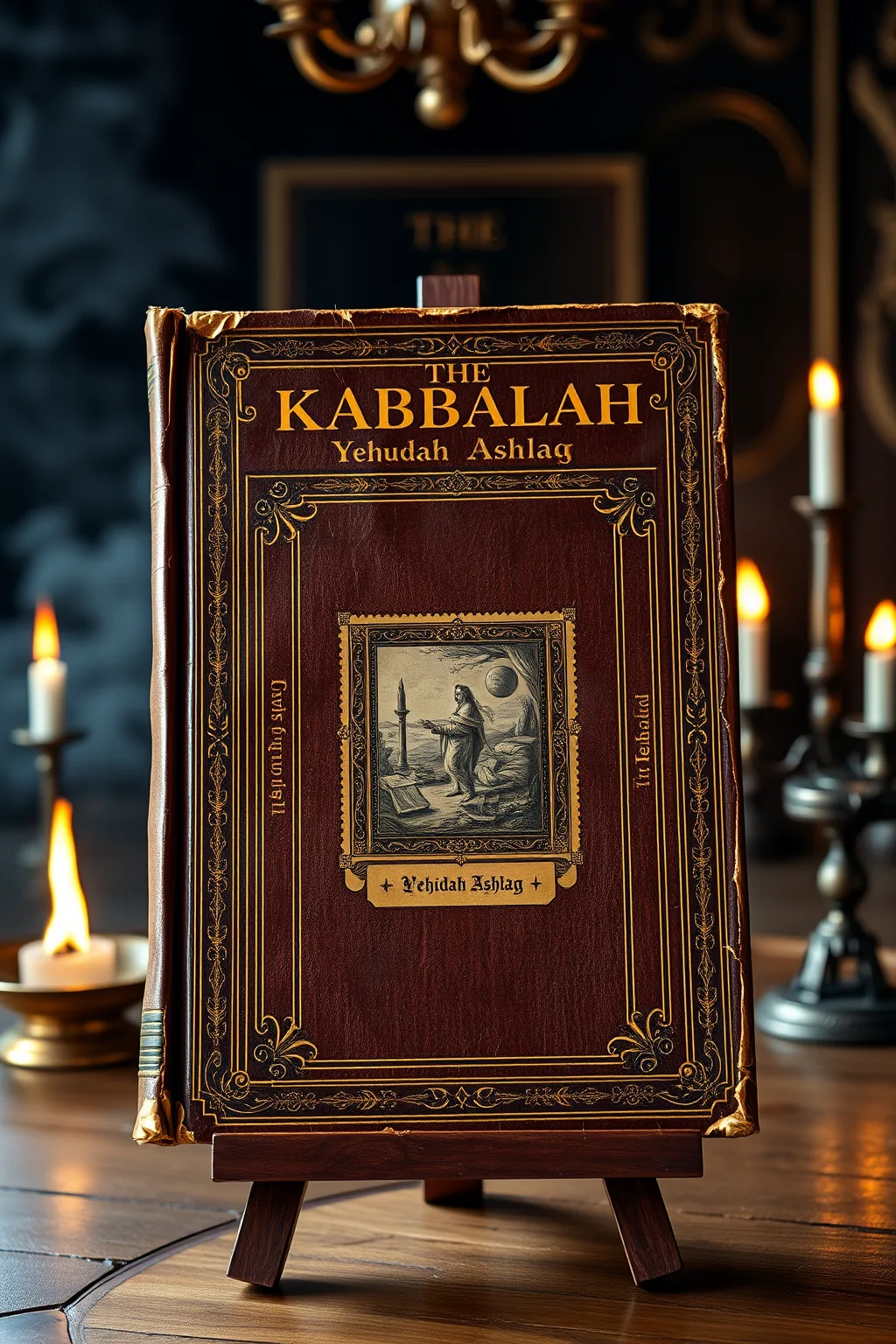
The Kabbalah
 61
61

The Kabbalah



Silas Hawthorne (Hermetic Studies Editor) — Yehudah Ashlag's 'The Kabbalah' stands as a towering achievement in the exposition of Kabbalistic thought. Ashlag, a luminary in modern Kabbalistic interpretation, provides an unparalleled clarity and depth, demystifying concepts that have long been shrouded in allegory. His exposition of the Sefirot and the process of creation offers profound insights into the mechanics of divine emanation and spiritual ascent. This work is indispensable for serious students of Kabbalah, offering a rigorous yet accessible framework for understanding its core principles. It is a rare gem that bridges the gap between ancient wisdom and contemporary understanding, urging readers toward profound self-discovery and spiritual actualization.
📝 Description
61
Yehudah Ashlag's 'The Kabbalah' deciphers the Zohar and Kabbalistic texts in 1920.
Yehudah Ashlag's 'The Kabbalah' presents his interpretation of Jewish mysticism, drawing heavily from earlier Kabbalistic sources like the Zohar. Ashlag aims to explain the structure of creation and the divine emanations. He details concepts such as the Tree of Life and the Sefirot, illustrating how the universe manifests from an infinite source.
The book also addresses the nature of consciousness and humanity's role within the cosmic order. Ashlag's work seeks to provide a framework for understanding these deep spiritual matters. It is intended for those seriously interested in the theoretical aspects of Kabbalah.
This work is situated within the tradition of Kabbalah, a school of Jewish mysticism that has developed complex symbolic and cosmological systems. Ashlag's commentary is a significant contribution to the Lurianic Kabbalah tradition, which itself built upon earlier Zoharic teachings. His approach seeks to make these esoteric concepts accessible and relevant, moving beyond purely theoretical contemplation to a more applied understanding of spiritual mechanics.
💡 Why Read This Book?
Uncover the deepest secrets of creation and divine consciousness. 'The Kabbalah' by Yehudah Ashlag offers a profound, systematic exploration of Jewish mysticism, revealing the hidden order of the universe through its intricate symbolism. Ideal for seekers of spiritual truth, scholars of esoteric traditions, and practitioners aiming for deeper self-understanding and connection to the divine.
⭐ Reader Reviews
Honest opinions from readers who have explored this book.
❓ Frequently Asked Questions
What is the primary focus of Yehudah Ashlag's 'The Kabbalah'?
The primary focus is on unveiling the esoteric principles and cosmological structure of Jewish mysticism, particularly through the lens of the Zohar and the concept of divine emanation, aiming to provide a systematic understanding of creation and spiritual ascent.
Is prior knowledge of Kabbalah required to read this book?
While prior familiarity with some mystical concepts can be helpful, Ashlag's work is structured to guide readers through complex ideas. However, a dedicated and open mind is the most crucial prerequisite for engaging with its profound teachings.
What are the 'Sefirot' mentioned in Kabbalistic texts?
The Sefirot are the ten divine emanations or attributes through which the Infinite Light (Ein Sof) manifests and interacts with the created universe, forming the spiritual structure of reality and consciousness.
How does Ashlag's interpretation differ from other Kabbalistic approaches?
Ashlag is renowned for his 'universal' approach, aiming to make Kabbalistic wisdom accessible and relevant to all humanity, focusing on the practical application for spiritual development and the correction of the soul.
What is the 'Tree of Life' in Kabbalah?
The Tree of Life is a central symbolic diagram in Kabbalah, illustrating the ten Sefirot and their interconnections, representing the divine flow of energy and the path of spiritual evolution from the divine source to the material world.
🔮 Key Themes & Symbolism
The Emanation of Creation
This theme examines the fundamental Kabbalistic concept of creation ex nihilo, not as a singular event, but as a continuous process of divine emanation. Ashlag meticulously details how the Infinite Light (Ein Sof) progressively unfolds through distinct stages and vessels, the Sefirot, to manifest the complex reality we perceive. Understanding this process reveals the underlying unity of all existence and the divine source from which everything originates, offering a profound perspective on causality and interconnectedness.
The Tree of Life and the Sefirot
The Tree of Life, a central diagram in Kabbalistic cosmology, serves as the framework for understanding the divine energies and consciousness. Ashlag's work illuminates the ten Sefirot – divine attributes and emanations – as the building blocks of reality. Each Sefirah represents a unique aspect of the divine, and their complex interplay forms the very fabric of existence, guiding the flow of spiritual energy from the highest realms to the lowest. This exploration offers a map for spiritual ascent and self-understanding.
The Correction of the Soul (Tikkun)
Beyond mere theoretical understanding, Ashlag emphasizes the practical application of Kabbalistic wisdom for the spiritual rectification of the individual and collective soul. This theme explores the concept of Tikkun, or correction, as the ultimate purpose of human existence – to refine one's desires and actions to align with the divine will. Through the study of Kabbalah, individuals can gain the insights necessary to mend the spiritual fragmentation and achieve a state of unity and spiritual perfection.
💬 Memorable Quotes
Direct passages from the work, attributed to the author.
“All creation is but a vessel to receive the Light.”
— This profound statement highlights the core Kabbalistic understanding that all of existence, from the subtlest spiritual realm to the densest physical matter, serves as a receptacle for the divine creative force, the Light.
“The Tree of Life is the path from the void to the fullness.”
— This captures the symbolic journey represented by the Sefirot, illustrating how divine energy flows and organizes to bring forth manifest reality from the primordial state of potentiality or 'void'.
“True wisdom is the ability to perceive the Creator in His creation.”
— This emphasizes the esoteric goal of Kabbalah: not just intellectual knowledge, but a direct spiritual perception where the divine presence is recognized and felt within every aspect of the created world.
“Man's essence is the desire to receive.”
— This foundational principle explains human motivation and spiritual potential, suggesting that the innate drive to receive can be refined and directed towards receiving spiritual light and divine consciousness.
💡 Key Ideas
Editorial paraphrase of the work's core concepts — not direct quotes.
The purpose of creation is to bestow pleasure upon the created.
This quote points to the benevolent nature of the Creator and the ultimate goal of existence: the experience of divine goodness and fulfillment for all beings, achieved through spiritual connection.
🌙 Esoteric Significance
Tradition
This work is deeply rooted in the tradition of Lurianic Kabbalah, as interpreted and expanded by Yehudah Ashlag. It draws heavily from the Zohar, the primary text of the Zoharistic school, but Ashlag's unique contribution lies in his systematic and philosophical approach, aiming to make these profound esoteric teachings accessible and applicable to a wider audience, focusing on the spiritual evolution of humanity.
Symbolism
The central symbolism revolves around the Tree of Life, a diagram representing the ten Sefirot (divine emanations) that structure reality. Ashlag meticulously decodes the symbolic language of Kabbalistic texts, explaining the profound meanings behind divine names, Hebrew letters, and cosmic processes like 'Tzimtzum' (contraction) and 'Shevirat HaKelim' (shattering of the vessels) as keys to understanding the mechanics of creation and spiritual redemption.
Modern Relevance
Ashlag's 'The Kabbalah' offers profound relevance for the modern seeker by providing a framework for understanding the underlying unity of existence, the nature of consciousness, and the purpose of life. It addresses contemporary existential questions through an ancient mystical lens, offering practical guidance for personal growth, spiritual development, and achieving a sense of meaning and connection in an often fragmented world. The emphasis on universal principles transcends religious boundaries.
👥 Who Should Read This Book
This essential text is recommended for a diverse audience. **Beginners** seeking an introduction to the foundational concepts of Jewish mysticism will find Ashlag's systematic approach invaluable. **Scholars** of religion and philosophy will appreciate the depth and rigor of his exegesis. **Spiritual seekers** yearning for a deeper understanding of divine reality, consciousness, and their place in the cosmos will find useful insights. **Practitioners** of meditation or contemplative practices can utilize the framework for enhancing their inner work and spiritual journey towards enlightenment.
📜 Historical Context
Yehudah Ashlag (1884-1954), also known as Baal HaSulam (Master of the Ladder), was a Polish-born Israeli Kabbalist and rabbi. He lived during a period of immense upheaval and transformation, including the rise of Zionism, the Holocaust, and the establishment of the State of Israel. His work emerged within the context of a rich and continuous tradition of Jewish mysticism, yet he sought to present Kabbalah in a way that was accessible and relevant to modern humanity, moving beyond the exclusivity that had sometimes characterized its study. Ashlag’s seminal contribution was his comprehensive commentary on the Zohar, the foundational text of Kabbalistic literature, which he intended to bridge the gap between ancient wisdom and contemporary spiritual needs, aiming for a universal understanding of Kabbalistic principles.
📔 Journal Prompts
Reflect on the concept of 'divine emanation' and how it might explain the interconnectedness of all things.
Consider the Sefirot as distinct aspects of your own consciousness. Which Sefirah resonates most with you today, and why?
What does the idea of 'spiritual correction' (Tikkun) mean in the context of your daily life and interactions?
Explore the symbolism of the Tree of Life. How can understanding its structure guide your personal spiritual growth?
Contemplate the 'desire to receive.' How can this innate drive be transformed from a source of ego to a vessel for divine light?
🗂️ Glossary
Ein Sof
The Infinite, Unknowable Divine Essence; the primordial state of God before any manifestation or emanation into creation. It represents absolute infinity and perfection beyond human comprehension.
Sefirot
The ten divine emanations or attributes through which the Infinite Light manifests and interacts with the created universe. They form the structure of spiritual reality and are often depicted as a divine blueprint.
Tree of Life (Etz Chaim)
A central diagram in Kabbalah representing the ten Sefirot and their interconnections, illustrating the flow of divine energy from the highest spiritual realms to the material world. It serves as a map for spiritual ascent.
Tzimtzum
The Kabbalistic concept of 'contraction' or 'withdrawal,' describing the divine act of receding to make space for creation. This initial divine self-limitation is crucial for the possibility of independent existence for the created world.
Tikkun
The spiritual rectification or correction of the soul and the universe. It refers to the process of mending the spiritual fragmentation caused by the 'shattering of the vessels' and restoring harmony between the created and the Creator.
This book appears in 1 collection
🔮 Readers Also Liked
Browse all →







More by Yehudah Ashlag
All books →


From the “Kabbalah” Collection
View all →







More Free Kabbalah & Jewish Mysticism Books
View all →