Yehudah Ashlag
Gershom Scholem pioneered the academic study of Kabbalah, revolutionizing its understanding through historical and linguistic analysis.
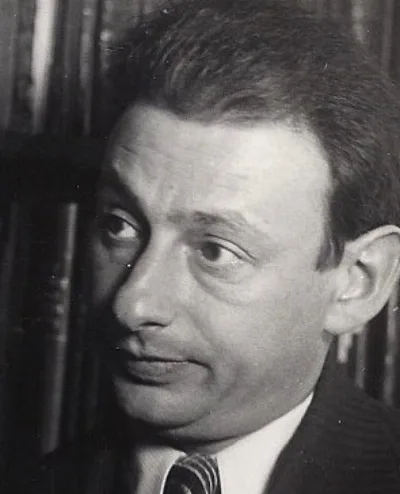
Gershom Scholem (1897-1982) was a seminal Israeli philosopher and historian, widely recognized as the founder of modern academic research into Kabbalah. Born in Berlin, he initially studied mathematics, philosophy, and Hebrew before immigrating to British Mandate Palestine in 1923. Scholem's academic career at the Hebrew University of Jerusalem, where he became the first professor of Jewish mysticism, was dedicated to approaching the subject from a scientific and historical perspective. He challenged earlier, less rigorous methods of studying Judaism, emphasizing the importance of mystical and mythical elements alongside rational ones. His work fundamentally reshaped the scholarly perception of Jewish mysticism, integrating it into broader historical and philosophical discourse. Scholem also played a crucial role in preserving Jewish heritage, including his work after World War II to recover plundered books. He died in Jerusalem, leaving a profound legacy in the field of Jewish studies.
Foundations of Kabbalistic Study
Gershom Scholem is credited with establishing the rigorous academic study of Kabbalah. He approached Jewish mysticism not as a fringe element but as a central component of Jewish history and thought. Scholem argued against the prevailing 19th-century academic approach, known as Wissenschaft des Judentums, which he believed treated Judaism as a static subject and overlooked its vital, non-rational forces. He posited that the mythical and mystical dimensions were as crucial as rational ones, forming the true essence of Judaism. His doctoral thesis focused on the Sefer ha-Bahir, one of the earliest Kabbalistic texts, highlighting his commitment to examining primary sources.
Historical and Linguistic Framework
Scholem's methodology involved deeply embedding the study of Jewish mysticism within its historical context. He proposed a three-period division of Jewish history to understand the evolution of its mystical currents, from the biblical struggle between monotheism and mythology to the Talmudic period's refinement of divine transcendence, and the medieval era's philosophical challenges leading to a resurgence of mysticism. He also developed a linguistic theory, asserting the unique power of the Hebrew language to reveal divine truth, contrasting with his contemporaries like Martin Buber and Walter Benjamin. Scholem viewed Kabbalists as interpreters of an inherent linguistic revelation.
Key Concepts and Controversies
Within his historical framework, Scholem explored controversial aspects of Jewish mysticism. He hypothesized that the 13th-century Kabbalah originated from Jewish Gnosticism and suggested that the 17th-century messianic movement of Sabbateanism evolved from Lurianic Kabbalah, with Hasidism emerging as a subsequent synthesis. These interpretations often challenged traditional understandings and generated debate. Scholem also critically engaged with the work of thinkers like Martin Buber, disagreeing with what he saw as Buber's personalization of Kabbalistic concepts and his approach to Jewish history and the land of Israel.
Later Life and Legacy
After immigrating to Palestine in 1923, Scholem became a librarian at the National Library, where he adapted the Dewey Decimal System for Judaica collections and oversaw significant ancient manuscripts, including Dead Sea Scrolls fragments. He was appointed the first professor of Jewish mysticism at Hebrew University in 1933, a position he held until his retirement. Following World War II, he undertook a mission to recover Jewish books plundered by the Nazis. Scholem's work fundamentally altered the academic landscape of Jewish studies, establishing Kabbalah as a legitimate and vital field of scholarly inquiry.
Key Ideas
- Recontextualization of Kabbalah as a central element of Jewish history.
- Critique of positivistic approaches to Jewish studies.
- Emphasis on the importance of mythical and irrational elements in religion.
- Historical periodization of Jewish mystical development.
- The privileged role of the Hebrew language in revealing divine truth.
Books by Yehudah Ashlag
5 free public domain books · Read online or download