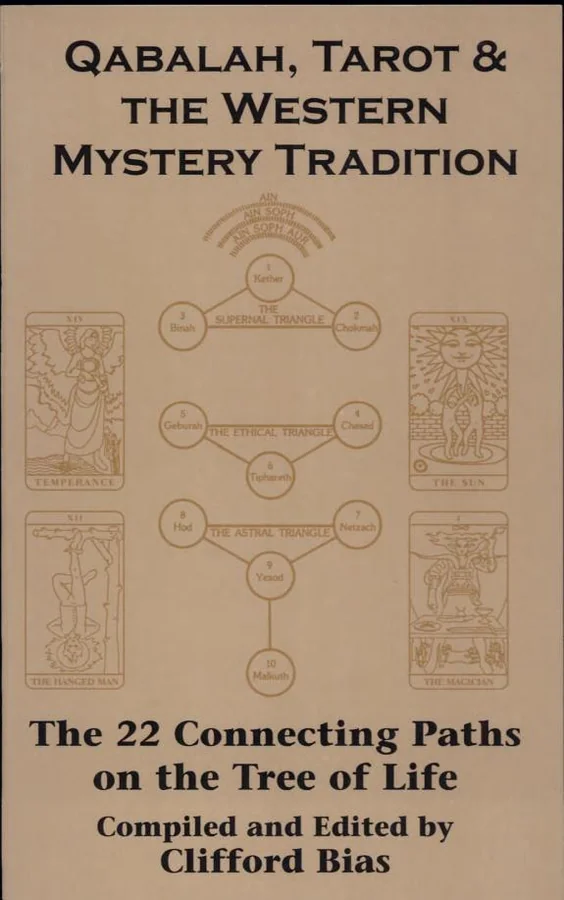
Qabalah, Tarot & the Western Mystery Tradition
 73
73

Qabalah, Tarot & the Western Mystery Tradition
Clifford Bias's exploration of the Qabalah and Tarot is commendable for its directness. Rather than getting lost in excessive historical detail or academic jargon, Bias prioritizes a functional application of the Tree of Life, specifically using the 22 Tarot Major Arcana to chart its paths. The book's strength lies in this practical, almost workbook-like approach, which can demystify complex Qabalistic concepts for newcomers. However, the text's brevity means that some of the deeper implications of each path-card correspondence are only lightly touched upon. For instance, the section on the Fool (Path 0/22) offers a competent overview but doesn't fully plumb the depths of its liminal nature as explored in other traditions. The illustrations, while present, are functional rather than elaborate, a minor point given the text's focus. Ultimately, Bias provides a solid, accessible entry point into correlating Tarot with the Qabalistic structure.
📝 Description
73
### What It Is
Clifford Bias's *Qabalah, Tarot & the Western Mystery Tradition* offers a structured approach to understanding the esoteric connections between the Kabbalistic Tree of Life and the Tarot. First published in 1997, this work presents a method for interpreting the 22 paths of the Tree of Life through the lens of Tarot symbolism. It aims to guide readers beyond conventional awareness, suggesting a path toward comprehending their place within a larger cosmic framework.
### Who It's For
This book is intended for individuals seeking a practical framework for self-exploration within esoteric studies. It appeals to those interested in the Western Mystery Tradition, specifically the intersection of Qabalistic concepts and Tarot archetypes. Readers should possess a foundational curiosity about spiritual development and a willingness to engage with symbolic language for personal insight.
### Historical Context
Emerging in the late 1990s, a period of renewed interest in Western esotericism following the earlier occult revival, Bias's work situates itself within a long lineage of Qabalistic and Tarot interpretation. The book builds upon foundational texts and teachings that have informed practitioners for centuries, offering a specific interpretive methodology that seeks to clarify the symbolic correspondences between the Hebrew alphabet, the Sephiroth, and the Major Arcana.
### Key Concepts
The central concept revolves around the mapping of the 22 Tarot Trumps onto the 22 paths connecting the 10 Sephiroth on the Kabbalistic Tree of Life. Bias explores how each path represents a stage of spiritual journey or a particular energetic principle, elucidated by the corresponding Tarot card. This framework facilitates a deeper understanding of the Tree of Life's dynamics and the archetypal forces at play in both the macrocosm and the individual microcosm.
💡 Why Read This Book?
• Learn a specific method for mapping the 22 Tarot Major Arcana onto the paths of the Kabbalistic Tree of Life, a technique that can clarify esoteric symbolism. • Gain practical exercises for self-exploration, using the symbolic journey described by Bias to understand personal awareness and cosmic connection. • Understand how the symbolism of the 22 paths on the Tree of Life is illuminated by the archetypes found within the Tarot, as first published in 1997.
⭐ Reader Reviews
Honest opinions from readers who have explored this book.
❓ Frequently Asked Questions
What is the primary focus of Clifford Bias's Qabalah, Tarot & the Western Mystery Tradition?
The book's primary focus is correlating the 22 paths of the Kabbalistic Tree of Life with the 22 Major Arcana of the Tarot, offering a symbolic framework for spiritual exploration.
Who is Clifford Bias?
Clifford Bias was a spiritualist minister and author whose work, including this book first published in 1997, aimed to bridge esoteric traditions for practical application.
What are the main esoteric traditions discussed?
The book centers on Qabalah and Tarot, framing them within the broader context of the Western Mystery Tradition.
Are there illustrations in the book?
Yes, the book is illustrated, intended to aid in the visual understanding of the symbolic connections presented.
What is the intended outcome for readers?
Readers are intended to achieve a greater awareness of their place in the cosmos and a deeper understanding of self through the symbolic exploration of the Tree of Life and Tarot.
When was Qabalah, Tarot & the Western Mystery Tradition first published?
The book was first published on November 1, 1997.
🔮 Key Themes & Symbolism
Tree of Life Paths
The work meticulously maps the 22 paths connecting the 10 Sephiroth on the Kabbalistic Tree of Life to the 22 Major Arcana of the Tarot. Each path is presented not merely as a connection but as a dynamic force or a stage in a spiritual ascent. Bias uses this framework to illustrate how these paths represent archetypal energies and developmental stages, guiding the reader through a symbolic journey that mirrors internal transformation. The 1997 publication date places it within a period of significant interest in practical esoteric application.
Tarot as Symbolic Key
Bias employs the Tarot, particularly the Major Arcana, as a primary interpretive tool for understanding the Qabalistic Tree of Life. The symbolism inherent in each Tarot card is used to elucidate the nature of the corresponding path, providing a more accessible and intuitive entry point than purely theoretical Qabalistic study. This approach highlights the Tarot's role not just as a divination tool but as a repository of archetypal wisdom integral to the Western Mystery Tradition.
Cosmic and Personal Awareness
A central aim of the book is to foster self-exploration by demonstrating how individual consciousness relates to the greater cosmic reality. By understanding the symbolic language of the Qabalah and Tarot, readers are encouraged to move beyond limited perspectives. The text suggests that this symbolic mapping provides a blueprint for recognizing one's place within the universal order and facilitates a conscious integration of the self with the divine or the All.
Western Esoteric Synthesis
This volume represents an effort to synthesize key elements of the Western Mystery Tradition, specifically Qabalistic cosmology and Tarot symbolism. It aims to provide a coherent system for practitioners interested in these disciplines. The work builds upon a long history of esoteric scholarship and practice, offering a particular methodology that seeks to unify disparate symbolic languages into a practical system for spiritual development, first presented in 1997.
💬 Memorable Quotes
“The 22 paths on the Tree of Life can be explored through the symbolism of the Tarot.”
— This core idea posits the Tarot's Major Arcana as keys to understanding the energetic and developmental significance of the connections between the Sephiroth on the Kabbalistic Tree of Life.
“This text encourages self-exploration leading out of limited awareness.”
— Bias's approach aims to expand the reader's consciousness by offering symbolic frameworks that reveal connections to the broader cosmos and the nature of reality.
“The symbolism provides a map for understanding our place in the greater reality.”
— The book utilizes esoteric symbols, particularly from Qabalah and Tarot, as tools to help individuals orient themselves within the universe and comprehend their personal significance.
“Bias offers a fresh approach to the Tree of Life's structure.”
— This suggests that the author presents an original or particularly clear method for engaging with the complex Qabalistic cosmology, distinct from other interpretations available at the time of its 1997 publication.
“The work is illustrated to aid understanding.”
— Visual aids are integral to Bias's method, intended to enhance the reader's grasp of the symbolic relationships between Qabalistic concepts and Tarot archetypes.
🌙 Esoteric Significance
Tradition
This work is firmly rooted in the Qabalistic and Hermetic branches of the Western Mystery Tradition. It adheres to the fundamental structure of the Kabbalistic Tree of Life, a cosmology central to Jewish mysticism and subsequently adopted and adapted by Hermetic orders like the Hermetic Order of the Golden Dawn. Bias's contribution lies in presenting a specific, accessible method for pathworking—the practice of traversing the Tree of Life—by employing the universally recognized symbolism of the Tarot.
Symbolism
The primary symbols explored are the 10 Sephiroth and the 22 paths of the Kabbalistic Tree of Life, which Bias explicitly links to the 22 Major Arcana of the Tarot. The Sephiroth represent divine emanations or states of consciousness, while the paths are the energetic connections between them. By using Tarot archetypes (e.g., The Fool, The Magician, The High Priestess) to illuminate these paths, Bias offers a symbolic language for understanding spiritual development, psychological processes, and cosmic principles.
Modern Relevance
Bias's approach continues to be relevant for modern practitioners of Western esotericism, particularly those engaged with Qabalistic studies and Tarot. Contemporary figures and schools focusing on practical magic, psychological astrology, and comparative mysticism often draw upon similar methods of symbolic correlation. The book's enduring appeal lies in its clear articulation of a system that facilitates personal growth and a deeper understanding of the interconnectedness of esoteric concepts, resonating with current interests in embodied spirituality and self-actualization.
👥 Who Should Read This Book
["• Students of Qabalah seeking a practical method to visualize and understand the Tree of Life's pathways, especially those who find traditional Qabalistic texts dense.", '• Tarot enthusiasts interested in exploring the deeper esoteric meanings and cosmological applications of the Major Arcana beyond divination.', '• Practitioners of Western Esotericism looking for a clear, illustrated guide that synthesizes Qabalistic cosmology with Tarot archetypes for personal development.']
📜 Historical Context
Published in 1997, Clifford Bias's *Qabalah, Tarot & the Western Mystery Tradition* emerged during a period of significant public and academic interest in esoteric subjects, following the foundational works of figures like Aleister Crowley and Dion Fortune in the early to mid-20th century. The late 1990s saw a proliferation of books aimed at demystifying complex occult systems for a new generation of practitioners. Bias's work fits within this trend by offering a structured, practical approach to the Qabalah and Tarot, two pillars of Western esotericism. While contemporary authors like Lon Milo DuQuette were also exploring similar intersections, Bias's specific focus on the 22 paths as a direct correlation with the Major Arcana provided a distinct pedagogical method. The book sought to consolidate and clarify these teachings, potentially making them more accessible than denser, older texts, and responded to an audience eager for guided pathways within the tradition.
📔 Journal Prompts
The symbolic journey along the 22 paths of the Tree of Life as mapped by the Major Arcana.
The concept of expanding awareness beyond limited circles through esoteric study.
The integration of Tarot archetypes with the Sephirothic emanations.
Personal resonance with the archetypal energies represented by specific paths on the Tree of Life.
The relationship between microcosm (personal) and macrocosm (cosmic) as illustrated by the book's framework.
🗂️ Glossary
Qabalah
A complex system of Jewish mysticism and esoteric philosophy that uses symbolic interpretation of scripture to explore the nature of God and creation, often represented by the Tree of Life.
Tree of Life
A diagram central to Kabbalistic cosmology, consisting of 10 Sephiroth (emanations) and 22 paths, representing the structure of the universe and the divine.
Sephiroth
The ten divine emanations or attributes of God described in Kabbalistic cosmology, arranged in a specific pattern on the Tree of Life.
Tarot
A deck of cards featuring symbolic imagery, traditionally used for divination and spiritual exploration, consisting of the Major and Minor Arcana.
Major Arcana
The 22 trump cards of the Tarot deck, each representing significant archetypal figures, events, or spiritual forces.
Pathworking
A practice within esoteric traditions involving the symbolic or meditative traversal of the paths on the Kabbalistic Tree of Life to achieve spiritual insight or transformation.
Western Mystery Tradition
A broad term encompassing esoteric and occult beliefs and practices originating in Western civilization, including Hermeticism, Qabalah, Rosicrucianism, and ceremonial magic.