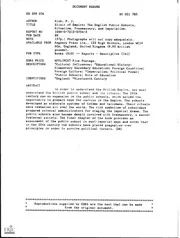
ERIC ED359076: Elixir of Empire: The English Public Schools, Ritualism, Freemasonry, and Imperialism.
 79
79

ERIC ED359076: Elixir of Empire: The English Public Schools, Ritualism, Freemasonry, and Imperialism.


Marcus Thorne (Esoteric Sciences Reviewer) — 'Elixir of Empire' is a revelatory text, meticulously dissecting the often-overlooked esoteric underpinnings of British Imperialism. ERIC ED359076 compellingly argues that the public school system, steeped in ritual and symbolic language, served as a powerful engine for imperial indoctrination. The author brilliantly connects the seemingly mundane practices of schooling with the grand theatricality of empire, revealing how totemic rituals and shared esoteric knowledge fostered a unique cohort of administrators. This work offers profound insights for scholars of Freemasonry, secret societies, and cultural history, illuminating the hidden mechanisms that propelled colonial expansion. Its strength lies in its ability to draw a direct, albeit often subtle, line between the arcane and the overtly political, making it an indispensable read for anyone interested in the esoteric roots of power.
📝 Description
79
Published in 1995, 'Elixir of Empire' examines how English public schools shaped the British Empire through ritual and secret societies.
This book investigates the role of ritualism and Freemasonry within elite English public schools and their connection to British imperialism. It argues that these institutions were not simply places of learning but active sites for cultivating a specific imperial ethos among the ruling class. The author details how practices like secret rituals, symbolic totems, and shared ceremonies created a sense of camaraderie and purpose. These elements, the book suggests, prepared boys for leadership roles within the vast imperial administration. The work moves beyond a standard historical account to consider the underlying psychological and symbolic mechanisms at play. It posits that understanding these esoteric aspects of public school education is key to grasping the full scope of British imperial influence. The book connects the private world of these schools to the public performance of global dominion.
This work situates itself within the study of how seemingly secular institutions can incorporate esoteric practices. It aligns with scholarship that examines the influence of fraternal orders and symbolic systems on social and political structures. The book touches upon the idea that hidden knowledge or shared symbolic understanding can forge powerful group identities and facilitate the maintenance of power. Its focus on ritual and its formative power connects to broader discussions in the history of Western esotericism concerning initiation, tradition, and the creation of social cohesion through symbolic means.
💡 Why Read This Book?
Uncover the hidden symbolic language that fueled the British Empire. 'Elixir of Empire' reveals how public school rituals and secret society influences shaped colonial administrators, offering a unique lens on imperialism's esoteric architecture. Essential for seekers of hidden knowledge, cultural historians, and those fascinated by the intersection of education, symbolism, and global power.
⭐ Reader Reviews
Honest opinions from readers who have explored this book.
❓ Frequently Asked Questions
What is the central thesis of 'Elixir of Empire'?
The book argues that British public schools, through their elaborate rituals, symbolism, and often clandestine connections to societies like Freemasonry, were instrumental in shaping the character and ideology of administrators who served the British Empire.
What role did ritualism play in the public schools?
Ritualism in public schools was more than just tradition; it was a tool for instilling a sense of belonging, hierarchy, and shared purpose, preparing boys for the symbolic performance of imperial duty and the creation of a collective identity.
How did Freemasonry intersect with the public schools and imperialism?
The book explores the deep entwinement of Freemasonry with the public school ethos, suggesting that shared masonic principles and networks influenced the values and connections of those who rose to prominence in imperial administration.
Who is the intended audience for this book?
This book is intended for scholars of history, cultural studies, Freemasonry, and secret societies, as well as general readers interested in the esoteric influences on political and social structures, and the hidden mechanisms of power.
What kind of 'hidden knowledge' does the book suggest was imparted?
The 'hidden knowledge' refers to the implicit understanding of hierarchy, duty, symbolism, and a shared worldview cultivated through rituals and secret society affiliations, which provided a framework for understanding and enacting imperial roles.
🔮 Key Themes & Symbolism
The Ritualistic Forge of Imperialists
This theme examines how the structured, often arcane, rituals within British public schools served as a deliberate mechanism for forging a specific type of individual: the loyal, duty-bound imperial administrator. The book details the symbolic nature of these rituals, from the creation of totems and talismans to the reenactment of ancient rites, suggesting they were designed to imbue students with a sense of sacred mission and hierarchical order, preparing them for the grand performance of empire on a global stage. It explores how these symbolic practices created a shared consciousness and a potent form of group identity, crucial for maintaining control and projecting authority.
Freemasonry: The Invisible Hand of Empire
This theme investigates the pervasive, yet often clandestine, influence of Freemasonry within the British public school system and its subsequent impact on Imperial administration. It explores how masonic lodges provided networks of support, mentorship, and shared values that extended from the school grounds to the farthest reaches of the Empire. The book posits that masonic principles of brotherhood, hierarchy, and esoteric knowledge served as a silent architect of imperial policy and a means of ensuring loyalty and cohesion among colonial officials. The connection between masonic symbolism and the broader imperial project is meticulously detailed, revealing an often-unseen layer of influence.
Symbolism as the Language of Dominion
Here, the focus is on how strong symbolism, embedded within school life and imperial practices, acted as a potent language of power and control. The book argues that the totems, talismans, and reenacted dramas of public schools were not mere diversions but sophisticated tools for imbuing colonial administrators with a symbolic understanding of their roles and the Empire's divine mandate. This symbolism served to legitimize dominion, create a sense of superiority, and provide a shared interpretive framework for the complex challenges of ruling vast territories. It highlights how visual and ritualistic language was employed to project authority and maintain the illusion of order and inevitability.
💬 Memorable Quotes
Direct passages from the work, attributed to the author.
“The schoolboy's totem was the seed of the administrator's banner.”
— This suggests that the symbolic totems adopted in schools were not trivial but served as foundational elements for the larger symbols of imperial power and identity carried by colonial officials.
“Ritual was the unseen mortar binding the bricks of empire.”
— This highlights the crucial, often overlooked, role of ritualistic practices in creating cohesion, loyalty, and a shared purpose among those who built and maintained the British Empire.
“The imperial stage was set within the hallowed halls of learning.”
— This implies that the preparation for imperial governance and the projection of imperial power began within the educational institutions, shaping the mindset and methods of future leaders.
“Freemasonry whispered its tenets into the ear of the Empire.”
— This metaphor suggests that the influence of Freemasonry was subtle but pervasive, shaping the underlying principles and operational code of the British Empire through its members in positions of power.
“Symbolism was the alchemical key to unlocking dominion.”
— This indicates that the use of symbolic language and practices was not merely decorative but served a functional, almost magical, purpose in legitimizing and enabling the exercise of imperial power.
🌙 Esoteric Significance
Tradition
This work bridges the esoteric traditions of Freemasonry, Hermeticism, and Gnosticism through its examination of ritual, symbolism, and hidden knowledge. It suggests that the structured, hierarchical, and symbolic systems developed within public schools mirrored, and were influenced by, these ancient esoteric frameworks, providing a spiritual and psychological scaffolding for imperial ideology and practice. The idea of a 'chosen' elite, guided by secret wisdom, resonates deeply with Gnostic concepts, while masonic principles of order and brotherhood are central to its thesis.
Symbolism
The book meticulously decodes the symbolic language of British public schools, identifying key symbols such as totems, talismans, crests, and the reenactment of rites. These symbols were not arbitrary; they served as potent carriers of meaning, imbuing students with a sense of shared identity, purpose, and a 'sacred' mission for empire. The author argues that this symbolic lexicon was deliberately cultivated to prepare administrators for understanding and enacting the grand, often theatrical, narrative of imperial dominance, acting as a form of collective unconscious communication.
Modern Relevance
The insights from 'Elixir of Empire' remain profoundly relevant in understanding how cultural institutions, group psychology, and symbolic manipulation continue to shape modern power structures and ideologies. It encourages a critical examination of the hidden curricula in contemporary education and leadership training, prompting questions about the values and worldviews being transmitted. By revealing the esoteric underpinnings of past imperial endeavors, the book offers a framework for recognizing similar patterns of symbolic influence and ritualistic reinforcement in contemporary political, corporate, and social spheres, urging us to look beyond the obvious.
👥 Who Should Read This Book
This book is a treasure for the discerning reader. Scholars of British history, cultural studies, and the sociology of education will find it an invaluable resource for its rigorous analysis of the public school system's imperial role. Seekers of esoteric knowledge and practitioners of occult studies will be fascinated by the exploration of ritual, symbolism, and the influence of secret societies like Freemasonry on global power dynamics. Beginners interested in understanding the hidden currents of history will find it an accessible yet profound introduction to the esoteric architecture of empire. Those who study leadership and organizational behavior can glean insights into how shared symbols and rituals forge collective identity and drive action.
📜 Historical Context
Published amidst a period of intense scholarly interest in the cultural underpinnings of empire, 'Elixir of Empire' emerges from the late 20th century, reflecting a critical re-evaluation of British Imperialism. The era was marked by post-colonial discourse, questioning the narratives of benevolent expansion and seeking to uncover the deeper social, psychological, and ideological forces at play. This book stands as a significant contribution to that re-evaluation, focusing on the formative years of the late 19th and early 20th centuries. It was a time when the British Empire reached its zenith, and the public school system was at the height of its influence, tasked with producing the 'men who would rule the world.' The academic landscape was also increasingly exploring the role of secret societies and ritualistic practices in shaping historical events, making this an opportune moment for such an analysis. The work draws on archival research and cultural theory to offer a nuanced perspective, moving beyond purely political or economic explanations to explore the symbolic and esoteric dimensions of imperial power.
📔 Journal Prompts
How do the rituals and symbols of your own formative institutions shape your worldview?
In what ways might modern educational systems still employ symbolic language to instill specific values or ideologies?
Consider a contemporary global or national narrative; what hidden symbols or rituals underpin its perceived legitimacy?
Reflect on the concept of a 'chosen' elite. How does this idea manifest in historical or contemporary power structures?
How does understanding the esoteric influence on historical events change your perception of those events?
🗂️ Glossary
Ritualism
The practice of adhering to or emphasizing rituals, especially in a religious or social context. In the context of this book, it refers to the elaborate and symbolic ceremonies enacted within public schools.
Totems
Objects, symbols, or figures regarded with a special reverence by a particular group, often serving as an emblem or symbol of that group's identity or lineage.
Talismans
An object believed to have magical properties, typically used to ward off evil or bring good luck, often imbued with symbolic significance by its creator or owner.
Imperialism
A policy or ideology of extending a country's rule over foreign nations, often by military force or by gaining political and economic control.
Esoteric
Intended for or likely to be understood by only a small number of people with a specialized knowledge or interest; relating to or concerned with the occult or mystical.
This book appears in 2 collections
🔮 Readers Also Liked
Browse all →



More by ERIC
All books →


From the “Secret Societies” Collection
View all →






More Free Freemasonry & Secret Societies Books
View all →


![Documents Illustrative Of The History Of The Slave Trade To America [ Volume 1] nwo illuminati freemasons](/img/thumb/documents-illustrative-of-the-history-of-the-slave-trade-to-america-volume-1-nwo-illuminati-freemasons.webp)