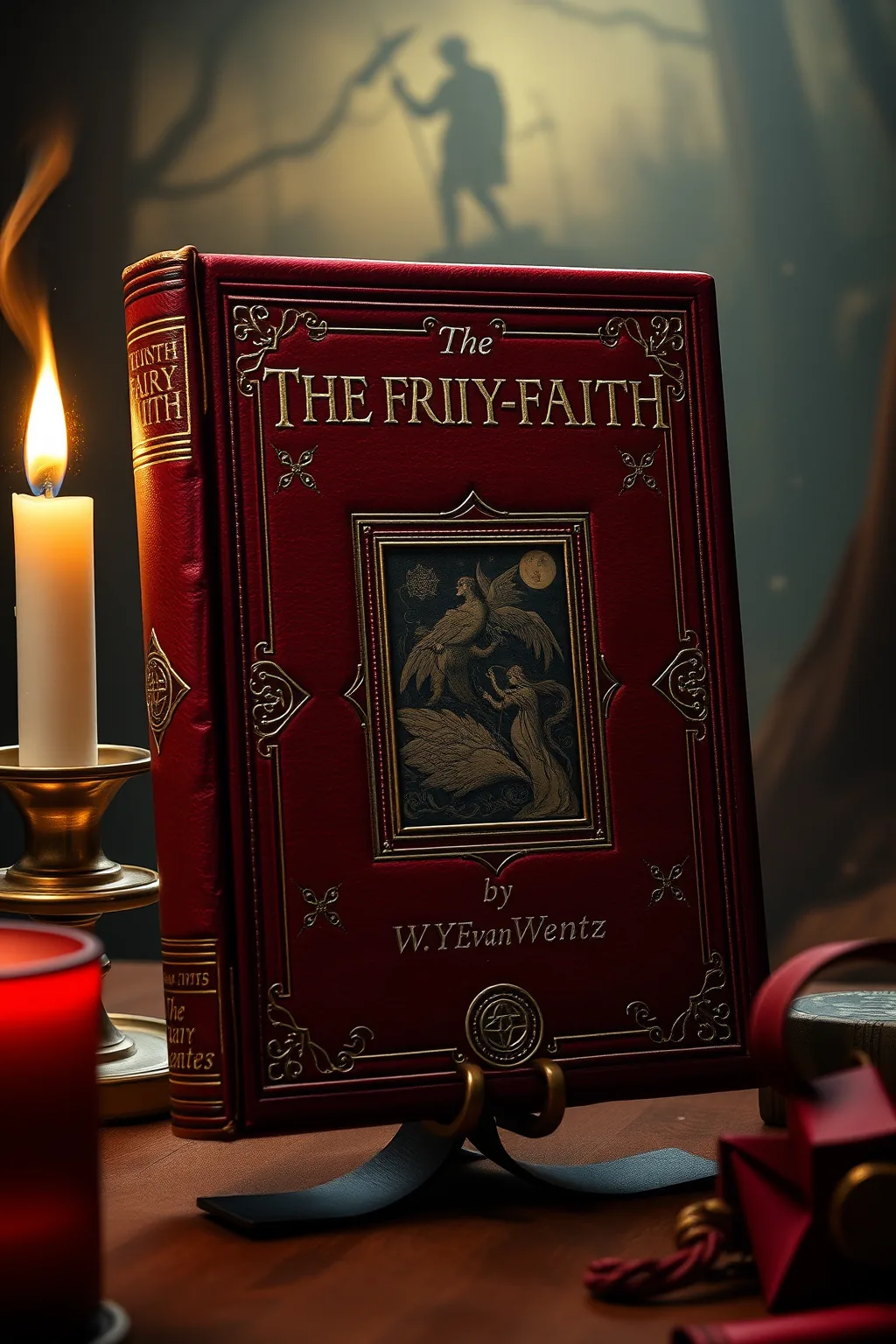
The Fairy-Faith in Celtic Countries
 82
82

The Fairy-Faith in Celtic Countries


Evander Ashcroft (Alchemy & Hermeticism Editor) — 'The Fairy-Faith in Celtic Countries' is an indispensable cornerstone for any serious student of Western esotericism and comparative mythology. Evans-Wentz's meticulous fieldwork and comparative analysis unlock profound insights into the enduring power of elemental spirits and their role in shaping human consciousness. This work transcends mere folklore, revealing the undercurrents of animism and pre-Christian spiritual practices that continue to influence our world. It is a vital resource for understanding the animistic worldview, the concept of the Sidhe, and the interconnectedness of the physical and spiritual planes. Essential reading for seekers of ancient wisdom and practitioners of nature-based spirituality.
📝 Description
82
W. Y. Evans-Wentz published 'The Fairy-Faith in Celtic Countries' in 1911, documenting beliefs about fairies.
In 1911, W. Y. Evans-Wentz released 'The Fairy-Faith in Celtic Countries,' a study based on his fieldwork across Ireland, Scotland, Wales, Brittany, Cornwall, and the Isle of Man. The book collects firsthand accounts of popular beliefs concerning fairies and related beings. Evans-Wentz sought to understand the persistence of these traditions in the early 20th century, examining their influence on rural communities and oral storytelling. He presented these beliefs not as mere superstition but as expressions of a deeper worldview that acknowledged unseen natural forces.
The author's aim was to capture the essence of these fairy traditions before they faded. He examined how these beliefs shaped the imagination and daily life of people in Celtic regions. The work stands as a record of a specific cultural phenomenon, connecting it to broader questions about humanity's relationship with the natural and supernatural worlds. It was written for those interested in the survival of ancient beliefs within modern society.
This book emerged from the early 20th-century interest in folklore and comparative religion, which often intersected with esoteric thought. Evans-Wentz, known for his work on Tibetan Buddhism, approached fairy beliefs as a serious subject, seeking underlying spiritual or psychological truths. His method involved direct inquiry and a belief that such traditions held a form of knowledge, a perspective common in theosophical and anthropological circles of the time. The study reflects a broader cultural moment where the rationalism of the age was challenged by inquiries into the subconscious, folk psychology, and non-Western spiritual systems.
✍️ Author
💡 Why Read This Book?
Uncover the hidden spiritual landscape of the Celtic world. This book offers direct access to the living traditions of fairy belief, revealing a profound connection between humanity and the unseen realms. Ideal for seekers of ancient wisdom, folklore enthusiasts, and anyone curious about the persistent influence of myth on our collective psyche.
⭐ Reader Reviews
Honest opinions from readers who have explored this book.
❓ Frequently Asked Questions
What is the primary focus of 'The Fairy-Faith in Celtic Countries'?
The book meticulously documents and analyzes the enduring beliefs in fairies and the 'Fairy-Faith' across various Celtic nations, exploring its cultural, spiritual, and psychological impact.
Who was W. Y. Evans-Wentz?
W. Y. Evans-Wentz was an American occultist, anthropologist, and author, renowned for his studies of Eastern and Western esoteric traditions, including Tibetan Buddhism and Celtic folklore.
What regions does the book cover?
It extensively covers Ireland, Scotland, Wales, Brittany, Cornwall, and the Isle of Man, gathering accounts directly from the inhabitants of these regions.
Is this book about literal fairies?
While it documents literal accounts, the book explores the deeper symbolic and psychological meanings of fairy beliefs, connecting them to spiritual traditions and the human psyche.
What is the historical significance of this book?
Published in 1911, it was one of the first comprehensive scholarly attempts to study and validate the persistence of fairy beliefs in modern times, bridging folklore and esoteric thought.
🔮 Key Themes & Symbolism
The Persistence of the Unseen
This theme examines the enduring presence of spiritual entities and beliefs in a seemingly rationalized world. Evans-Wentz argues that the 'Fairy-Faith' is not a relic of the past but a living evidence of humanity's innate connection with the unseen. It explores how these beliefs shape perception, influence behavior, and offer a framework for understanding the subtle energies that permeate existence, challenging purely materialistic worldviews and highlighting a universal human need for communion with the divine and elemental forces.
Celtic Spirituality and the Sidhe
The book acts as a profound exploration into the heart of Celtic spirituality, focusing on the ancient concept of the Sidhe, or the 'Otherworld' inhabitants. It examines how these beings are not merely characters in stories but are perceived as integral aspects of the natural world and spiritual landscape, possessing their own consciousness and influence. Evans-Wentz connects these beliefs to older pagan traditions, shamanic practices, and the deep reverence for nature inherent in Celtic cultures, revealing a body of animistic and mystical thought.
The Folklore as a Mirror of the Soul
Beyond simple narratives, Evans-Wentz treats folklore as a powerful symbolic language reflecting the collective unconscious and the spiritual aspirations of a people. He demonstrates how tales of fairies, their abodes, and their interactions with humans serve as allegorical expressions of inner spiritual journeys, moral lessons, and the archetypal forces at play in human life. This perspective elevates fairy lore from mere superstition to a profound reservoir of psychological and metaphysical wisdom, offering insights into human nature and our relationship with the divine.
💬 Memorable Quotes
Direct passages from the work, attributed to the author.
“The fairy-faith is an inheritance from the ancient past.”
— It highlights the deep historical roots of these beliefs, suggesting they are not fleeting fancies but enduring aspects of ancestral spiritual traditions passed down through generations.
“The Sidhe are dwellers in the Otherworld.”
— This points to the belief in a parallel spiritual realm inhabited by fairy beings, a concept central to Celtic mythology and the understanding of the unseen dimensions of existence.
“Folklore is the language of the soul.”
— This suggests that traditional stories and beliefs, like those concerning fairies, are not just narratives but profound expressions of humanity's inner spiritual landscape and collective consciousness.
“The ancient peoples understood the interconnectedness of all things.”
— It underscores the holistic worldview of ancient cultures, where the spiritual, natural, and human realms were seen as intrinsically linked and mutually influential.
💡 Key Ideas
Editorial paraphrase of the work's core concepts — not direct quotes.
Fairies are still very real to the people of the Celtic countries.
This quote emphasizes the living, breathing nature of fairy belief, asserting its continued relevance and tangible impact on the lives and consciousness of people in Celtic lands.
🌙 Esoteric Significance
Tradition
This work is deeply rooted in the Western Esoteric Tradition, particularly its branches concerned with nature spirits, elemental beings, and the study of comparative mythology. It draws parallels with ancient Celtic paganism, animism, and the Gnostic concept of veiled realities. Evans-Wentz's approach aligns with the Hermetic principle of 'as above, so below,' suggesting that the symbolic language of folklore mirrors deeper spiritual truths and the structure of consciousness.
Symbolism
Key symbols include the Sidhe (fairies or the Otherworld folk), their dwellings (mounds, hills, islands), and their interactions with humans (abductions, blessings, curses). These symbols represent the veil between the physical and spiritual realms, the power of the subconscious, the allure of the unknown, and the potent forces of nature. The fairy-faith itself symbolizes humanity's enduring intuition of a world beyond the mundane, a connection to primal forces and hidden wisdom.
Modern Relevance
In an age often characterized by disconnection from nature and spiritual skepticism, 'The Fairy-Faith' offers a compelling counter-narrative. It reminds us of the deep, inherent connection between humanity and the natural world, the persistence of subtle energies, and the profound wisdom held within ancient traditions. Its exploration of the collective unconscious and the archetypal power of myth remains highly relevant for psychological and spiritual growth in the 21st century.
👥 Who Should Read This Book
This book is a treasure for a diverse audience. **Seekers of Ancient Wisdom** will find it a profound exploration of enduring spiritual beliefs. **Folklore Enthusiasts** will appreciate the meticulous collection of firsthand accounts and insightful analysis. **Students of Esotericism and Mythology** will find it an indispensable resource for understanding Western occult traditions and comparative spirituality. **Practitioners of Nature-Based Spirituality** will gain a deeper appreciation for the animistic worldview and the presence of elemental forces. **Anyone curious about the persistent power of myth and the unseen dimensions of reality** will find this book useful and thought-provoking.
📜 Historical Context
Published in the burgeoning era of occult revival and anthropological interest at the turn of the 20th century, 'The Fairy-Faith in Celtic Countries' emerged during a period when Western society was grappling with the impact of industrialization and scientific rationalism. Many scholars and spiritual seekers were looking to ancient traditions and folklore for deeper meaning and a connection to the pre-modern world. Evans-Wentz's work, steeped in the spirit of his mentor Theodore Besterman and influenced by figures like Helena Blavatsky, sought to legitimize and explore the enduring power of animistic beliefs and spiritual traditions that persisted outside the dominant religious and scientific frameworks. It represented a significant contribution to the burgeoning field of comparative mythology and esoteric studies, offering a bridge between academic inquiry and firsthand spiritual experience.
📔 Journal Prompts
Reflect on a personal experience that felt touched by the 'unseen.' How does Evans-Wentz's description of the fairy-faith resonate with this experience?
Consider the concept of the 'Otherworld' as presented in the book. What does this concept symbolize for you in your own life or spiritual journey?
How has the modern world influenced or suppressed beliefs in nature spirits or the 'Fairy-Faith'? What are the potential consequences of such suppression?
If you were to interview someone deeply connected to local folklore or nature spirits, what questions would you ask, inspired by Evans-Wentz's methodology?
Explore the idea of folklore as a 'mirror of the soul.' What hidden truths or aspects of your own psyche might be reflected in traditional stories you grew up with?
🗂️ Glossary
Fairy-Faith
The collective beliefs, traditions, and practices associated with fairies, nature spirits, and the 'Otherworld' within Celtic cultures, viewed as a living spiritual system.
Sidhe
A term originating from Irish mythology, referring to the fairy folk or the inhabitants of the 'Otherworld,' often associated with supernatural beings and hidden realms.
Otherworld
In Celtic mythology, a parallel spiritual or supernatural realm distinct from the physical world, often inhabited by deities, spirits, and the Sidhe.
Animism
The belief that all natural objects, phenomena, and the universe itself possess an independent spiritual or soulful existence.
Folklore
The traditional beliefs, customs, and stories of a community, passed through the generations by word of mouth, encompassing myths, legends, and superstitions.
This book appears in 3 collections
🔮 Readers Also Liked
Browse all →








From the “Transcendental Meditation” Collection
View all →




More Free Esoteric History & Biography Books
View all →