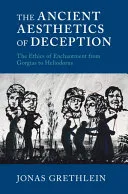
The Ancient Aesthetics of Deception
 81
81

The Ancient Aesthetics of Deception
Jonas Grethlein’s "The Ancient Aesthetics of Deception" offers a vital corrective to scholarship overly focused on mimesis. By foregrounding apatē, the book reveals a crucial, under-examined facet of ancient Greek thought on representation. Its strength lies in meticulously tracing the conceptual threads from Gorgias through Plato and into later Hellenistic thinkers, demonstrating how deception and aesthetic illusion were distinct but related preoccupations. The analysis of Plato's engagement with apatē, particularly in dialogues where rhetoric itself is under scrutiny, is particularly sharp. A limitation, however, is the book's dense academic prose, which may deter readers not deeply steeped in classical philology. The exploration of Philo's use of apatē in his philosophical exegesis, for instance, while intellectually rigorous, requires significant background knowledge. Nevertheless, Grethlein’s work successfully repositions our understanding of ancient aesthetic discourse, proving that the perceived boundary between truth and falsehood in art was far more actively debated than previously acknowledged.
📝 Description
81
### What It Is This work re-examines the discourse surrounding representation in ancient Greek literature, moving beyond the pervasive concept of mimesis. It introduces apatē, a distinct but often overlooked mode of reflection concerned with deceit and aesthetic illusion. The book investigates how ancient thinkers conceptualized the power and function of art and rhetoric when they operated not through direct imitation, but through artifice and artful deception.
### Who It's For Academics and advanced students of classical literature, philosophy, and rhetoric will find this book essential for its nuanced arguments. It appeals to anyone interested in the history of aesthetics, the ethics of representation, and the philosophical underpinnings of communication in the ancient world. Readers seeking a deeper understanding of how illusion and reality were debated in antiquity will benefit.
### Historical Context The book situates its analysis within the rich intellectual landscape of ancient Greece, a period characterized by intense philosophical inquiry into the nature of reality, knowledge, and art. The dominant scholarly framework has long centered on Aristotle's and Plato's theories of mimesis. Grethlein challenges this by highlighting figures like Gorgias, whose sophisticated engagement with rhetoric and persuasion often skirted the boundaries of outright deception, suggesting a parallel but distinct intellectual current.
### Key Concepts The central concept is apatē, presented not merely as 'deceit' but as a complex interplay of aesthetic illusion and intentional misdirection. This contrasts with mimesis, which focuses on imitation. The work explores how authors like Plato, in his dialogues, and later figures such as Philo and Plutarch, grappled with the ethical and epistemological implications of representations that aimed to enchant or mislead as much as to mirror reality. The book dissects the sophisticated understanding of persuasive techniques that predated formal aesthetic theory.
💡 Why Read This Book?
• Gain a new lens on ancient Greek representation by understanding the concept of apatē, distinct from mimesis, as explored through figures like Gorgias. • Uncover the philosophical debates surrounding aesthetic illusion and deceit in classical antiquity, moving beyond simple imitation theory. • Deepen your appreciation for how thinkers like Plato and Philo grappled with the persuasive power of language and art when it intentionally deviated from direct representation.
⭐ Reader Reviews
Honest opinions from readers who have explored this book.
❓ Frequently Asked Questions
What is apatē in the context of "The Ancient Aesthetics of Deception"?
Apatē, as explored by Grethlein, refers to a nuanced concept in ancient Greek discourse, often translated as 'deceit' but encompassing aesthetic illusion and intentional artifice in representation, distinct from mere imitation (mimesis).
Which ancient authors are discussed in relation to apatē?
The book examines apatē through the writings of key figures including Gorgias, Plato, Philo, and Plutarch, demonstrating its significance across different periods and philosophical schools.
How does this book differ from studies focusing solely on mimesis?
It shifts focus from representation as imitation (mimesis) to representation as artful deception or illusion (apatē), revealing a parallel and equally important strand of ancient thought on art and rhetoric.
What was the publication year of Jonas Grethlein's book?
Jonas Grethlein's "The Ancient Aesthetics of Deception" was first published on September 16, 2021.
What is the primary contribution of this book to classical studies?
It elevates the study of apatē, arguing for its central role in understanding ancient Greek reflections on rhetoric and representation, thereby complicating the traditional emphasis on mimesis.
Is this book suitable for general readers or primarily academics?
While academically rigorous, the book offers valuable insights for serious students of philosophy, rhetoric, and classical literature interested in the history of aesthetics and deception.
🔮 Key Themes & Symbolism
Apatē vs. Mimesis
The core of the work lies in distinguishing and analyzing apatē as a mode of representation separate from mimesis. While mimesis concerns faithful imitation, apatē explores the sophisticated deployment of deception, illusion, and artifice. This distinction is crucial for understanding how ancient Greeks perceived the power of rhetoric and art to manipulate perception and belief, often through means other than direct mirroring of reality. The book argues apatē was a recognized, albeit less discussed, category of aesthetic reflection.
The Ethics of Representation
By focusing on deceit and illusion, the book inherently engages with the ethical dimensions of representation in antiquity. It examines how thinkers grappled with the potential dangers and persuasive force of art and rhetoric that did not aim for truthfulness in a mimetic sense. This includes discussions on how persuasive speech, as exemplified by figures like Gorgias, could be seen as a form of apatē, raising questions about the moral responsibility of the speaker and the susceptibility of the audience.
Aesthetic Illusion in Practice
The work delves into how aesthetic illusion functioned within ancient literature and philosophy. It moves beyond simple notions of falsehood to explore the deliberate creation of effects designed to enchant, persuade, or mislead. This involves analyzing specific rhetorical strategies and literary techniques that aimed to create a particular experience for the audience, blurring the lines between what is presented and what is real, and exploring the value placed on such artful constructions.
Philosophical Skepticism and Rhetoric
The book connects the concept of apatē to broader currents of philosophical skepticism and the development of sophisticated rhetorical theory. It shows how figures like Plato, while often critical of rhetoric's deceptive potential, were deeply engaged with its mechanisms. The exploration of how apatē operates in dialogues and philosophical treatises reveals an ancient awareness of the constructed nature of reality and knowledge, and the role of language in shaping it.
💬 Memorable Quotes
“The concept of apatē oscillates between notions of 'deception' and 'aesthetic illusion'.”
— This captures the dual nature of apatē as presented in the book: not just straightforward lying, but a more complex aesthetic strategy involving artful misdirection and the creation of illusory experiences.
“Beyond mimesis, there was an important but unacknowledged strand of reflection focused instead on the nuanced idea of apatē.”
— This highlights the book's central thesis – that scholarship has overlooked a significant aspect of ancient thought on representation by prioritizing mimesis, and that apatē offers a vital counterpoint.
“Many authors from Gorgias and Plato to Philo, Plutarch...”
— This indicates the broad chronological and philosophical scope of Grethlein's investigation, showing that the concept of apatē was relevant across various periods and thinkers in the classical and Hellenistic worlds.
“The work challenges the dominance of mimetic theory in understanding Greek literature.”
— This paraphrases the book's core critical intervention, suggesting that the traditional focus on imitation is insufficient and that alternative frameworks like apatē are necessary for a fuller picture.
“Reflection focused instead on the nuanced idea of apatē.”
— This emphasizes the subtlety Grethlein attributes to apatē, positioning it not as a crude form of deceit but as a sophisticated intellectual concept with deep implications for aesthetics and epistemology.
🌙 Esoteric Significance
Tradition
While not explicitly belonging to a single esoteric lineage, the book's focus on illusion, deception, and the manipulation of perception aligns with themes found in Gnosticism and Hermeticism. These traditions often explore the illusory nature of the material world and the hidden mechanisms (often involving deception) that bind consciousness. Grethlein's analysis of apatē can be seen as a secular, philosophical exploration of how 'deception' operates not just in interpersonal communication but within the very fabric of perceived reality and artistic creation, echoing esoteric concerns about veils and hidden truths.
Symbolism
The primary symbolic motif explored is the 'veil' or 'mask,' representing apatē – the deliberate obscuring of reality or the presentation of artifice as truth. Another implicit symbol is the 'mirror' (mimesis) versus the 'kaleidoscope' (apatē), where the latter refracts and reconfigures reality rather than reflecting it directly. The serpent, often a symbol of cunning and hidden knowledge, could also be seen as an emblem for apatē, representing the seductive power of illusion that promises deeper understanding but may lead astray.
Modern Relevance
Contemporary fields such as post-structuralist literary theory, critical media studies, and even certain strands of performance art echo the concerns Grethlein raises about apatē. Thinkers examining simulation, hyperreality, and the constructed nature of identity find resonance in the ancient exploration of how representation can actively shape, rather than merely reflect, reality. Practices involving digital artifice, virtual reality, and the pervasive influence of curated online personas can be understood through this ancient lens of intentional aesthetic deception.
👥 Who Should Read This Book
• Scholars of Classical Antiquity: Those specializing in Greek literature, philosophy, and rhetoric will find this book essential for its revisionist arguments about representation. • Students of Aesthetics and Philosophy: Readers interested in the historical development of aesthetic theory and the philosophical underpinnings of art and deception will gain new perspectives. • Researchers in Rhetoric and Communication: Individuals studying the persuasive power of language and the ethics of communication will benefit from the analysis of apatē as a rhetorical strategy.
📜 Historical Context
Published in 2021, Jonas Grethlein's "The Ancient Aesthetics of Deception" enters a field long dominated by Aristotelian and Platonic theories of mimesis. For centuries, scholarship on ancient Greek representation has largely orbited around the concept of imitation. Grethlein’s work deliberately challenges this hegemony by excavating the significance of apatē – a strand of thought concerned with deceit and aesthetic illusion. This intellectual current was particularly potent in the Sophistic movement, exemplified by figures like Gorgias, whose rhetorical prowess often played on the ambiguity between appearance and reality. While Plato critically engaged with rhetoric’s potential for deception, Grethlein argues that this engagement itself points to a recognized category of aesthetic strategy distinct from mimesis. The book positions apatē as a vital counterpoint, offering a more complete understanding of how ancient thinkers conceptualized the power and function of representation, particularly in the Hellenistic period through thinkers like Philo and Plutarch.
📔 Journal Prompts
Apatē's role in Gorgias' rhetoric: how does deliberate deception function aesthetically?
Plato's critique of apatē: explore the tension between philosophical truth and aesthetic illusion in his dialogues.
The ethical implications of aesthetic deception as presented through Philo's interpretations.
Compare and contrast the ancient concept of apatē with modern forms of media manipulation.
How does the distinction between mimesis and apatē change our understanding of ancient dramatic arts?
🗂️ Glossary
Mimesis
The ancient Greek concept of representation primarily understood as imitation or mirroring of reality. It was a dominant framework for analyzing art and literature, particularly in the thought of Plato and Aristotle.
Apatē
A Greek term often translated as 'deceit' or 'trickery,' but which Grethlein argues encompasses a broader concept of aesthetic illusion and artful misdirection in representation, distinct from mere imitation.
Gorgias
A prominent Sophist and rhetorician of the 5th century BCE, known for his sophisticated and sometimes controversial theories on rhetoric, persuasion, and the power of language to create illusion.
Philo
A Hellenistic Jewish philosopher (c. 20 BCE – c. 50 CE) who synthesized Jewish theology with Greek philosophy. The book examines his use of apatē in his allegorical interpretations.
Plutarch
A Greek biographer and essayist (c. 46 – c. 120 CE) whose works explored history, philosophy, and ethics. Grethlein analyzes his engagement with representational concepts.
Sophists
Traveling teachers in ancient Greece, particularly prominent in the 5th century BCE, who offered instruction in rhetoric, philosophy, and other subjects, often emphasizing practical skills and persuasive argumentation.
Aesthetic Illusion
The creation of a convincing sensory or emotional experience through art or rhetoric that engages the audience, often by departing from strict realism or truthfulness, a key component of apatē.