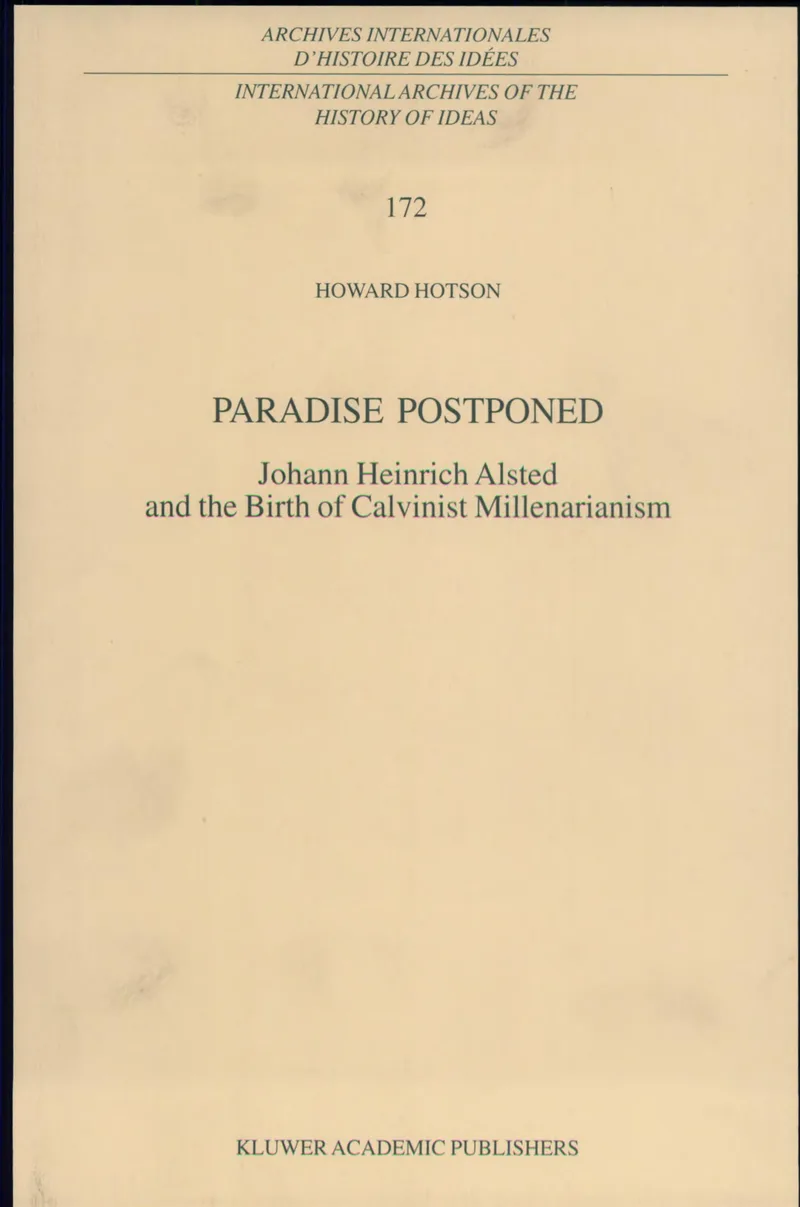
Paradise Postponed
 81
81

Paradise Postponed
Howard Hotson’s *Paradise Postponed* moves beyond conventional analyses of millennialism by excavating the specific, idiosyncratic eschatology of Johann Heinrich Alsted. The strength of Hotson’s meticulous scholarship lies in his ability to illuminate Alsted’s pre-apocalyptic "illumination" concept, a nuanced vision that deviates from standard apocalyptic timelines. The work is particularly effective in tracing the influences of astrological and alchemical traditions on Alsted’s thought, demonstrating their integration into his Calvinist framework. A minor limitation might be the dense academic prose, which requires dedicated attention from the reader. The exploration of Alsted’s early engagement with a "poorly understood Central European tradition" is a high point, offering fresh perspectives on the period's esoteric undercurrents. Ultimately, *Paradise Postponed* offers a valuable, detailed case study for specialists in early modern religious and intellectual history.
📝 Description
81
Howard Hotson's 2007 book examines Johann Heinrich Alsted's vision of a brief spiritual renewal before the apocalypse.
Paradise Postponed analyzes the millenarian thought of Johann Heinrich Alsted, a Calvinist theologian and encyclopedist active in the early 17th century. Hotson reconstructs Alsted's theological framework, which posited a coming period of spiritual and intellectual renewal. This era, distinct from traditional apocalyptic expectations, stemmed from a less recognized intellectual current in Central Europe. The book situates Alsted's ideas within the turbulent intellectual environment of the early 1600s, a time of significant theological debate and widespread interest in encyclopedic knowledge. Alsted's work also engaged with prevailing European fascinations concerning prophecy and the divine order, influenced by contemporaries and operating in a scholarly sphere where mystical and astrological inquiries were still integrated with academic discourse.
Hotson scrutinizes Alsted's specific concept of a pre-apocalyptic "illumination" period. This was not characterized by divine intervention but by an intensification of spiritual and intellectual clarity. Alsted synthesized biblical prophecy, astrological predictions, and alchemical symbolism to articulate this vision. The author highlights Alsted's connection to a specific Central European tradition that merged spiritualist ideas with scholarly pursuits, shaping a unique perspective on the end times.
This work situates Johann Heinrich Alsted's thought within the broader currents of early modern esotericism, where theological speculation intertwined with astrological prognostication and alchemical symbolism. Alsted's conception of a pre-apocalyptic "illumination" period, driven by intellectual clarity rather than divine wrath, reflects a less common strand of millenarianism that sought order and understanding in celestial and prophetic signs. The book connects Alsted to a specific Central European tradition that blended spiritualist interpretations with academic inquiry, demonstrating how esoteric ideas were not entirely separate from mainstream intellectual life in the 17th century.
💡 Why Read This Book?
• Gain insight into Johann Heinrich Alsted's unique pre-apocalyptic "illumination" concept, a departure from typical apocalyptic visions, as detailed in the book's analysis of his early writings. • Understand the integration of astrological and alchemical symbolism within a Calvinist theological framework, a key focus of Hotson's examination of Alsted's work from the early 17th century. • Discover the specific, lesser-known Central European esoteric tradition that shaped Alsted's millenarian views, providing a deeper context for his theological pronouncements.
⭐ Reader Reviews
Honest opinions from readers who have explored this book.
❓ Frequently Asked Questions
What is the central argument of Howard Hotson's Paradise Postponed regarding Johann Heinrich Alsted?
The book argues that Alsted, a significant Calvinist thinker, developed a unique millenarian concept focused on a brief period of enhanced spiritual and intellectual illumination, distinct from traditional apocalyptic visions.
When was Paradise Postponed first published?
Paradise Postponed by Howard Hotson was first published in 2000.
What specific intellectual traditions influenced Alsted's millenarianism?
Alsted's thought was influenced by Calvinist theology, encyclopedism, and a Central European tradition that incorporated astrological, alchemical, and spiritualist elements.
Who was Johann Heinrich Alsted?
Johann Heinrich Alsted (1588-1638) was a German Calvinist theologian, philosopher, and encyclopedist known for his extensive scholarly works and his engagement with millenarian ideas.
What distinguishes Alsted's view of the millennium from other contemporary ideas?
Alsted's concept emphasized a short, final period of intensified divine illumination and knowledge rather than the dramatic, often violent, divine intervention typically associated with apocalyptic millennialism.
What is the significance of the 'Central European tradition' mentioned in the book?
This tradition represents a specific, less understood current of thought that blended esoteric practices like astrology and alchemy with spiritualist and prophetic ideas, providing a unique foundation for Alsted's distinct eschatological views.
🔮 Key Themes & Symbolism
Alsted's Unique Millennial Vision
The work meticulously details Johann Heinrich Alsted's conception of a "brief, final period of enhanced illumination." This vision diverges from standard apocalyptic interpretations of the millennium, presenting instead a phase of accelerated spiritual and intellectual clarity. Hotson argues this was Alsted's primary eschatological focus in his early work, stemming from a synthesis of theological and esoteric sources that aimed for a more enlightened human condition prior to ultimate divine judgment.
Esoteric Influences on Calvinism
Paradise Postponed highlights the significant, yet often overlooked, role of astrological, alchemical, and spiritualist traditions in shaping the thought of a prominent Calvinist exponent like Alsted. It challenges the perception of a strict divide between orthodox theology and esoteric inquiry in the 17th century, demonstrating how these currents could be integrated into a coherent, albeit unconventional, theological framework.
Central European Intellectual Currents
The book sheds light on a specific, under-researched intellectual milieu within Central Europe that fostered a unique blend of mystical, prophetic, and esoteric thought. Alsted's engagement with this tradition is presented as crucial to understanding his distinctive approach to millenarianism, moving beyond the more widely studied Reformation centers to explore a different vein of early modern thought.
The Encyclopedic Impulse
As an encyclopedist, Alsted sought to synthesize vast amounts of knowledge. This impulse is directly linked to his theological and eschatological projects. The book suggests that his vision of an "enhanced illumination" was, in part, a reflection of his belief in the possibility of a comprehensive understanding of divine and natural order, achievable through a concentrated period of intellectual and spiritual effort.
💬 Memorable Quotes
“Alsted looked forward not to the millennium of Apocalypse 20 but to a brief, final period of enhanced illumination.”
— This highlights the core argument that Alsted's eschatology was distinct from common apocalyptic expectations, focusing instead on an imminent era of heightened spiritual and intellectual clarity.
“The work provides a uniquely detailed case study of the origins of millenarianism within the vast opera of Johann Heinrich Alsted.”
— This statement emphasizes the book's scholarly depth and specific focus on Alsted as a key figure in understanding the development of early modern millennial thought.
“The Herborn encyclopedist Johann Heinrich Alsted (1588-1638) was one of the earliest and most influential Calvinist exponents of millenarianism.”
— This positions Alsted as a pivotal, yet perhaps under-recognized, figure whose theological contributions significantly impacted discussions surrounding the end times and the nature of divine intervention.
“Alsted's vision was described in a poorly understood Central European tradition of astrological, alchemical, spiritualist, and generally 'occult' propensities.”
— This points to the esoteric and less conventional influences that shaped Alsted's ideas, suggesting a complex intellectual inheritance that goes beyond mainstream theological discourse.
“The young Alsted emerged as a proponent of a future epoch of divine knowledge.”
— This paraphrased concept underscores Alsted's optimistic outlook regarding humanity's potential for spiritual and intellectual advancement within a divinely ordained historical progression.
🌙 Esoteric Significance
Tradition
This work engages with the esoteric dimensions of early modern Protestantism, particularly within the Hermetic, alchemical, and astrological traditions that permeated European intellectual life. It positions Alsted not merely as a theologian but as a thinker who integrated esoteric cosmology and prognostication into his eschatological framework, suggesting a continuity between seemingly disparate intellectual streams in the 17th century.
Symbolism
The text likely explores symbols associated with astrological cycles and alchemical transformation as integral to Alsted's vision of an "enhanced illumination." These symbols would represent stages of spiritual purification and intellectual enlightenment, a process guided by divine will and celestial configurations, leading towards a perfected state of knowledge and faith.
Modern Relevance
Contemporary scholars of esoteric history and comparative religion may draw upon Hotson's analysis to understand the historical roots of syncretic thought. Thinkers interested in the intersection of science, religion, and occultism in the past can find parallels in modern attempts to reconcile spiritual aspirations with empirical or speculative knowledge, particularly within traditions that seek hidden meanings in natural phenomena.
👥 Who Should Read This Book
• Scholars of early modern European history and theology seeking detailed case studies on the development of millenarian thought. • Researchers in the history of esotericism interested in the integration of astrological, alchemical, and spiritualist ideas within a Protestant context. • Students of intellectual history examining how figures like Johann Heinrich Alsted synthesized diverse philosophical and religious currents in the 17th century.
📜 Historical Context
Published in 2000, Howard Hotson's *Paradise Postponed* revisits the intellectual ferment of the early 17th century, a period characterized by intense theological debate and a pervasive sense of eschatological anticipation. Johann Heinrich Alsted (1588-1638), the subject of the book, was a prominent figure in this era, known for his encyclopedic ambitions and his engagement with Calvinist doctrines. Hotson places Alsted's unique millenarian ideas within the context of contemporary thought, which included both orthodox theological frameworks and more heterodox currents. The work implicitly engages with scholars of Reformation history and the history of ideas, challenging simpler categorizations of early modern thought. Alsted's intellectual milieu was also populated by figures like Andreas Osiander and Johannes Sleidanus, whose works contributed to the broader discourse on divine providence and historical progression, though Alsted's specific synthesis of esoteric traditions offered a distinct perspective.
📔 Journal Prompts
Alsted's "enhanced illumination" concept: How might a period of intense intellectual clarity precede a major spiritual shift?
The integration of astrological prognostication and Calvinist theology: Reflect on the potential for harmony between scientific observation and faith.
Central European esoteric traditions: What aspects of these traditions might have appealed to a 17th-century encyclopedist?
The concept of a "brief, final period": Consider the psychological and societal impact of anticipating a concentrated era of change.
Johann Heinrich Alsted's synthesis of occult and theological ideas: How does this challenge traditional divisions in early modern thought?
🗂️ Glossary
Millenarianism
A belief system centered on the idea of a future 1,000-year period of peace and righteousness on Earth, often linked to divine intervention and the end times.
Chiliasm
An alternative term for millenarianism, referring specifically to the belief in a future earthly kingdom of Christ lasting one thousand years.
Johann Heinrich Alsted
A German Calvinist theologian and encyclopedist (1588-1638) who produced extensive works on theology, philosophy, and various sciences, including significant contributions to millenarian thought.
Encyclopedist
A scholar dedicated to compiling comprehensive works that aim to systematically organize and present the entirety of human knowledge available at their time.
Apocalypse 20
Refers to the common interpretation of the Book of Revelation (often chapter 20) which describes the final battle, the binding of Satan, and the establishment of the 1,000-year reign of Christ.
Occult
Practices, traditions, or knowledge considered hidden, secret, or beyond the scope of ordinary understanding, often involving supernatural or mystical elements.
Astrology
The study of the movements and relative positions of celestial bodies interpreted as having an influence on human affairs and the natural world.