???
 77
77

???
The Brooks' edition of the *Analects* offers a compelling argument for chronological reconstruction, a methodology that certainly enhances the perception of intellectual fluidity rather than rigid dogma. Their meticulous work in placing the sayings within the historical sweep of the Warring States period is its signal achievement. This approach, while demanding, allows for a granular understanding of how Confucian ideas might have been shaped by and responded to their immediate circumstances. However, the sheer density of historical and linguistic scholarship underpinning this reconstruction can present a steep initial barrier for readers not already immersed in the academic discourse surrounding early Chinese texts. A specific passage that exemplifies this approach is the detailed discussion around the dating and contextualization of sayings related to the Duke of Ai, illustrating the editors' commitment to historical accuracy over thematic generalization. While invaluable for specialists, its scholarly apparatus might overshadow the accessibility for those simply seeking foundational Confucian wisdom. It is a scholarly triumph that re-frames our understanding of a foundational text.
📝 Description
77
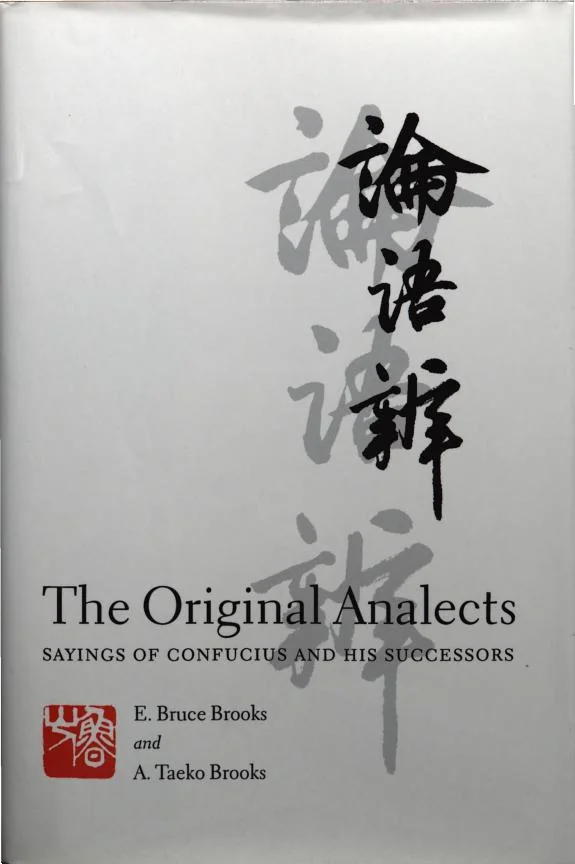
### What It Is This edition of the *Analects* by Confucius, meticulously re-edited by E. Bruce Brooks and A. Taeko Brooks, reconstructs the text within its original historical and intellectual milieu. Published in 1998, this work aims to present the sayings not as a static doctrine but as a dynamic record of evolving thought across the Warring States period. It prioritizes chronological sequencing to reveal the intellectual development of Confucius and his immediate disciples.
### Who It's For Scholars of early Chinese philosophy and historical linguistics will find this a crucial resource. Students of comparative thought and those interested in the genesis of ethical systems will appreciate the contextualization. It is also for readers seeking a more authentic, less anachronistic understanding of Confucian thought, moving beyond later interpretations to engage with the text's origins.
### Historical Context The *Analects* emerged during a period of profound societal upheaval in China, roughly spanning the Spring and Autumn and Warring States periods (c. 771–256 BCE). This era, marked by the decline of Zhou dynasty authority and the rise of competing states, fostered intense philosophical debate. Confucius (551–479 BCE) sought to restore social harmony through ethical cultivation and proper governance. His teachings, compiled by his disciples, became foundational for subsequent Chinese intellectual history, influencing figures like Mencius and Xunzi, and later impacting Neo-Confucianism.
### Key Concepts The work centers on *ren* (benevolence, humaneness), *li* (rites, propriety), *xiao* (filial piety), and *junzi* (the noble person or gentleman). These concepts are presented not as abstract ideals but as practical guides for personal and social conduct, aimed at fostering order and virtue within the family and state. The Brooks' edition emphasizes the historical development of these ideas, showing how they were debated and applied in the turbulent centuries following Confucius's death.
💡 Why Read This Book?
• Gain a chronological understanding of Confucian thought, tracing its evolution through the Warring States period, as presented by the Brooks' meticulous sequencing. • Understand *ren* and *li* not as static ideals but as concepts debated and applied within the specific socio-political conditions of ancient China, as detailed in the historical context provided. • Appreciate the *Analects* as a record of intellectual interaction rather than a closed system, a perspective uniquely offered by the Brooks' analytical framework.
⭐ Reader Reviews
Honest opinions from readers who have explored this book.
❓ Frequently Asked Questions
What is the main goal of the Brooks' edition of the Analects?
The primary goal is to reconstruct the historical and intellectual setting of the Analects, organizing the sayings chronologically to reveal their evolution during the Warring States period, rather than presenting them as a finished philosophical system.
When was the original publication of this specific edition of the Analects?
This edition, edited by E. Bruce Brooks and A. Taeko Brooks, was first published in 1998.
How does this edition differ from other translations of the Analects?
It differs by prioritizing a chronological arrangement of Confucius's sayings, aiming to show the development of his thought and its interaction with the historical context of the Warring States period, as opposed to thematic or arbitrary ordering.
What is the significance of the Warring States period in relation to the Analects?
The Warring States period (c. 475–221 BCE) was a time of significant social and political upheaval in China, providing the dynamic backdrop against which Confucius's teachings on ethics, governance, and social harmony were developed and debated.
Who are E. Bruce Brooks and A. Taeko Brooks?
They are the scholars responsible for this edition, known for their extensive research into early Chinese texts and their efforts to situate Confucian thought within its original historical and intellectual environment.
Does this edition focus on Confucius's biography?
While it provides historical context, the focus is on the intellectual evolution of the sayings attributed to Confucius and his disciples, aiming for maximum understanding of the text as a record of evolving thought, rather than a biographical account.
🔮 Key Themes & Symbolism
Chronological Reconstruction
The core innovation of this edition lies in its commitment to arranging the *Analects* according to a proposed chronological sequence. This departs from thematic or traditional orderings, aiming instead to illuminate the intellectual trajectory of Confucius and his followers across the Warring States period. By understanding the historical evolution of the sayings, readers can perceive the dynamic nature of early Confucian thought and its engagement with contemporary issues, rather than viewing it as a static philosophical corpus.
Intellectual Milieu
This edition meticulously places the *Analects* within its original historical and intellectual context, moving beyond later interpretations. It situates Confucius's teachings within the turbulent socio-political landscape of ancient China, allowing for a richer appreciation of the philosophical debates and societal challenges that shaped his ethical and political ideas. The emphasis is on understanding the text as a product of its time.
Evolution of Thought
Rather than presenting the *Analects* as a closed system, the Brooks' scholarship frames it as a revealing record of life and thought in evolution. This perspective encourages readers to see the development of concepts like *ren* and *li* over time, reflecting the ongoing discourse and adaptation of Confucian principles during the centuries following Confucius's life, particularly during the Warring States period.
Textual Authenticity
The work of E. Bruce Brooks and A. Taeko Brooks is dedicated to restoring the *Analects* to its most historically plausible early form. This involves careful linguistic analysis and historical contextualization to permit maximum understanding, treating the text as a primary source for understanding the Warring States intellectual world, not as a later, codified doctrine.
💬 Memorable Quotes
“The Analects to be read for maximum understanding, not as a closed system of thought but as a richly revealing record of the interaction of life and thought as it evolved over almost the entire Warring States period.”
— This statement highlights the editors' core objective: to present the *Analects* as a dynamic historical document that captures evolving ideas, rather than a static collection of rules or doctrines.
“Bruce and Taeko Brooks have returned this wide-ranging text to its full historical and intellectual setting.”
— This emphasizes the scholarly effort to situate Confucius's teachings within their original time and intellectual currents, providing a grounded understanding of their genesis and initial reception.
“organizing the sayings in their original chronological sequence”
— This describes the methodological approach taken by the editors to reveal the potential development and historical layering of the *Analects* over the Warring States period.
“permitting the Analects to be read... as a richly revealing record of the interaction of life and thought”
— This points to the desired outcome of the scholarly work: enabling readers to see the text not just as philosophy, but as a living record of how ideas were formed and debated in response to real-life circumstances.
“almost the entire Warring States period”
— This phrase indicates the extensive temporal scope the editors consider for the compilation and evolution of the *Analects*, suggesting its ideas were shaped over a considerable duration of Chinese history.
🌙 Esoteric Significance
Tradition
While Confucianism is primarily known as a socio-political and ethical philosophy, its emphasis on self-cultivation, the pursuit of virtue, and the alignment of the individual with cosmic order can be interpreted through an esoteric lens. Its focus on ritual (*li*) as a means of harmonizing the self and society echoes aspects found in Hermeticism and some forms of Western esotericism that value structured practice for spiritual attainment. The pursuit of becoming a *junzi* (noble person) involves a transformation of character that aligns with inner spiritual development.
Symbolism
Key symbols within Confucianism, particularly as presented in the *Analects*, include the concept of the 'Square' and the 'Circle' (representing order and flexibility, or fixed principles and adaptable practice), though these are often more implicit than explicit in the text itself. The 'Mandate of Heaven' (*Tianming*) serves as a crucial symbolic link between virtuous leadership and cosmic approval, imbuing governance with a sacred dimension. The ideal of the 'Noble Person' (*junzi*) itself functions as a symbolic archetype of perfected human potential and ethical embodiment.
Modern Relevance
Contemporary thinkers and practitioners in fields ranging from ethical leadership and organizational development to mindfulness and personal growth draw upon Confucian principles. The emphasis on diligent self-improvement, the cultivation of virtues like benevolence (*ren*), and the understanding of one's role within a community continues to resonate. In esoteric circles, the structured approach to ethical development and the pursuit of inner harmony offer a complement to more mystical or ecstatic paths, providing a grounded framework for spiritual practice.
👥 Who Should Read This Book
• Students of Eastern philosophy and comparative religion seeking foundational texts in their original historical context, benefiting from the Brooks' chronological reconstruction. • Scholars of early Chinese history and linguistics interested in textual analysis and the evolution of thought during the Warring States period, particularly appreciating the detailed scholarly apparatus. • Individuals drawn to ethical frameworks and the development of personal character who wish to engage with Confucianism beyond later commentaries and understand its genesis.
📜 Historical Context
The *Analects* emerged from the crucible of ancient China's Spring and Autumn and Warring States periods (c. 771–256 BCE). This era witnessed the fragmentation of central authority and intense competition among regional states, fostering an environment ripe for philosophical innovation as thinkers sought solutions to societal chaos. Confucius (551–479 BCE) himself lived during the later Spring and Autumn period, a time when traditional Zhou dynasty rituals and social structures were eroding. His teachings, compiled by his disciples, offered a path toward social order through ethical cultivation, emphasizing concepts like *ren* (humaneness) and *li* (rites). These ideas profoundly influenced later philosophers such as Mencius and Xunzi, who developed Confucianism in different directions. The competing schools of thought during this period included Legalism, Daoism, and Mohism, each offering distinct visions for governance and human nature. The Brooks' edition, published in 1998, aims to place these sayings back into their original, evolving context, challenging later interpretations and presenting the *Analects* as a dynamic record of thought development.
📔 Journal Prompts
The concept of *ren* as presented across different chronological strata.
The role of *li* in shaping social order within the Warring States context.
The evolving definition of the *junzi* throughout the text.
Confucius's views on governance during periods of political flux.
The relationship between personal virtue and cosmic order as depicted.
🗂️ Glossary
Ren (仁)
Often translated as benevolence, humaneness, or goodness. It represents the core virtue of Confucianism, emphasizing empathy, compassion, and the ideal of ethical conduct towards others.
Li (禮)
Encompasses rites, rituals, propriety, and etiquette. Li serves as the outward expression of inner virtue and is crucial for maintaining social harmony and order, guiding conduct in various social situations.
Xiao (孝)
Filial piety, a fundamental virtue in Confucianism. It denotes respect, obedience, and care for one's parents and elders, extending to reverence for ancestors.
Junzi (君子)
Literally 'son of a ruler,' but translated as the 'noble person' or 'gentleman.' It refers to the ideal moral exemplar in Confucian thought, characterized by virtue, wisdom, and ethical cultivation.
Warring States period
A period in ancient Chinese history (c. 475–221 BCE) characterized by intense warfare and political fragmentation among rival states, following the decline of the Zhou Dynasty. It was also a time of significant philosophical development.
Spring and Autumn period
The period preceding the Warring States (c. 771–476 BCE), marked by the gradual decline of the Zhou Dynasty's authority and the rise of powerful regional lords. Confucius lived during the latter part of this era.
Tianming (天命)
The Mandate of Heaven. A concept suggesting that Heaven grants rulers the right to rule based on their virtue and ability to govern justly. It implies a cosmic approval that can be withdrawn if a ruler becomes corrupt.