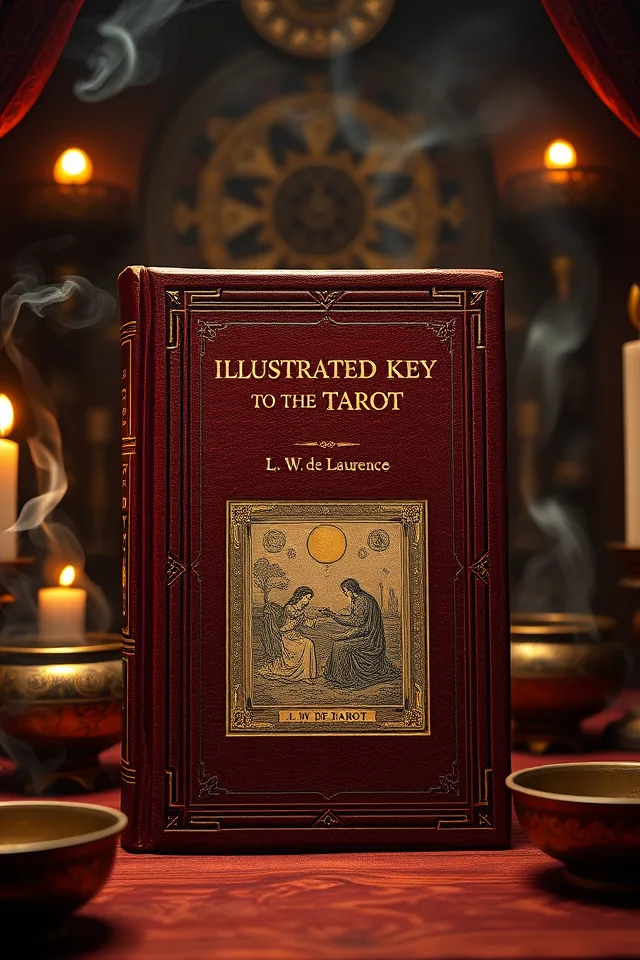
The Illustrated Key To The Tarot

 73
73

The Illustrated Key To The Tarot
De Laurence's *The Illustrated Key to the Tarot* offers a dense, almost encyclopedic approach to the Rider-Waite-Smith imagery, a stark contrast to more modern, streamlined guides. Its strength lies in its unwavering commitment to detail, meticulously dissecting each card’s symbolism through a lens informed by early 20th-century occultism. The frequent references to Qabalistic correspondences, for instance, ground the interpretations in a specific esoteric framework. However, the sheer volume of information and the sometimes archaic language can be intimidating for newcomers. The section detailing the Lesser Arcana, while thorough, can feel repetitive without a strong interpretive narrative to bind it. Nevertheless, for those willing to engage with its historical context and detailed symbolism, it provides a solid, if challenging, foundation in Tarot interpretation.
📝 Description
73
### What It Is
The Illustrated Key to the Tarot by L. W. de Laurence presents a comprehensive visual and textual guide to the ancient practice of Tarot divination. Originally published in 1903, this edition focuses on the Rider-Waite-Smith deck, offering detailed explanations of the symbolism inherent in each of the 78 cards. The work aims to demystify the Tarot, providing readers with the foundational knowledge to interpret the cards for personal insight and foresight.
### Who It's For
This book is intended for serious students of occultism and esoteric philosophy, particularly those interested in the Western Mystery Tradition. It caters to individuals seeking a structured approach to Tarot study, moving beyond superficial interpretations to understand the deeper allegorical meanings. Those who appreciate historical occult texts and the foundational works that shaped modern Tarot practice will find significant value here.
### Historical Context
Published during a fervent period for occult revival in the late 19th and early 20th centuries, de Laurence’s work emerged alongside movements like Theosophy and the Hermetic Order of the Golden Dawn. This era saw a concerted effort to systematize and disseminate esoteric knowledge, often drawing from diverse sources like Kabbalah, Hermeticism, and Egyptian mythology. De Laurence himself was a prolific publisher of occult literature, contributing to the widespread availability of such texts, sometimes through controversial means, making his work a significant, albeit debated, piece of early 20th-century occult publishing history.
### Key Concepts
The core of de Laurence's approach lies in the detailed explication of the Tarot trumps and court cards. Each card is presented with its traditional meanings, astrological associations, and symbolic imagery, often linking them to Qabalistic concepts and elemental forces. The book emphasizes the Tarot as a key to understanding the universe and the human psyche, portraying the cards as archetypal representations of life's journey and spiritual development. The visual component, the "illustrated" aspect, is crucial, as de Laurence believed the imagery itself held direct keys to interpretation.
💡 Why Read This Book?
• Gain a foundational understanding of Tarot symbolism as interpreted through early 20th-century occultism, particularly the Rider-Waite-Smith deck, moving beyond simple divinatory meanings. • Explore the Qabalistic correspondences assigned to each Tarot card, a key element in Western Esotericism, directly from a historical practitioner’s perspective. • Appreciate the historical significance of L. W. de Laurence's contribution to the popularization of Tarot, understanding its place within the broader esoteric revival of the early 1900s.
⭐ Reader Reviews
Honest opinions from readers who have explored this book.
❓ Frequently Asked Questions
What is the primary focus of L. W. de Laurence's The Illustrated Key to the Tarot?
The book focuses on providing a detailed explanation of the symbolism and meanings of the 78 cards in the Rider-Waite-Smith Tarot deck, particularly as understood within early 20th-century occult traditions.
When was The Illustrated Key to the Tarot first published?
The work was first published in 1903, placing it within the context of the late Victorian and Edwardian occult revival.
Does this book use the Rider-Waite-Smith imagery?
Yes, the book is specifically structured around the imagery and symbolism of the Rider-Waite-Smith Tarot deck, which was itself a significant innovation in Tarot design.
What esoteric traditions influence de Laurence's interpretations?
De Laurence's interpretations are heavily influenced by Western Esotericism, including Qabalistic principles, Hermeticism, and elemental symbolism, common in occult circles of his time.
Is this book suitable for complete beginners to Tarot?
While comprehensive, the book's dense language and historical esoteric context might be challenging for absolute beginners. It is better suited for those with some existing interest in occultism or Tarot.
What makes de Laurence's approach unique?
De Laurence's approach is characterized by its detailed, almost scholarly examination of each card's visual elements and their purported esoteric meanings, aiming for a comprehensive key to Tarot symbolism.
🔮 Key Themes & Symbolism
Symbolic Language of the Arcana
The book meticulously deciphers the visual language of the Tarot, focusing on the Rider-Waite-Smith deck. Each card, from the Major Arcana's archetypal journey to the Lesser Arcana's elemental interactions, is presented as a symbolic tableau. De Laurence emphasizes how colors, figures, and objects within the card's design convey specific esoteric meanings, often linking them to Qabalistic concepts and the Tree of Life. This approach treats the deck not merely as a divination tool, but as a complex symbolic map of consciousness and the cosmos.
Qabalistic Correspondences
A central tenet of de Laurence's interpretation is the integration of Qabalistic principles. The book assigns Hebrew letters, paths on the Tree of Life, and Sephirotic influences to various Tarot cards, particularly the Major Arcana. This framework suggests that the Tarot serves as a visual representation of Qabalistic cosmology and the process of creation. Understanding these correspondences is presented as essential for unlocking the deeper layers of Tarot meaning and its connection to universal energies.
Tarot as a Key to Esoteric Knowledge
De Laurence positions the Tarot not just as a fortune-telling device but as a fundamental 'key' to understanding broader esoteric doctrines. The book implies that by mastering the symbolism and meanings of the cards, one gains access to ancient wisdom traditions, including Hermeticism and alchemy. The Tarot is presented as a pedagogical tool designed to initiate the student into the mysteries of the universe and the human condition, bridging the visible and invisible realms.
The Illustrated Method
The emphasis on 'illustrated' in the title is paramount. De Laurence believed that the visual presentation of the cards was intrinsically linked to their interpretive power. He guides the reader to observe specific details in the artwork – the posture of figures, the presence of animals, the surrounding elements – as direct carriers of meaning. This visual-centric approach highlights the power of archetypal imagery to communicate profound concepts that transcend ordinary language.
💬 Memorable Quotes
“The Tarot cards are a book of wisdom.”
— This statement encapsulates de Laurence's view of the Tarot not as a simple divinatory tool, but as a profound text containing ancient knowledge and symbolic truths accessible to those who study it.
“Each card is a symbol, a hieroglyph of occult science.”
— Here, the author emphasizes the symbolic nature of Tarot imagery, likening each card to a sacred symbol or 'hieroglyph' that holds coded meanings within the realm of occult philosophy.
“The Major Arcana represent the great forces of nature and the stages of spiritual evolution.”
— This interpretation highlights the belief that the 22 trump cards are not mere pictures but allegorical representations of fundamental universal powers and the transformative journey of the soul.
“The symbolism of the Lesser Arcana relates to the practical affairs of life and elemental forces.”
— This concept suggests that the numbered cards (Wands, Cups, Swords, Pentacles) correspond to the mundane world and the interplay of the four elements, offering insights into daily events and their underlying energies.
“The Fool represents the beginning of a cycle, often associated with divine inspiration and the unknown.”
— This interpretation points to the archetypal meaning of the Fool card, signifying new beginnings, faith, potential, and the leap into the uncharted territory of experience.
🌙 Esoteric Significance
Tradition
This work fits squarely within the Western Esoteric Tradition, particularly influenced by Hermeticism and Qabalistic studies prevalent in the late 19th and early 20th centuries. De Laurence sought to synthesize various esoteric streams, presenting the Tarot as a key to unlocking these ancient systems. It departs from purely folkloric or divinatory interpretations by embedding the cards within a complex cosmological and philosophical framework, aiming to provide a systematic guide to occult knowledge.
Symbolism
Key symbols explored include the archetypal figures of the Major Arcana, such as The Magician (representing divine will and manifested power) and The High Priestess (embodying intuition and the hidden feminine principle). The book also details the elemental symbolism of the suits (Wands for Fire, Cups for Water, Swords for Air, Pentacles for Earth) and the significance of numbers and court card figures within the Lesser Arcana, connecting them to Qabalistic paths and elemental forces.
Modern Relevance
De Laurence's detailed approach to symbolism, particularly his emphasis on Qabalistic correspondences, continues to inform modern Tarot practitioners and esoteric students. While contemporary interpretations may evolve, the foundational work of understanding the visual language and symbolic depth of the Rider-Waite-Smith deck, as laid out by de Laurence and others of his era, remains a significant reference point for many studying Western esotericism and Tarot.
👥 Who Should Read This Book
• Students of Western Esotericism seeking to understand the historical context of Tarot interpretation, particularly its Qabalistic and Hermetic dimensions. • Tarot enthusiasts interested in a detailed, symbolic analysis of the Rider-Waite-Smith deck, moving beyond basic meanings to explore esoteric layers. • Researchers of occult history and early 20th-century mystical literature who wish to examine de Laurence's influential publications in the field.
📜 Historical Context
L. W. de Laurence's *The Illustrated Key to the Tarot*, first published in 1903, emerged during a period of intense interest in spiritualism and occultism, heavily influenced by figures like Helena Blavatsky and the Theosophical Society. This era saw a surge in the publication and dissemination of esoteric texts, often aiming to systematize previously fragmented mystical traditions. De Laurence himself was a prolific, and sometimes controversial, publisher and author in this field. The book's focus on the Rider-Waite-Smith deck, designed by Arthur Edward Waite and illustrated by Pamela Colman Smith and published in 1909, places it at the cusp of a new wave of Tarot popularization. While de Laurence's work predates the RWS deck's full publication, his foundational approach to symbolism resonated with the intellectual currents of groups like the Hermetic Order of the Golden Dawn, which explored Qabalistic and Hermetic interpretations of Tarot imagery, contrasting with the more traditional cartomantic approaches prevalent earlier.
📔 Journal Prompts
The symbolism of The World card and its representation of completion.
The elemental associations of the suit of Swords and their connection to intellect and conflict.
The depiction of The Hermit and its association with introspection and inner guidance.
Qabalistic correspondences as applied to the Major Arcana, such as the link between The Lovers and the Hebrew letter Vau.
The role of the four court cards (King, Queen, Knight, Page) in representing different facets of elemental expression.
🗂️ Glossary
Major Arcana
The set of 22 trump cards in a Tarot deck, representing significant archetypal figures, life lessons, and spiritual journeys.
Lesser Arcana
The 56 numbered cards of a Tarot deck, divided into four suits (Wands, Cups, Swords, Pentacles), typically representing more mundane events and circumstances.
Qabalah
A complex system of Jewish mysticism that involves esoteric traditions concerning the nature of God and the creation of the universe, often represented by the Tree of Life.
Hermeticism
A philosophical and religious tradition based on writings attributed to Hermes Trismegistus, emphasizing esoteric knowledge, spiritual ascent, and the interconnectedness of the cosmos.
Rider-Waite-Smith Deck
A highly influential Tarot deck first published in 1909, known for its fully illustrated Minor Arcana and symbolic imagery, designed by Arthur Edward Waite and illustrated by Pamela Colman Smith.
Divination
The practice of seeking knowledge of the future or the unknown by supernatural means, often through tools like Tarot cards.
Esotericism
Belief systems and practices that focus on inner, spiritual knowledge, often reserved for initiates or those with specialized understanding, contrasting with exoteric or public teachings.