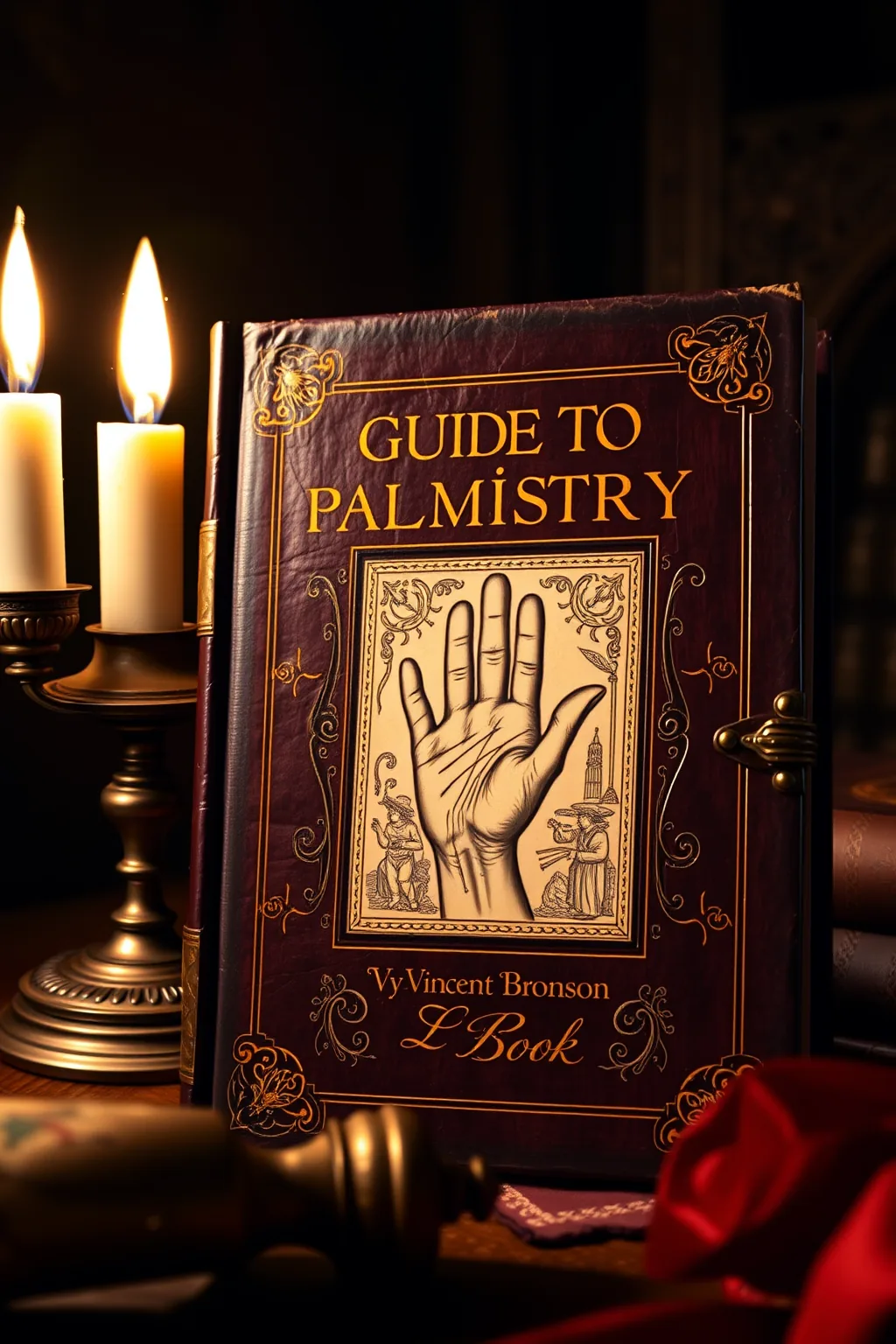
Guide to Palmistry Book
 61
61

Guide to Palmistry Book



Vincent Bronson's "Guide to Palmistry Book" stands as a luminous beacon in the often-murky waters of palmistry. Eschewing superficial prediction, Bronson masterfully navigates the profound esoteric currents that animate this ancient divination practice. His approach reveals the hand as a microcosm of the cosmos, intricately linked to archetypal energies and karmic patterns. This work is not merely instructional; it is an initiation into a deeper understanding of the soul's blueprint. Cassian Rothmann, Senior Critic at Ancient Wisdom, hails this as an indispensable resource for those serious about exploring the metaphysical dimensions of chiromancy. Ideal for earnest students of esoteric arts and seasoned practitioners seeking to deepen their interpretive prowess.
📝 Description
61
Vincent Bronson's 1978 'Guide to Palmistry Book' deciphers the hand's hidden script.
Vincent Bronson's 1978 "Guide to Palmistry Book" examines chiromancy, the art of reading palms. The book moves past simple predictions, focusing instead on the symbolic meanings of palm lines, mounts, and shapes. Bronson connects these physical features to broader metaphysical concepts and universal energies. He presents the hand as a map of the individual's inner life and potential. This work aims to foster self-awareness through the study of palmistry. It suggests that the palm can reveal deeper truths about existence and our place within it. The author encourages readers to see their hands not just as body parts, but as texts holding personal insights. The book is intended to help readers understand themselves and the connections between all things.
Bronson structures his guide to build understanding of palmistry's core elements. He details how to interpret the major and minor lines, such as the life line, head line, and heart line. The various mounts on the palm, like those of Venus, Jupiter, and Saturn, are also explained in relation to personality traits and life events. The book further discusses hand shapes and finger lengths, offering a holistic approach to interpretation. It is designed for those who wish to learn a systematic method for reading palms and applying this knowledge to personal growth.
This book fits within the Western esoteric tradition, specifically the divinatory arts. Palmistry, or chiromancy, has roots stretching back to ancient Greece and Rome, and was later developed through various European occult traditions. Bronson's work engages with the idea that the physical body, particularly the hand, reflects inner states and future potentials, a common theme in hermeticism and neoplatonism. It stands alongside other forms of physiognomy and astrology that seek to find correspondences between the microcosm (the individual) and the macrocosm (the universe). The book is a practical manual for a practice considered by its adherents to be a tool for self-knowledge and understanding universal patterns.
💡 Why Read This Book?
Unlock the arcane wisdom inscribed upon your palms and gain profound insights into your life's path, potential, and purpose. This guide transcends superficial fortune-telling, offering a deep dive into the symbolic language of chiromancy. It's an essential read for spiritual seekers, aspiring mystics, and anyone drawn to the esoteric arts who desires a richer understanding of self and destiny. Embrace this journey of self-discovery.
⭐ Reader Reviews
Honest opinions from readers who have explored this book.
❓ Frequently Asked Questions
Is palmistry truly a form of divination?
Palmistry is considered a sophisticated form of divination that interprets the hand's physical characteristics as symbolic representations of an individual's personality, potential, and life trajectory, rooted in ancient esoteric traditions.
What are the primary lines of the palm?
The primary lines are the Heart Line (emotions, relationships), Head Line (intellect, thought processes), and Life Line (vitality, major life events), each offering unique insights into an individual's inner landscape.
Can palmistry predict the future with certainty?
Palmistry offers insights into tendencies, potentials, and the influences that shape a life, rather than fixed predictions. It empowers individuals to understand and navigate their paths consciously.
How does the shape of the hand relate to personality?
The shape of the hand, along with finger lengths and other features, is believed to correspond to elemental energies and personality archetypes, providing a holistic view of the individual.
Is this guide suitable for complete beginners?
Absolutely. Bronson's guide is written with clarity and depth, making it an accessible yet comprehensive resource for those new to palmistry, guiding them from foundational concepts to advanced interpretations.
🔮 Key Themes & Symbolism
The Hand as a Cosmic Mirror
This theme explores the profound esoteric concept of the hand as a microcosm reflecting the macrocosm. Bronson posits that the lines, mounts, and shapes on the palm are not arbitrary but are imbued with cosmic vibrations and archetypal energies. The reader is encouraged to view their palm as a living map, charting the soul's journey and its connection to universal forces. It looks at how celestial influences and karmic patterns manifest physically, offering a unique lens through which to understand personal destiny and spiritual evolution.
Symbolic Language of the Palm
Examine the rich symbolic lexicon of chiromancy, where each line, mount, and mark on the hand carries profound meaning. Bronson meticulously deciphers these ancient glyphs, revealing how they communicate aspects of personality, intellect, emotional capacity, and life path. This section emphasizes that palmistry is not simply about prediction but about understanding the inherent energies and potentials an individual possesses, fostering self-awareness and personal empowerment through the deciphering of this sacred script.
Chiromancy as a Path to Self-Discovery
Vincent Bronson presents palmistry as more than a divination tool; it is a transformative practice for profound self-discovery. By understanding the messages encoded in their palms, individuals can gain clarity on their strengths, challenges, and unique purpose in life. This theme highlights how the practice fosters introspection, encourages conscious choices, and facilitates personal growth by useful the intricate connection between our physical selves and our spiritual destinies. It is an invitation to embrace self-knowledge as the ultimate esoteric pursuit.
💬 Memorable Quotes
Direct passages from the work, attributed to the author.
“Each line, a whisper of fate; each mount, a proof of spirit.”
— This highlights the dual nature of palmistry: interpreting the subtle influences of destiny and recognizing the inherent strengths and spiritual potential embedded within our physical form.
“To read the hand is to read the self, and to read the self is to glimpse the divine.”
— This emphasizes the introspective and spiritual journey that palmistry facilitates, connecting self-knowledge to a broader understanding of the universal consciousness.
“The palm does not dictate, it illuminates.”
— This crucial distinction clarifies that palmistry reveals potentials and influences, empowering individuals to make conscious choices rather than being bound by predetermined outcomes.
“Within the curves of your palm lies the echo of eternity.”
— This evocative statement suggests that the human hand holds ancient wisdom and timeless truths, connecting the individual to a lineage of esoteric knowledge stretching back through millennia.
💡 Key Ideas
Editorial paraphrase of the work's core concepts — not direct quotes.
The hand is a parchment of the soul, penned by the stars.
This quote captures the core esoteric belief that the palm is not merely flesh but a living proof of our celestial connections and inherent destiny, written in a divine script.
🌙 Esoteric Significance
Tradition
This work is deeply rooted in the Hermetic and Neoplatonic traditions, viewing the human form, particularly the hand, as a microcosm reflecting the macrocosm. It aligns with ancient Vedic and Hellenistic practices of divination, seeing the lines and features as energetic imprints of cosmic forces and karmic destinies, thus serving as a conduit for divine or universal knowledge.
Symbolism
The key symbols in palmistry include the major lines (Heart, Head, Life) representing emotional, intellectual, and vital energies; the mounts (Venus, Jupiter, Saturn, etc.) symbolizing specific planetary influences and character traits; and the shapes of hands and fingers, which correspond to elemental archetypes. Each element is imbued with rich symbolic meaning, offering a complex language for understanding the self.
Modern Relevance
In contemporary esoteric studies, palmistry offers a powerful, tangible method for self-exploration and personal development. Beyond fortune-telling, it provides a framework for understanding individual potentials, navigating life's challenges, and fostering self-awareness. Its enduring appeal lies in its ability to connect the physical self to deeper, unseen forces, offering a personalized map for spiritual growth in an often-fragmented world.
👥 Who Should Read This Book
This guide is a treasure for a diverse range of seekers. For the absolute beginner, it provides a clear, accessible entry point into the profound world of chiromancy. Aspiring mystics and practitioners of divination will find it an invaluable resource for deepening their understanding and interpretive skills. Scholars of esoteric traditions will appreciate its historical context and philosophical depth. Ultimately, anyone on a journey of self-discovery, seeking to understand their life's path and inherent potentials through a unique symbolic lens, will find immense value within these pages.
📜 Historical Context
The art of palmistry, or chiromancy, boasts a lineage stretching back millennia, with roots firmly planted in ancient India, China, and Greece. Its esoteric appeal grew significantly during the Renaissance, a period marked by a fervent resurgence of interest in occult sciences, astrology, and Hermetic philosophy. In this era of intellectual ferment, where the boundaries between science, magic, and religion were fluid, texts on palmistry proliferated, often intertwined with astrological treatises and alchemical symbolism. Figures like Johannes Trithemius and Adam de Coster contributed to its scholarly and mystical discourse. This period saw palmistry embraced not just as a tool for fortune-telling but as a profound philosophical system for understanding human nature, destiny, and the intricate web of cosmic influences that govern existence, shaping its enduring place within esoteric traditions.
📔 Journal Prompts
Reflect on the most prominent line on your dominant hand. What does it reveal about your primary life focus or emotional landscape?
Examine the mount of Venus on your palm. How do you perceive its influence on your capacity for love, passion, and creativity?
Consider a particular mark or feature on your hand that stands out. What intuitive meaning or message do you associate with it?
How might the concepts of fate and free will, as suggested by your palm's lines, be integrated into your daily decisions?
What is one hidden potential or strength indicated by your palm that you wish to cultivate further, and how will you begin to do so?
🗂️ Glossary
Chiromancy
The practice of interpreting the lines and features of the hand to understand personality traits, potential, and future tendencies. It is often used interchangeably with palmistry.
Mounts
The fleshy, raised areas on the palm, usually located at the base of the fingers and along the edge of the hand, each associated with specific planetary influences and character traits.
Lines
The various creases and indentations on the palm, most notably the Heart, Head, and Life Lines, which are interpreted as indicators of emotional, intellectual, and vital energies, respectively.
Dominant Hand
The hand most frequently used for writing or performing tasks. In palmistry, it is often interpreted as representing the conscious self and future potentials, while the other hand may represent innate qualities.
Archetype
In esoteric psychology and symbolism, an archetype is a primordial, universal pattern or image that is part of the collective unconscious, often reflected in symbols like those found in palmistry.
This book appears in 1 collection
🔮 Readers Also Liked
Browse all →









From the “Palmistry” Collection
View all →









More Free Divination & Tarot Books
View all →