Life time astrology
 73
73

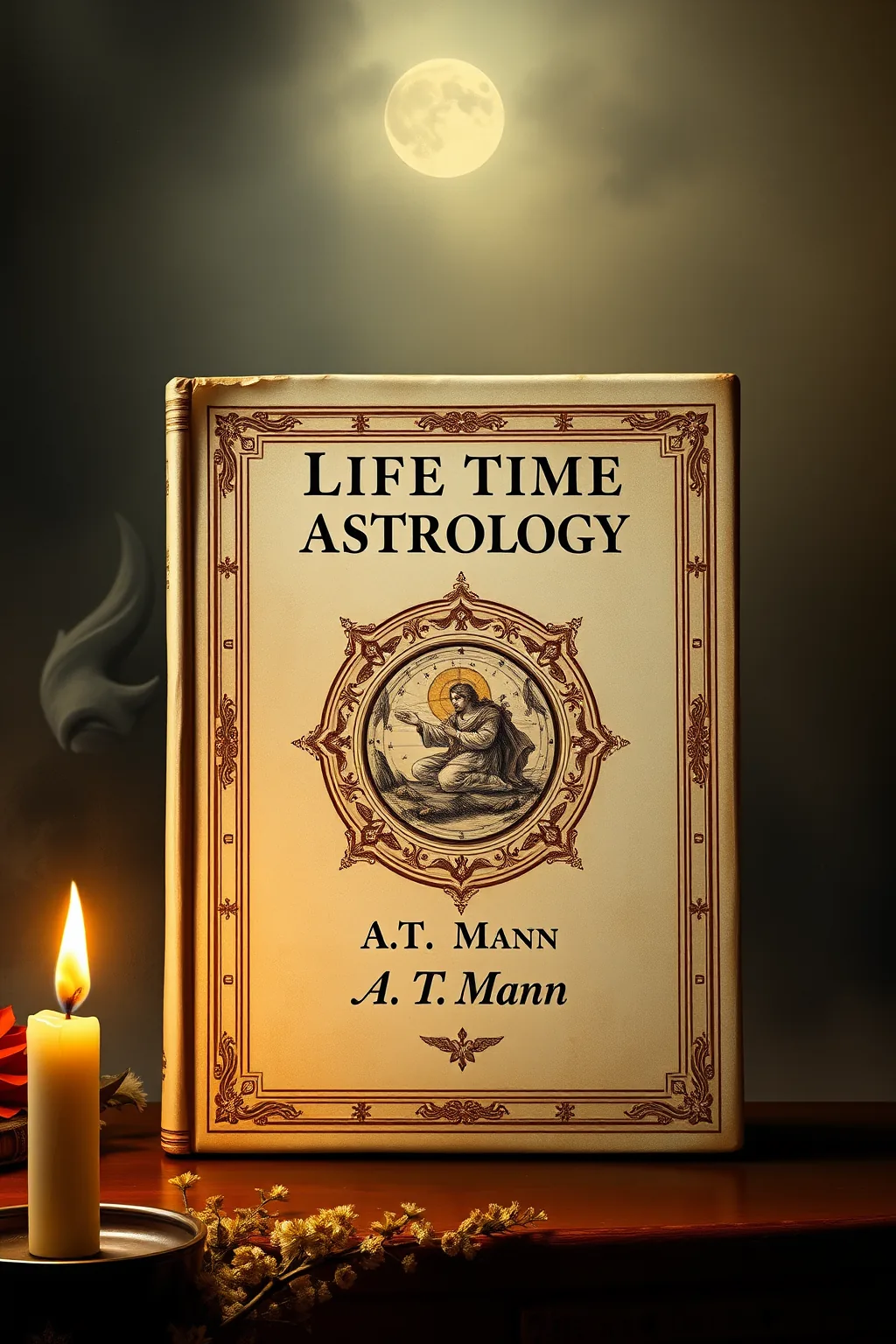
Life time astrology
A. T. Mann’s ‘Life Time Astrology’ offers a compelling re-framing of astrological charts, presenting them not as fixed destinies but as dynamic maps of personal evolution. The strength of the work lies in its detailed exposition of how planetary cycles align with developmental stages, moving beyond the superficial. Mann’s ability to connect astrological symbolism to tangible life phases, such as the Saturn Return or the mid-life transitions, provides a structured approach for understanding personal growth. However, the sheer density of information, while exhaustive, can occasionally feel overwhelming for the uninitiated, demanding a dedicated reader. A particularly insightful passage discusses the 'Grand Cross' configurations as potential crucibles for significant life restructuring, illustrating the book's capacity to interpret complex celestial patterns in human terms. The work is an essential, if demanding, resource for serious astrological students seeking depth. Verdict: A foundational text for understanding astrological developmental psychology.
📝 Description
73
A. T. Mann's 1985 book applies astrological principles to the entire human lifespan.
'Life Time Astrology' examines how planetary energies and cycles shape human development from birth to old age. Mann moves past simple horoscopes to frame astrology as a system for understanding personal growth, life challenges, and the unfolding of individual potential at different stages. The author integrates astrological symbolism with psychological and developmental concepts, creating a detailed map of both inner and outer life.
This work is for those seeking a deeper astrological understanding of personal development. It appeals to experienced astrologers wanting to broaden their interpretative methods and students of esoteric philosophy interested in connecting celestial patterns with human experience. Readers drawn to the intersection of psychology, mythology, and ancient traditions will find Mann's integrated perspective valuable. The book requires engagement with complex symbolic systems, not a search for quick horoscopes.
Published in 1985, 'Life Time Astrology' appeared during a revival of esoteric studies in the West. This period saw increased interest in subjects like Jungian psychology and mythology, which influenced Mann's synthesis. The book contributed to a trend of integrating ancient symbolic languages with modern psychological understanding, positioning astrology as a tool for self-awareness rather than just prediction.
💡 Why Read This Book?
• Gain a structured understanding of how planetary cycles, like the influence of Saturn's return around age 29, correlate with distinct developmental phases and personal challenges throughout your life. • Learn to interpret your birth chart not as a static prediction, but as a dynamic blueprint that evolves, offering insights into your potential for growth and transformation across different age brackets. • Explore the concept of archetypal influences within astrology, linking specific celestial symbols to universal human experiences and developmental milestones, providing a richer framework for self-reflection.
⭐ Reader Reviews
Honest opinions from readers who have explored this book.
❓ Frequently Asked Questions
What is A. T. Mann's approach to astrology in 'Life Time Astrology'?
A. T. Mann's approach is developmental, viewing astrological charts as dynamic maps of human growth across the lifespan. He integrates psychological and symbolic interpretations to illustrate how planetary cycles influence distinct life stages from birth through old age.
When was 'Life Time Astrology' first published?
'Life Time Astrology' by A. T. Mann was first published in 1985, placing it within a period of renewed interest in psychological and developmental astrology.
Does the book focus on predictive astrology?
No, the book emphasizes understanding personal development and potential rather than providing precise future predictions. It uses astrological symbolism as a framework for self-analysis and understanding life's natural cycles.
Who would benefit most from reading 'Life Time Astrology'?
Serious students of astrology, those interested in psychological archetypes, and individuals seeking a deeper understanding of how celestial patterns relate to life stages will find this book particularly beneficial.
What is a key concept explored in the book regarding life stages?
A key concept is the correlation between specific planetary cycles and developmental phases. For instance, the book explores how the energies of certain planets are particularly prominent during particular ages or life transitions.
Is 'Life Time Astrology' suitable for beginners?
While comprehensive, the book's depth and integration of complex concepts might be more suited for those with some foundational knowledge of astrology or a strong interest in esoteric psychology.
🔮 Key Themes & Symbolism
Developmental Life Stages
The central theme is the application of astrological principles to map the human lifespan. Mann posits that distinct planetary cycles and configurations correspond to specific developmental phases, from infancy through old age. This involves understanding how energies shift and manifest differently at various points in life, such as adolescence, mid-life, and elderhood. The work frames astrological interpretation as a tool for comprehending personal evolution and the unfolding of potentials across these stages, offering a structured way to engage with the natural progression of human experience through a celestial lens.
Archetypal Influences
Mann explores how astrological symbols represent universal archetypes that influence human psychology and behavior across the lifespan. These archetypes, often linked to planetary deities and zodiacal signs, are presented as fundamental patterns of consciousness that shape our experiences and development. The book suggests that understanding these archetypal forces, as expressed through the birth chart and transit cycles, can illuminate our inner world and guide us through life's inherent challenges and opportunities. This perspective connects astrological study to depth psychology and mythological studies.
The Evolving Birth Chart
Contrary to a static view, 'Life Time Astrology' presents the birth chart as a dynamic and evolving blueprint. While the natal configuration remains constant, its expression and significance change as individuals mature and progress through different life cycles. The book details how transits and progressions activate specific potentials within the natal chart, influencing psychological states and life events. This dynamic interpretation encourages readers to view their astrological makeup not as a fixed destiny, but as a living system that offers guidance for reading through the ongoing process of personal growth and transformation.
Astrology and Psychological Integration
A core aspect of Mann's work is the integration of astrological symbolism with psychological theory, particularly drawing from Jungian concepts of individuation and archetypes. The book posits astrology as a valuable symbolic language for understanding the psyche's journey. By examining the interplay of celestial patterns and inner development, readers can gain insights into their own psychological makeup, unconscious motivations, and the process of becoming whole. This approach elevates astrology from a predictive art to a sophisticated tool for self-awareness and psychological integration.
💬 Memorable Quotes
Direct passages from the work, attributed to the author.
“The birth chart is a map of potential, not a sentence of fate.”
— This highlights the book's core philosophy: astrology provides a framework for understanding one's inherent capacities and life path, but emphasizes free will and the active role individuals play in shaping their destiny.
“Each Saturn Return marks a significant transition, a restructuring of our responsibilities and our place in the world.”
— This interpretation focuses on a specific astrological event, the Saturn Return (occurring around age 29, 58, etc.), as a critical period for reassessment and maturation, underscoring the book's developmental perspective.
“The Grand Cross configuration acts as a cosmic crucible, demanding profound transformation.”
— This references a complex astrological aspect, the Grand Cross, and interprets it as a catalyst for significant personal change, illustrating Mann's method of linking celestial patterns to deep psychological processes.
“Understanding planetary cycles offers a rhythm to the chaos of life.”
— This interpretation suggests that astrology, by outlining predictable celestial movements and their corresponding life influences, provides a sense of order and meaning to the often unpredictable nature of human existence.
💡 Key Ideas
Editorial paraphrase of the work's core concepts — not direct quotes.
Mid-life is often heralded by potent astrological alignments that challenge established identities.
This paraphrase points to the book's exploration of the mid-life phase, suggesting that significant astrological transits during this period can precipitate psychological shifts and a re-evaluation of one's life direction.
🌙 Esoteric Significance
Tradition
This work aligns with the modern Western Esoteric tradition, particularly its branches focused on psychological astrology and Hermetic principles of correspondence. It draws implicitly from the Hermetic axiom 'As Above, So Below,' applying it to the human life cycle. While not strictly Kabbalistic or Gnostic, it integrates symbolic interpretation methods common in these traditions. Mann's approach is a continuation of the Theosophical and Anthroposophical emphasis on spiritual evolution through distinct stages, filtered through a more accessible psychological lens.
Symbolism
Key symbols include planetary archetypes (e.g., Saturn representing structure and limitation, Jupiter signifying expansion and wisdom) and zodiacal signs as expressions of consciousness. The 'life cycle' itself functions as a primary symbolic structure, representing the journey of the soul or ego through distinct phases of development. Mann also utilizes concepts like 'aspects' between planets as symbolic representations of internal psychological dynamics and relationships.
Modern Relevance
Mann's framework for understanding astrological influences across life stages remains highly relevant for contemporary psychological astrologers and developmental psychologists interested in symbolic systems. His work is foundational for practitioners who emphasize natal chart interpretation within a life-cycle context. Modern schools of evolutionary astrology and archetypal psychology often cite or implicitly build upon his developmental models, continuing the exploration of how celestial patterns inform the human journey of growth and transformation.
👥 Who Should Read This Book
• Students of psychological astrology seeking a detailed model for applying birth charts to understand personal growth across different life stages. • Individuals interested in Jungian psychology and archetypes who wish to explore how celestial symbolism can illuminate the process of individuation. • Esoteric scholars and practitioners looking for a comprehensive text that bridges ancient astrological wisdom with modern developmental theory and symbolic interpretation.
📜 Historical Context
Published in 1985, 'Life Time Astrology' emerged during a period when esoteric studies were gaining broader traction, moving beyond fringe circles into more academic and self-help spheres. This era saw a confluence of interests in Jungian psychology, mythology, and comparative religion, all of which heavily influenced Mann's integrative approach. Figures like Dane Rudhyar had already laid groundwork for psychological astrology, but Mann's specific focus on mapping astrological influences across the entire lifespan offered a distinct developmental framework. The book contributed to a burgeoning intellectual current that sought to synthesize ancient symbolic systems with modern psychological understanding. It appeared in a landscape where astrology was increasingly viewed not just as fortune-telling, but as a complex symbolic language for self-exploration, a perspective that gained momentum throughout the late 20th century.
📔 Journal Prompts
The Saturn Return's call for responsibility in your life.
Mapping the archetypal influences of your early childhood chart.
Reflecting on the 'mid-life challenge' as described by astrological transits.
Identifying the symbolic meaning of a potent planetary aspect in your natal chart.
How the concept of 'life stages' informs your current personal evolution.
🗂️ Glossary
Birth Chart (Natal Chart)
A diagram representing the positions of the Sun, Moon, planets, and astrological aspects at the moment of a person's birth, used to interpret personality and life potential.
Planetary Cycles
The predictable orbital paths and periods of planets, which astrologers correlate with recurring themes and energies in human life and the wider world.
Life Stages
Distinct phases of human development (e.g., adolescence, adulthood, old age) that the book associates with specific astrological influences and symbolic meanings.
Archetypes
Universal, primordial patterns of human experience and behavior, often represented by mythological figures or symbols, which are believed to be reflected in astrological configurations.
Saturn Return
An astrological event occurring approximately every 29.5 years when the planet Saturn returns to the same position it occupied at the time of birth, often marking a period of significant maturation and responsibility.
Aspects
The angular relationships between planets in a birth chart, which astrologers interpret as indicating how different energies and psychological functions interact.
Transits
The ongoing movement of planets through the sky, interpreted by astrologers as influencing current events and psychological states in relation to the birth chart.
🔮 Readers Also Liked
Browse all →








More by A. T. Mann
All books →





More Free Astrology & Cosmology Books
View all →