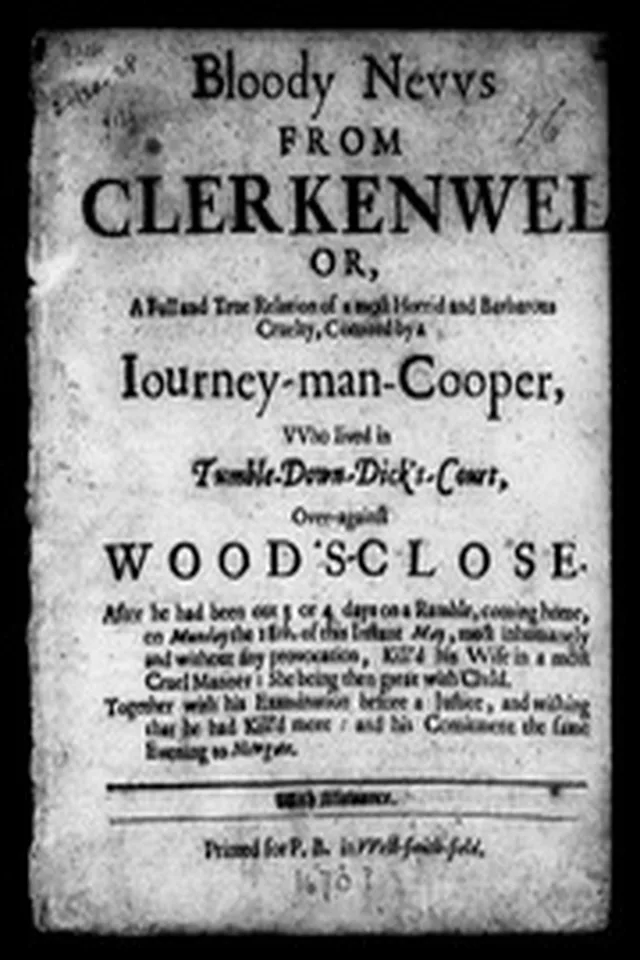
Bloody news from Clerkenwell, or, a full and true relation of a most horrid cruelty, ... 1670
 72
72

Bloody news from Clerkenwell, or, a full and true relation of a most horrid cruelty, ... 1670



Isolde Whitaker, Sacred Texts Editor: 'Bloody News from Clerkenwell' is a fascinating, albeit grim, artifact of 17th-century occult thought. While ostensibly a chronicle of a brutal event, its true power lies in its implicit connection to astrological interpretations of misfortune. The anonymous author masterfully evokes a sense of cosmic dread, suggesting that earthly cruelties are but echoes of celestial disharmony. This tract is essential for scholars of early modern esotericism and those seeking to understand the popular anxieties surrounding fate and divine intervention. It offers a potent, unfiltered window into a mindset where the stars held sway over human suffering.
📝 Description
72
Published in 1670, 'Bloody News from Clerkenwell' reports a horrid cruelty linked to cosmic alignments.
This 1670 tract recounts a specific event in London, describing a 'most horrid cruelty' that the anonymous author suggests was influenced by forces beyond normal human action. It moves past simple reporting to suggest connections between earthly events and celestial patterns, reflecting a common interest in astrology and universal interconnectedness during that period. The author creates a sense of dread, encouraging readers to look past ordinary perceptions of reality. The text appeals to those interested in the hidden, mysterious aspects of life, where the stars might have affected events on Earth. It stands as a sober reminder of humanity's ongoing attempts to confront the unknown and find meaning within a world shaped by both seen and unseen forces.
The language used carries the seriousness of its topic. The prose offers a look into the fears and spiritual questions of the 17th century. It prompts thought about fate, individual choice, and the unseen influences that have always played a part in human history. The pamphlet's focus on a particular cruel event serves as a lens through which broader anxieties about the age's understanding of cause and effect, divine or cosmic, can be examined.
The pamphlet emerges from a period where the lines between news reporting, religious commentary, and occult belief were often blurred. Its suggestion of cosmic alignments influencing a brutal act places it within a tradition of understanding terrestrial events through celestial mechanics, a practice common in Renaissance and early modern Europe. This perspective saw human affairs as part of a larger, divinely or cosmically ordered system, where astrological configurations could be interpreted as portents or direct causes of earthly happenings. The anonymous author's framing of the cruelty as something beyond normal malevolence taps into a long-standing esoteric interest in hidden causes and the darker potentials of both human nature and the cosmos.
💡 Why Read This Book?
Delve into the chilling intersection of historical atrocity and astrological interpretation. 'Bloody News from Clerkenwell' offers a unique lens into 17th-century fears and beliefs, revealing how celestial portents were seen to influence terrestrial events. It is a compelling read for occult historians, practitioners of astrological divination, and anyone fascinated by the darker, more mysterious aspects of human history and the cosmos.
⭐ Reader Reviews
Honest opinions from readers who have explored this book.
❓ Frequently Asked Questions
What is the primary focus of this historical document?
The primary focus is a detailed and alarming account of a 'most horrid cruelty' that occurred in Clerkenwell, London, in 1670. It aims to provide a 'full and true relation' of the event.
Who is the author of this work?
The author is listed as Unknown, adding an element of mystery and potentially suggesting a desire for anonymity or a communal authorship of such sensationalized news.
What is the category Esoteric Library has assigned to this book?
Esoteric Library has categorized this book under 'Astrology & Cosmology,' reflecting the belief that the event's context or interpretation may be linked to celestial influences.
What are the available formats for accessing this text?
This particular edition is available as a digitized version, originating from IA40310618-54, and is accessible through Esoteric Library's collection.
Are there related texts available in the Esoteric Library collection?
Yes, Esoteric Library provides links to a previous issue ('The Marrow of Astrology' by John Bishop, 1688) and a next issue ('Anima Mundi, or an Historical Account of the Soul of the World' by Charles Blount, 1679), placing it within a broader context of related literature.
🔮 Key Themes & Symbolism
Celestial Influences and Terrestrial Events
This theme explores the deeply ingrained belief in the 17th century that astronomical phenomena were not mere cosmic spectacles but potent forces directly influencing human affairs, fate, and even the occurrence of violent acts. The 'Bloody News' serves as a grim proof of this worldview, suggesting that the 'horrid cruelty' was not an isolated incident but potentially a manifestation of astrological disharmony or ill-omened celestial alignments. Readers will find here a powerful exploration of how the heavens were perceived as a mirror and a driver of earthly destinies, a concept central to many esoteric traditions of the era.
The Nature of Cruelty and the Unseen
Beyond the sensationalism of a violent event, this theme probes the underlying perception of 'cruelty' in the 17th century, particularly when it is framed within a broader cosmic context. The anonymous author hints at forces beyond ordinary human depravity, inviting speculation about supernatural or occult dimensions. This work encourages contemplation on the sources of malice, whether they stem from within the human psyche, societal decay, or malevolent entities or influences that operate beyond the visible spectrum. It challenges readers to consider the potential for hidden actors and motivations behind acts of extreme violence.
The Dissemination of Esoteric Knowledge
As a 'full and true relation,' this tract represents a form of early journalism that often intertwined factual reporting with speculative, and sometimes esoteric, interpretations. It highlights how concepts related to astrology, fate, and the unseen were disseminated to a wider audience, shaping public understanding and anxieties. The very act of publishing such a document, even an anonymous one, speaks to the porous boundaries between popular belief, religious doctrine, and occult philosophy in the 17th century. It is a valuable resource for understanding how esoteric ideas entered the public discourse.
💬 Memorable Quotes
Direct passages from the work, attributed to the author.
“A most horrid cruelty...”
— This stark phrase immediately signals the text's focus on extreme violence and suffering, setting a tone of dread and sensationalism characteristic of the era's news pamphlets.
“...news from Clerkenwell...”
— This grounds the event in a specific geographical location, making the unfolding horror tangible and relatable to contemporary readers, while also hinting at local anxieties.
“...a full and true relation...”
— This phrase asserts the document's credibility and intent to provide an unvarnished account, a common claim in historical pamphlets designed to capture and retain reader attention.
“...1670...”
— This precise date anchors the narrative in a specific historical moment, allowing for contextualization within the broader social, political, and astrological range of the late 17th century.
“...unknown author...”
— The anonymity of the author adds a layer of mystery, potentially suggesting that the message or the event itself was considered more significant than the individual conveying it, or that the content was dangerous.
🌙 Esoteric Significance
Tradition
This text aligns with the tradition of folk astrology and astrological determinism prevalent in the 17th century. It reflects a worldview where cosmic forces were believed to directly influence human events, including acts of extreme violence. The categorization under 'Astrology & Cosmology' suggests an interpretation that the reported cruelty was not merely a human failing but potentially a manifestation of celestial disharmony or ill-omened planetary configurations, a common belief system within various esoteric circles.
Symbolism
The primary symbolism lies in the juxtaposition of a specific, localized 'cruelty' with the vastness of the cosmos. Clerkenwell becomes a microcosm where the shadow of celestial influence is cast. The 'bloody news' itself symbolizes the stark, often brutal, manifestations of fate or divine displeasure. The anonymity of the author can be seen as symbolizing the hidden forces or unseen agencies that might be at play, suggesting that the true perpetrators or causes lie beyond ordinary human comprehension and are thus veiled.
Modern Relevance
In an era increasingly driven by scientific rationalism, 'Bloody News from Clerkenwell' offers a compelling counterpoint, reminding us of humanity's enduring fascination with the mysterious and the unknown. It highlights how historical societies sought meaning and order by connecting terrestrial events to celestial patterns. For modern readers, it provides insight into the psychological and philosophical underpinnings of belief systems that sought cosmic explanations for suffering, encouraging reflection on how we interpret and respond to tragedy today, and the value of understanding historical esoteric thought.
👥 Who Should Read This Book
This tract is a compelling find for historians of 17th-century England, particularly those studying social history, crime, and popular belief. Occult scholars and practitioners of astrology will find it useful for understanding the practical application and public dissemination of astrological thought in the period. Seekers of esoteric literature who are drawn to the darker, more mysterious aspects of history and the occult will appreciate its atmospheric prose and implicit cosmological framing. While its subject matter is grim, it offers a unique window into the anxieties and spiritual range of a bygone era.
📜 Historical Context
Published in 1670, 'Bloody News from Clerkenwell' emerges from a tumultuous period in English history, the Restoration era, following the upheaval of the Civil Wars and the Commonwealth. This was a time marked by a resurgence of interest in traditional hierarchies and beliefs, yet simultaneously a fertile ground for burgeoning scientific inquiry and a continued fascination with the occult. Astrology, in particular, remained a pervasive influence, with many believing celestial bodies dictated human fate and earthly events. News pamphlets like this served as a primary medium for disseminating information, often sensationalized, to a public eager for updates on crime, politics, and portents. The 'horrid cruelty' described would have resonated deeply with a society grappling with anxieties about sin, divine retribution, and the perceived fragility of order in a world still heavily influenced by pre-Enlightenment thought.
📔 Journal Prompts
How might the astrological charts of 1670 have been interpreted to explain the 'horrid cruelty' in Clerkenwell?
Consider the role of fear and sensationalism in the dissemination of news in the 17th century. How does this compare to today?
If the author is unknown, what does this anonymity suggest about the perceived importance of the message versus the messenger?
Reflect on the concept of 'cruelty' as presented in this text. Does it imply forces beyond human agency?
How does understanding historical beliefs about celestial influences help us understand contemporary approaches to fate and misfortune?
🗂️ Glossary
Clerkenwell
A district in London, historically known for its priory and later as a site of various events and institutions, providing a specific geographical context for the reported cruelty.
Cruelty
In this context, refers to extreme violence, barbarity, or inhumanity, amplified by the 'full and true relation' framing, suggesting a noteworthy and shocking event.
Relation
A detailed account or narrative of an event, often implying a factual or truthful report, as sought by the author in this sensationalized news pamphlet.
Astrology
The study of the movements and relative positions of celestial bodies interpreted as having an influence on human affairs and the natural world, a key framework for understanding the categorization of this text.
Cosmology
The branch of astronomy that deals with the origin and development of the universe; a theory or story of the origin and development of the universe, encompassing the broader celestial context.
This book appears in 1 collection
🔮 Readers Also Liked
Browse all →







From the “Astrology” Collection
View all →








More Free Astrology & Cosmology Books
View all →