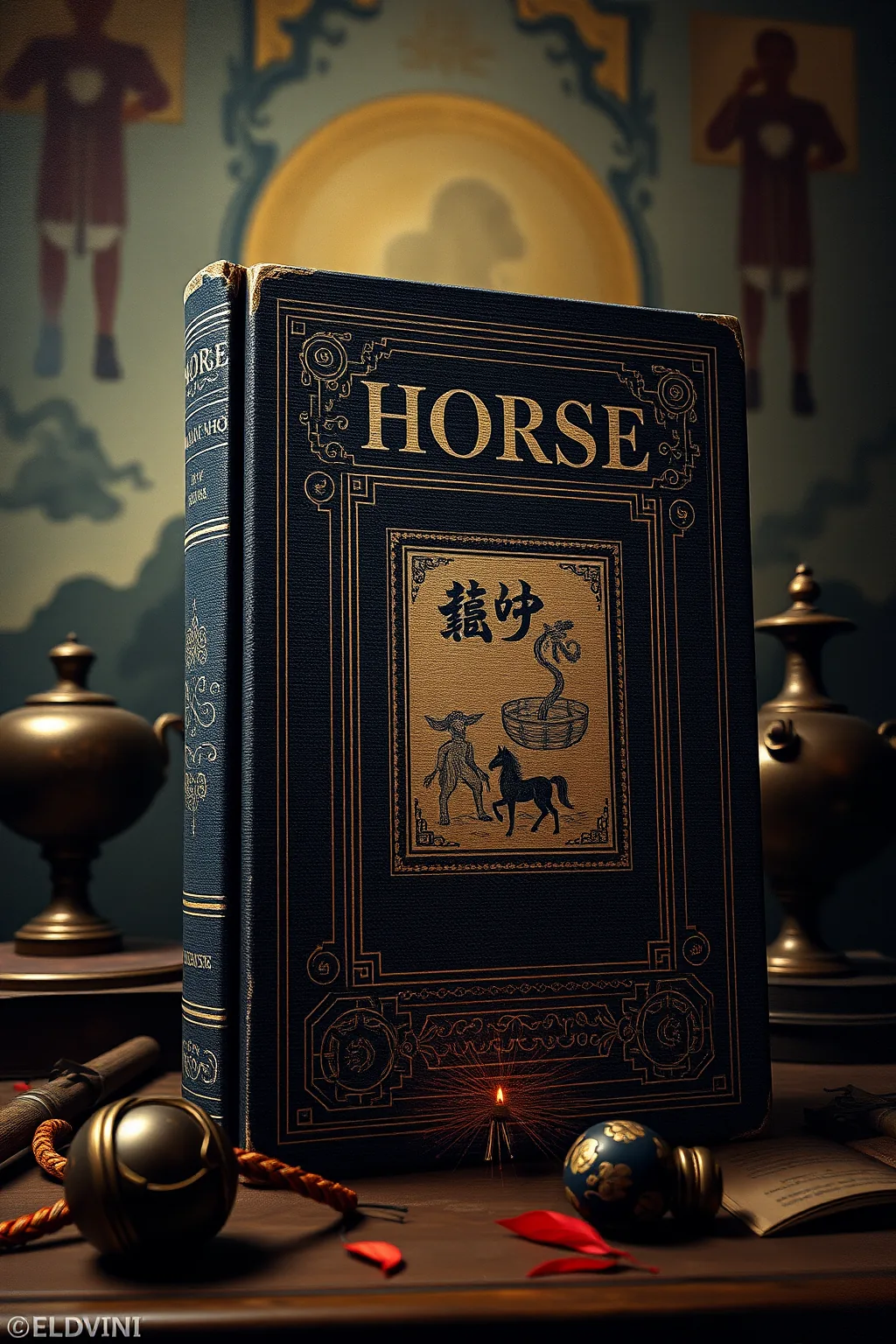
Horse
 72
72

Horse
Kwok Man-ho’s "Horse" presents a curious case, offering a dense, almost academic dissection of a single subject. The author's commitment to exhaustively exploring the multifaceted symbolism of the horse is commendable, moving beyond simple animalistic traits to engage with its archetypal significance. The strength lies in its rigorous, almost encyclopedic approach to symbolic association. However, the prose, while precise, can feel quite dry, lacking the evocative quality one might expect from a text on esoteric themes. A passage detailing the horse's representation in various cosmological diagrams is particularly effective, illustrating the book's potential. Yet, the overall experience is one of intellectual pursuit rather than spiritual revelation. "Horse" is a valuable, if somewhat austere, contribution to symbolic studies.
📝 Description
72
Kwok Man-ho's "Horse," published in 1994, analyzes symbolic representation through a philosophical lens.
This 1994 book by Kwok Man-ho approaches symbolic representation and esoteric philosophy not as a narrative, but as a structured examination of concepts. It functions like a lexicon or a series of meditations on specific ideas, analyzed through a unique perspective. The text dissects elements that are often viewed holistically, offering an analytical breakdown. This work is for readers interested in symbolic systems and comparative philosophy who are willing to engage with abstract thought and view familiar concepts from new angles. It appeals to dedicated students of esoteric traditions rather than casual readers, providing detailed examinations of cultural and spiritual iconography. The book emerged in the mid-1990s, a time of growing global interest in Eastern and Western philosophies. Kwok Man-ho's work fits into this intellectual climate, offering a perspective on symbolism distinct from purely academic or devotional methods.
Kwok Man-ho's "Horse" engages with esoteric philosophy by dissecting how objects and concepts, like the horse, accumulate multiple layers of meaning across diverse cultural and philosophical frameworks. It questions the construction and transmission of meaning within symbolic language itself. The book treats its subject not merely as an animal but as a convergence of ideas, energies, and archetypes, fitting within traditions that explore the deeper, often hidden, connections between the mundane and the symbolic.
💡 Why Read This Book?
• Gain a deeper understanding of symbolic representation by analyzing the horse motif through Kwok Man-ho's specific framework, first published in 1994, which offers a unique lens on cultural iconography. • Explore the layered meanings of a single archetype, moving beyond superficial interpretations to grasp its connection to esoteric concepts as presented in the text's structured analyses. • Appreciate the 1990s intellectual climate surrounding esoteric studies by examining how "Horse" engages with symbolic systems, providing context for its original publication.
⭐ Reader Reviews
Honest opinions from readers who have explored this book.
❓ Frequently Asked Questions
When was Kwok Man-ho's "Horse" first published?
Kwok Man-ho's "Horse" was first published in 1994. This date places it within a period of renewed interest in esoteric studies and comparative cultural symbolism.
What is the main subject of "Horse" by Kwok Man-ho?
The primary subject of "Horse" is an in-depth exploration of the symbolism and esoteric significance attributed to the horse across various traditions and philosophical systems.
Is "Horse" a narrative book?
No, "Horse" is not a narrative book. It functions more as a structured analysis or a series of meditations on the symbolic and conceptual meanings associated with the horse.
What kind of reader would appreciate "Horse"?
Readers interested in symbolic systems, comparative philosophy, and detailed examinations of cultural or spiritual iconography would find "Horse" particularly engaging.
What is a key concept explored in "Horse"?
A key concept is the multifaceted nature of symbols and how a single entity, like the horse, can embody numerous layers of meaning across different cultural and philosophical contexts.
Does the book discuss the horse in a purely biological sense?
No, the book focuses on the symbolic, archetypal, and esoteric dimensions of the horse, treating it as a nexus of ideas rather than solely as a biological creature.
🔮 Key Themes & Symbolism
Archetypal Representation
The work examines the horse not merely as an animal but as a potent archetype that carries significant symbolic weight across diverse cultures. It looks at how this archetype functions as a vessel for concepts such as power, freedom, and spiritual conveyance. The text analyzes the structure of such representations, questioning how an image can transcend its literal form to embody broader philosophical or cosmological ideas, a central tenet in many esoteric traditions.
Symbolic Lexicon
"Horse" functions as a specialized lexicon, dissecting the various meanings attributed to the horse in different contexts. It maps out these semantic layers, revealing connections between seemingly disparate interpretations. This approach highlights the interconnectedness of symbolic language, suggesting that meanings are not isolated but part of a larger symbolic economy. The book's meticulous cataloging of these associations is key to its esoteric value.
Philosophy of Meaning
Beyond its specific subject, the book engages with the underlying philosophy of how meaning is constructed and perceived. It explores how symbols operate, what makes them potent, and how they relate to human consciousness and perceived reality. The work implicitly questions the nature of interpretation itself, suggesting that understanding symbolic texts requires a specific mode of engagement that goes beyond literal comprehension.
Cultural Resonance
The text traces the horse's resonance through various cultural and historical periods, demonstrating its enduring presence in human thought and spiritual expression. It highlights how the symbol adapts and persists, reflecting underlying human needs or universal principles. This cross-cultural analysis is fundamental to understanding the book's esoteric perspective, which seeks universal truths within specific cultural manifestations.
💬 Memorable Quotes
Direct passages from the work, attributed to the author.
“The horse as a vehicle for spiritual journeys.”
— This concept suggests the horse's symbolic role in moving not just the physical body, but the consciousness or soul. It points to its representation in myths and rituals as a mediator between the mundane and the sacred.
“The layered significance of the equine form.”
— This refers to the idea that the horse, as a symbol, contains multiple, often interconnected, meanings. These can range from primal energy and instinct to nobility, divine messengers, or even aspects of the self.
“Equine imagery in cosmological diagrams.”
— This highlights the book's exploration of how the horse is integrated into visual representations of the universe or spiritual planes, serving as a component within a larger symbolic map.
“The horse as a symbol of untamed forces.”
— This interpretation focuses on the horse's inherent wildness and power, often representing primal energies or instinctual drives that must be understood and potentially integrated, rather than suppressed.
“Symbolic transformation through equine association.”
— This suggests that engaging with the symbolism of the horse can lead to personal or spiritual change, altering one's perception or understanding of fundamental concepts.
🌙 Esoteric Significance
Tradition
The work draws implicitly from traditions that place high value on symbolic interpretation and archetypal analysis, such as Hermeticism and certain schools of comparative mythology. It departs from strict adherence to any single lineage by focusing on the universality of symbolic resonance, treating the horse as a cross-cultural archetype rather than exclusively a figure within a specific pantheon or magical system.
Symbolism
Central symbols include the horse itself, representing power, freedom, spiritual conveyance, and the untamed aspects of nature or the psyche. Its depiction in cosmological diagrams signifies its role as a component within a larger map of reality or spiritual planes. The equine form can also symbolize transformation and the bridge between the material and the spiritual worlds.
Modern Relevance
Contemporary practitioners in fields like Jungian psychology, comparative mythology, and even some forms of modern occultism continue to find value in detailed symbolic analysis. Kwok Man-ho's methodical approach to deconstructing archetypal imagery offers a framework for understanding how symbols function across different belief systems, aiding in the interpretation of ancient texts and modern spiritual expressions.
👥 Who Should Read This Book
• Students of comparative mythology and symbolism seeking to understand archetypal representations across cultures. • Esoteric practitioners interested in a rigorous, analytical exploration of a single potent symbol rather than a broad survey. • Scholars of 1990s esoteric literature interested in how symbolic systems were being dissected and presented during that period.
📜 Historical Context
Kwok Man-ho's "Horse," released in 1994, appeared during a dynamic period for esoteric and comparative religious studies. The late 20th century saw a significant increase in the availability of translated Eastern texts and a growing academic interest in non-Western spiritual traditions, alongside a persistent fascination with Western esotericism. While established academic fields often focused on textual criticism or historical lineage, "Horse" engaged with symbolism from a perspective that sought deeper, perhaps more universal, conceptual connections. It arrived in a landscape where authors like Mircea Eliade had already popularized comparative mythology, and figures in occult circles were actively synthesizing diverse traditions. The work navigated this space by offering a focused, analytical approach to a single potent symbol, distinct from the broader syncretism or devotional practices common in some esoteric circles of the time.
📔 Journal Prompts
The horse's role as a spiritual vehicle.
Equine imagery within cosmological frameworks.
Untamed forces symbolized by the horse.
The layered meanings of the equine form.
Personal associations with the horse archetype.
🗂️ Glossary
Archetype
A universal, inherited pattern of thought or image derived from the collective unconscious, often manifesting in myths, symbols, and dreams. The horse serves as a potent archetype in many cultures.
Symbolic Representation
The use of an image, object, or concept to stand for something else, often an abstract idea or a deeper reality. The book analyzes the horse as a rich example of this.
Cosmological Diagrams
Visual representations or maps depicting the structure of the universe, spiritual planes, or the relationship between different areas of existence.
Esoteric
Relating to or accessible only by a relatively small number of people with a specialized knowledge or interest. Esoteric texts often explore hidden meanings.
Lexicon
A vocabulary of a language, field, or specific text. In this context, it refers to the book's function as a detailed catalog of meanings associated with the horse.
Phenomenology
The philosophical study of the structures of experience and consciousness. While not explicit, the book's focus on perception of symbols touches upon this.
Ontology
The philosophical study of being or existence. The book implicitly touches on the 'being' of the horse as a symbol.
🔮 Readers Also Liked
Browse all →








More by Kwok Man-ho
All books →





More Free Astrology & Cosmology Books
View all →