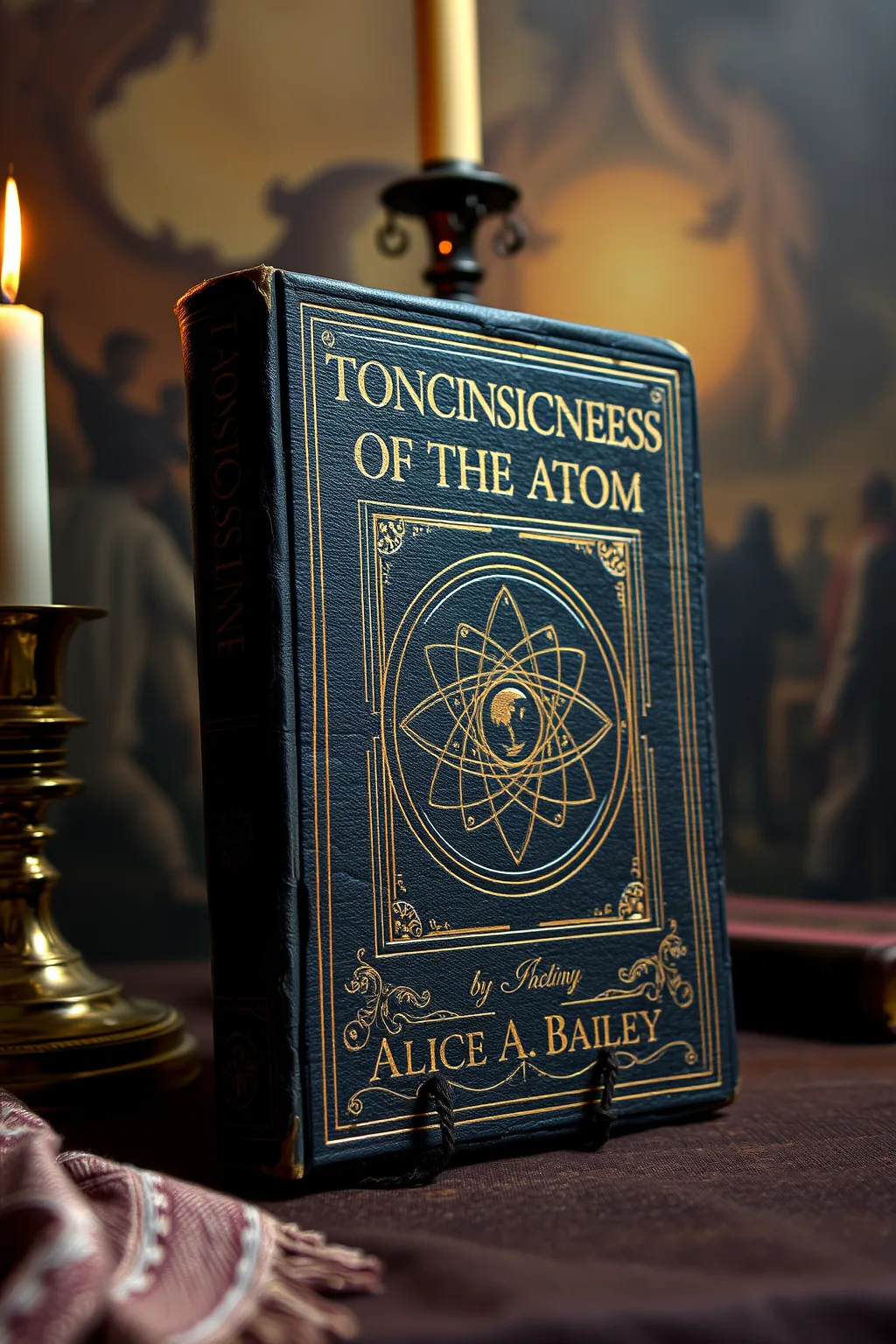
The Consciousness of the Atom
 82
82

The Consciousness of the Atom



Marcus Thorne (Esoteric Sciences Reviewer) — Alice A. Bailey's 'The Consciousness of the Atom' remains a cornerstone of esoteric literature, offering unparalleled insights into the energetic nature of reality. Bailey masterfully bridges the gap between ancient wisdom and nascent scientific understanding, positing a universe animated by consciousness at its most fundamental level. This text is not merely theoretical; it provides a framework for perceiving the subtle energies that shape our world and our inner lives. Its strengths lie in its comprehensive scope and its ability to inspire a profound shift in perspective. Highly recommended for serious students of Hermeticism, Alchemy, and Theosophy seeking to deepen their understanding of universal principles.
📝 Description
82
Alice A. Bailey's 1927 book, 'The Consciousness of the Atom,' posits the atom as a conscious entity.
Published in 1927, Alice A. Bailey's 'The Consciousness of the Atom' presents a unique perspective on the fundamental nature of reality. Bailey describes the atom not as dead particles, but as a living, conscious unit imbued with divine intelligence. The book elaborates on how these atomic consciousnesses organize and interact to form the manifest universe.
Bailey connects the structure and behavior of the atom to the greater cosmic order. She suggests that understanding the microcosm, the atom, can lead to insights about the macrocosm, the universe. The text uses symbolic language to encourage readers to move beyond a purely material view of existence and recognize the underlying unity. It aims to provide a framework for perceiving the divine structure of creation and an individual's role within it.
This book fits within the Theosophical tradition, building upon ideas of a living universe and monadic principles. It shares with Theosophy a focus on the energetic and conscious nature of all existence, from the smallest particle to the largest cosmic structure. Bailey's work further develops concepts of divine order and the interconnectedness of all things through a detailed examination of the atom as a fundamental unit of consciousness.
💡 Why Read This Book?
Unlock a revolutionary understanding of matter and consciousness. 'The Consciousness of the Atom' offers a profound re-framing of physics and metaphysics, revealing the spiritual essence within the material world. Ideal for seekers of hidden knowledge, students of esoteric philosophy, and practitioners aiming to align with universal energies. Discover the energetic blueprint of creation and your role within it.
⭐ Reader Reviews
Honest opinions from readers who have explored this book.
❓ Frequently Asked Questions
What is the central thesis of 'The Consciousness of the Atom'?
The book posits that atoms are not inert particles but possess consciousness and are fundamental units of divine energy, orchestrated by intelligent forces.
How does this book relate to science?
It offers a spiritual interpretation of atomic structure, proposing that consciousness underlies physical phenomena, complementing rather than contradicting scientific inquiry.
Who was Alice A. Bailey?
An influential esoteric author who wrote extensively on spiritual science, occultism, and the evolution of consciousness, often channeling teachings from a Tibetan Master.
Is this book suitable for beginners?
While profound, it is accessible to dedicated beginners willing to engage with complex metaphysical concepts and symbolic language.
What is the significance of the atom in this esoteric context?
The atom is presented as a microcosm of the universe, a unit of life and consciousness that reflects the grander, divine plan of creation.
🔮 Key Themes & Symbolism
The Energetic Nature of Reality
This theme explores the fundamental esoteric concept that all of existence is comprised of vibrating energy, with consciousness as its animating principle. Bailey elucidates how this energy manifests at the atomic level, revealing the atom not as a dead, material construct, but as a dynamic, conscious entity. It explores the subtle forces and vibratory rates that govern the material world, offering a shift in thinking from a purely materialistic view to one where spirit and energy are indivisible, forming the very foundation of all forms and phenomena in the cosmos.
Consciousness as the Primordial Force
Central to Bailey's work is the idea that consciousness predates and underlies all physical form. 'The Consciousness of the Atom' posits that the atomic structure itself is imbued with awareness, a spark of the universal Mind. This theme examines the hierarchical nature of consciousness, from the atom's inherent awareness to the greater cosmic intelligence. It invites readers to contemplate the interconnectedness of all conscious beings and the role of intention and thought in shaping reality, urging a deeper understanding of our own divine potential.
The Microcosm and Macrocosm
This profound theme draws parallels between the smallest constituent parts of the universe and the entirety of creation. Bailey illustrates how the principles governing the atom are mirrored in the larger structures of planets, solar systems, and galaxies. The book's exploration of the atom serves as a gateway to understanding the universal laws and divine order that govern all levels of existence. It emphasizes that by comprehending the fundamental nature of the atom, one can gain insights into the grand cosmic design and one's own integral place within it.
💬 Memorable Quotes
Direct passages from the work, attributed to the author.
“Consciousness is the life-power of the atom.”
— Highlighting the animation of the atomic realm, this suggests that inherent awareness is the driving force behind atomic behavior and existence.
“The universe is a manifestation of Divine Thought.”
— This profound statement underscores the idealistic nature of creation, where all physical reality originates from a cosmic consciousness or mind.
“The atom is the building block of all that is.”
— Emphasizing the foundational role of the atom, this highlights its importance not just in physical matter but as a fundamental unit of all existence, spiritual and material.
💡 Key Ideas
Editorial paraphrase of the work's core concepts — not direct quotes.
The atom is the smallest particle of matter, and it is the smallest particle of spirit.
This quote expresses the core esoteric tenet that matter and spirit are not separate but are dual aspects of a single, unified reality, with the atom as a fundamental manifestation of both.
Energy is the expression of consciousness.
Connecting the abstract concept of consciousness to tangible phenomena, this quote posits that all energetic displays are outward manifestations of underlying awareness.
🌙 Esoteric Significance
Tradition
This work is a central to the Ageless Wisdom tradition, heavily influenced by Theosophy, and further developed by Alice A. Bailey's specific teachings. It bridges Hermeticism, Neoplatonism, and Eastern philosophies, presenting a unified cosmology where consciousness is the primary reality, and the material world is its energetic expression.
Symbolism
The atom itself serves as a profound symbol of microcosm reflecting macrocosm. It represents the smallest unit of divine life and consciousness, mirroring the grander cosmic order. Other symbols include the underlying energies, vibrations, and the divine spark within all matter, signifying unity and interconnectedness.
Modern Relevance
In an era grappling with the limits of purely materialistic science and seeking deeper meaning, Bailey's insights into consciousness as the fundamental fabric of reality are profoundly relevant. Her work offers a spiritual framework for understanding quantum physics and the interconnectedness of all life, guiding individuals towards a more holistic and conscious existence.
👥 Who Should Read This Book
This book is important for serious students of esoteric philosophy, spiritual science, and Hermeticism. It is particularly suited for those seeking to understand the energetic basis of reality, the nature of consciousness, and the interconnectedness of all things. While it can be challenging, dedicated beginners will find it informative. Scholars of comparative religion and metaphysics will appreciate its unique synthesis of ideas. Practitioners of meditation and energy work may find it offers a deeper theoretical underpinning for their practices.
📜 Historical Context
Published in 1922, 'The Consciousness of the Atom' emerged during a period of intense intellectual and spiritual ferment. The early 20th century witnessed groundbreaking discoveries in physics, particularly concerning atomic structure, alongside a burgeoning interest in esoteric philosophies, mysticism, and spiritualism. Alice A. Bailey, writing through her unique channeling process, sought to synthesize ancient wisdom traditions with these contemporary developments. Her work addressed a growing global consciousness yearning for deeper meaning beyond materialist paradigms. The book's publication by Lucis Publishing Company (initially Lucifer Publishing Company) placed it within the lineage of Theosophical thought, contributing significantly to the esoteric landscape and influencing subsequent generations of spiritual seekers and occultists.
📔 Journal Prompts
Reflect on the concept of atomic consciousness. How might this alter your perception of the physical world around you?
Consider the parallels between the atom and the human being. What lessons can be drawn from this microcosm-macrocosm analogy?
Explore the idea of energy as the expression of consciousness. How does this concept resonate with your personal experiences?
Meditate on the underlying unity of all existence as suggested by the atomic model presented. What feelings or insights arise?
How can the understanding of 'The Consciousness of the Atom' be practically applied to foster greater harmony and interconnectedness in your life?
🗂️ Glossary
Esoteric
Pertaining to or accessible only to a select group of people with a specialized knowledge or interest; inner or hidden meaning.
Hermeticism
A spiritual, philosophical, and esoteric tradition based primarily upon the writings attributed to Hermes Trismegistus, emphasizing the interconnectedness of all things and the power of the mind.
Macrocosm
The universe considered as a complex whole, in which the human body is reflected, or seen as an analogue.
Microcosm
A miniature world or universe; a person or thing seen as a model or epitome of something larger.
Theosophy
A mystical philosophy that claims to derive knowledge of God and the universe from direct experience or intuition, often blending elements of Eastern and Western mysticism.
This book appears in 2 collections
🔮 Readers Also Liked
Browse all →









From the “Hermeticism” Collection
View all →








More Free Alchemy & Hermeticism Books
View all →