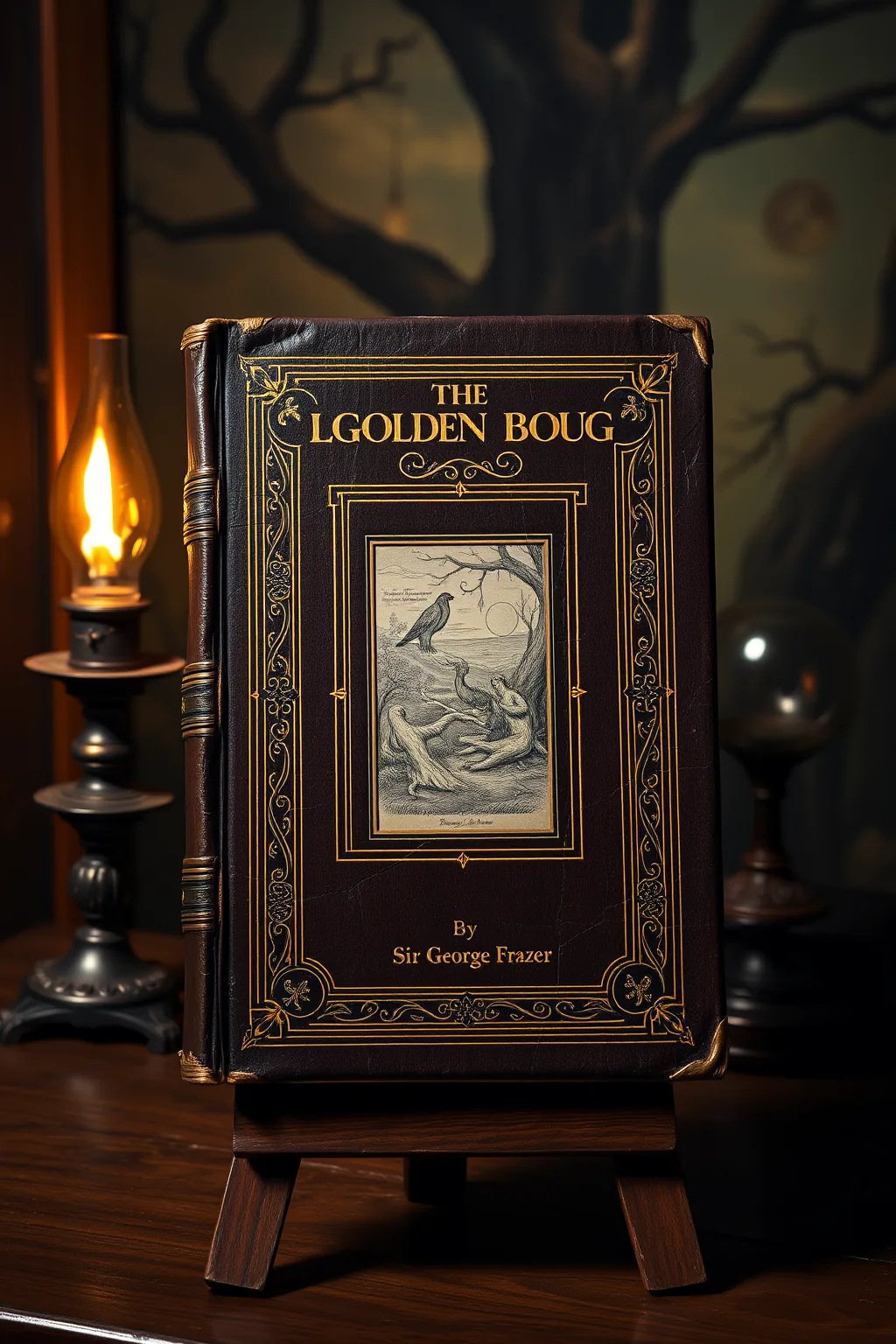
The Golden Bough
 84
84

The Golden Bough



By Aurelia Blackwood (Occult Philosophy Critic) — 'The Golden Bough' remains an unparalleled cornerstone for anyone seeking to decipher the hidden grammar of magic and myth. Frazer's exhaustive cataloging of global rituals and beliefs, particularly his exploration of the divine king and sympathetic magic, offers profound insights into the archetypal forces that drive human spiritual evolution. While some interpretations have been refined by modern scholarship, the sheer breadth of its research and the compelling connections drawn between seemingly disparate cultures are breathtaking. This is essential reading for occultists, anthropologists, and anyone fascinated by the ancient roots of paganism and its enduring, potent symbolism. A truly illuminating work for the serious student of the hidden arts.
📝 Description
84
Sir James George Frazer's 1890 study connected magic, religion, and science through comparative myth.
First published in 1890, 'The Golden Bough' examines the evolution of human belief from magic to religion and science. Sir James George Frazer collected vast amounts of ethnographic data to argue that magic, religion, and science represent successive stages in humanity's attempt to control the natural world. He focused on the concept of sympathetic magic, dividing it into imitative (like cures like) and contagious (things once in contact continue to affect each other) forms.
The book uses examples drawn from across the globe and throughout history, from the priest-king of Nemi to various fertility rites and taboos. Frazer sought to uncover universal patterns in human thought and ritual, linking the practices of seemingly disparate cultures. His work became a significant, though later debated, influence on anthropology and the study of religion.
While not strictly an esoteric text in the sense of grimoires or occult practices, 'The Golden Bough' profoundly influenced esoteric thought by providing a framework for understanding the connections between ancient rituals, myth, and psychology. Frazer's broad comparative approach, which saw magic as an early stage of human reasoning, resonated with occultists and scholars of comparative religion seeking to understand the roots of spiritual and magical traditions. His work offered a way to interpret symbolism and ritual across diverse cultures as expressions of underlying human needs and desires.
💡 Why Read This Book?
Uncover the universal patterns of human belief and ritual that underpin magic and religion. 'The Golden Bough' offers a deep dive into sympathetic magic, divine kingship, and ancient fertility cults. It's essential for understanding the esoteric underpinnings of pagan traditions and the collective unconscious. Ideal for scholars, practitioners, and seekers of hidden wisdom.
⭐ Reader Reviews
Honest opinions from readers who have explored this book.
❓ Frequently Asked Questions
What is the central thesis of 'The Golden Bough'?
The central thesis posits that magic and religion evolved from a common source, often involving rituals of sympathetic magic and the concept of a divine or priestly king whose fate was tied to the well-being of his community and the natural world.
What is sympathetic magic?
Sympathetic magic is a type of magic based on the belief that like produces like (homoeopathic magic) and that things once in contact continue to be connected (contagious magic), allowing practitioners to influence events or individuals from afar.
Who was the King of the Wood?
The King of the Wood, a key figure in Frazer's early chapters, refers to the priest-king of the sacred grove of Nemi, whose rule was maintained by ritual combat and whose death was often a sacrifice to ensure the fertility of the land.
Is 'The Golden Bough' still relevant today?
Absolutely. Its rich ethnographical data and groundbreaking theories on magic and religion continue to inform fields from anthropology and mythology to literary criticism and psychology, offering timeless insights into the human psyche and spiritual quests.
What are the main subjects covered?
The book covers a vast array of subjects including priestly kings, sympathetic magic (homoeopathic and contagious), taboo, the worship of nature, resurrection myths, and the evolution of religious beliefs and magical practices across diverse cultures.
🔮 Key Themes & Symbolism
The Divine King and Sacred Sacrifice
This theme investigates the pervasive concept of the divine or priestly king, whose power and very existence were intrinsically linked to the fertility and prosperity of his land and people. Frazer meticulously details the various forms of ritual sacrifice, often involving the king himself, as a means to appease deities, ensure cosmic order, and guarantee the continuation of life cycles. The 'King of the Wood' at Nemi serves as a potent archetype, illustrating the brutal yet profoundly symbolic nature of these ancient power structures and their connection to the earth's generative forces.
Sympathetic Magic: The Laws of the Invisible
Frazer systematically unpacks the two fundamental principles of sympathetic magic: homoeopathic (like produces like) and contagious (things once in contact remain so). This section examines how ancient peoples believed they could influence the physical world and individuals through the manipulation of images, effigies, or remnants of their subjects. It reveals a worldview where the unseen forces of attraction and repulsion governed reality, and where the magician's will could transcend the limitations of space and time, shaping destiny through a sophisticated understanding of natural and supernatural connections.
The Evolution of Belief: Magic to Religion
A core argument of 'The Golden Bough' is the evolutionary trajectory of human thought, moving from a stage dominated by magic to one governed by religion, and eventually, perhaps, to a scientific understanding. Frazer illustrates how early magical practices, aimed at directly controlling nature, gradually gave way to appeals to supernatural beings and deities. This progression highlights the changing human relationship with the divine and the cosmos, revealing a continuous search for order, meaning, and power, albeit through increasingly complex and abstract belief systems.
💬 Memorable Quotes
Direct passages from the work, attributed to the author.
“Magic is a false science.”
— This provocative statement suggests that while magic operates with its own internal logic, its efficacy is based on flawed premises, setting the stage for the transition to more rational or divinely mediated systems of thought.
“The belief in the efficacy of magic is as old as mankind.”
— This highlights the deep-seated, primal nature of magical thinking, positioning it as a fundamental aspect of human consciousness and an early attempt to understand and control the surrounding world.
“The king is the life of his people.”
— This expresses the concept of the divine or priestly king as a vital nexus for the community's well-being, where his vitality and fate were metaphorically and often literally tied to the land and its inhabitants.
“Man, in his ignorance, has always been prone to mistake the sign for the thing itself.”
— This observation points to the human tendency towards symbolic representation and the potential for mistaking superficial resemblances or associations for causal relationships, a core principle in understanding homoeopathic magic.
“The essence of the matter is the substitution of a magical for a physical explanation.”
— This underscores the shift in worldview from seeking direct, imitative control over phenomena (magic) to attributing outcomes to supernatural forces or divine will (religion), a key evolutionary step in human belief.
🌙 Esoteric Significance
Tradition
While 'The Golden Bough' is primarily a work of comparative mythology and anthropology, its exhaustive study of magic, ritual, and ancient belief systems profoundly resonates within numerous esoteric traditions. It provides a foundational text for understanding the archetypal patterns that underpin Western esotericism, Neopaganism, and occult philosophy. By dissecting the universal principles of sympathetic magic and the role of the divine king, Frazer inadvertently maps out a symbolic language and a framework of power that many practitioners seek to reintegrate into their spiritual practices.
Symbolism
The book is rich with potent symbolism, from the bleeding king of the wood to the sacred mistletoe, each element acting as a key to unlock deeper meanings. The cycle of death and rebirth, the power of imitation and contagion in magic, and the symbolic representation of cosmic order through ritual sacrifice are central motifs. Frazer's work illuminates how these symbols functioned within ancient cultures to mediate between the human and the divine, the terrestrial and the celestial, offering a symbolic lexicon for understanding universal forces and human aspiration.
Modern Relevance
In the contemporary resurgence of interest in paganism, witchcraft, and ancient spiritualities, 'The Golden Bough' remains a vital, albeit controversial, resource. It offers a comprehensive, if sometimes dated, survey of practices that inspire modern rituals and beliefs. Its exploration of sympathetic magic continues to be a point of reference for practitioners seeking to understand the principles behind their craft. Furthermore, its deconstruction of myth and ritual provides a framework for reinterpreting ancient wisdom in a modern context, connecting contemporary seekers to the deep, enduring currents of human spirituality.
👥 Who Should Read This Book
This monumental work is essential for several distinct groups. **Scholars** of anthropology, mythology, religious studies, and comparative folklore will find it an indispensable, though to be read critically, primary source. **Occultists and Pagan practitioners** will discover a valuable collection of ancient practices, symbolic meanings, and theoretical frameworks that inform and inspire their modern craft. **Seekers of hidden knowledge** and those interested in the deep history of human consciousness will be captivated by Frazer's sweeping narratives and clear insights into the universal themes of life, death, and the divine. Even **beginners** with a serious interest in the origins of ritual and belief will find much to ponder and learn.
📜 Historical Context
Published in its complete form in 1915, 'The Golden Bough' emerged from the late Victorian era's fervent intellectual curiosity about humanity's origins and cultural development. This period saw the rise of anthropology as a discipline, fueled by colonial expansion and a desire to categorize and understand the 'primitive' cultures encountered. Frazer, heavily influenced by evolutionary theories and comparative mythology, synthesized a vast amount of ethnographic data from around the globe. The work reflected a prevailing Eurocentric perspective, viewing 'primitive' societies as earlier stages in a linear progression of civilization. Despite its dated anthropological methods and inherent biases, the book's immense scope and its groundbreaking exploration of magic, myth, and religion profoundly influenced subsequent generations of scholars, artists, and thinkers.
📔 Journal Prompts
Reflect on a personal experience where you instinctively felt a connection between two seemingly unrelated things. How might this relate to the principles of sympathetic magic?
Consider the concept of the 'divine king' or a leader whose well-being is tied to their people. Where do we see traces of this in modern society, and what are its implications?
Explore a myth or ritual from your own cultural background. Can you identify elements of homoeopathic or contagious magic within it?
How has your understanding of 'magic' evolved throughout your life? Compare your current view with the concepts Frazer presents.
Imagine you are an ancient priest or priestess. What ritual would you devise to ensure the fertility and prosperity of your community, and what would be its core components?
🗂️ Glossary
Sympathetic Magic
A form of magic based on the belief that like produces like (homoeopathic magic) and that things once in contact continue to be connected (contagious magic), allowing influence over objects or persons from a distance.
Homoeopathic Magic
The first principle of sympathetic magic, based on the idea that 'like produces like,' meaning that an effect resembles its cause. E.g., using a doll to represent a person to influence them.
Contagious Magic
The second principle of sympathetic magic, based on the idea that things which have been in contact with each other continue to remain connected. E.g., using hair clippings or personal belongings to affect an individual.
Taboo
A prohibition against an action, object, or person, often stemming from a belief that it is sacred, unclean, or possesses dangerous supernatural power, leading to social sanctions or spiritual retribution.
Priestly King
A ruler who holds both secular and religious authority, often believed to be divine or a mediator between humanity and the gods, whose rituals and well-being are crucial for the community's prosperity.
This book appears in 2 collections
🔮 Readers Also Liked
Browse all →








From the “Witchcraft” Collection
View all →
![D. [i. e., Doktor] Balthasar Bekkers reformierten Predigers in Amsterdam bezauberte Welt. ... 1781: Vol 1 Iss 81](/img/thumb/d-i-e-doktor-balthasar-bekkers-reformierten-predigers-in-amsterdam-bezauberte-welt-1781-vol-1-iss-81-bekker-balthasar-1634-1698.webp)






More Free Witchcraft & Paganism Books
View all →