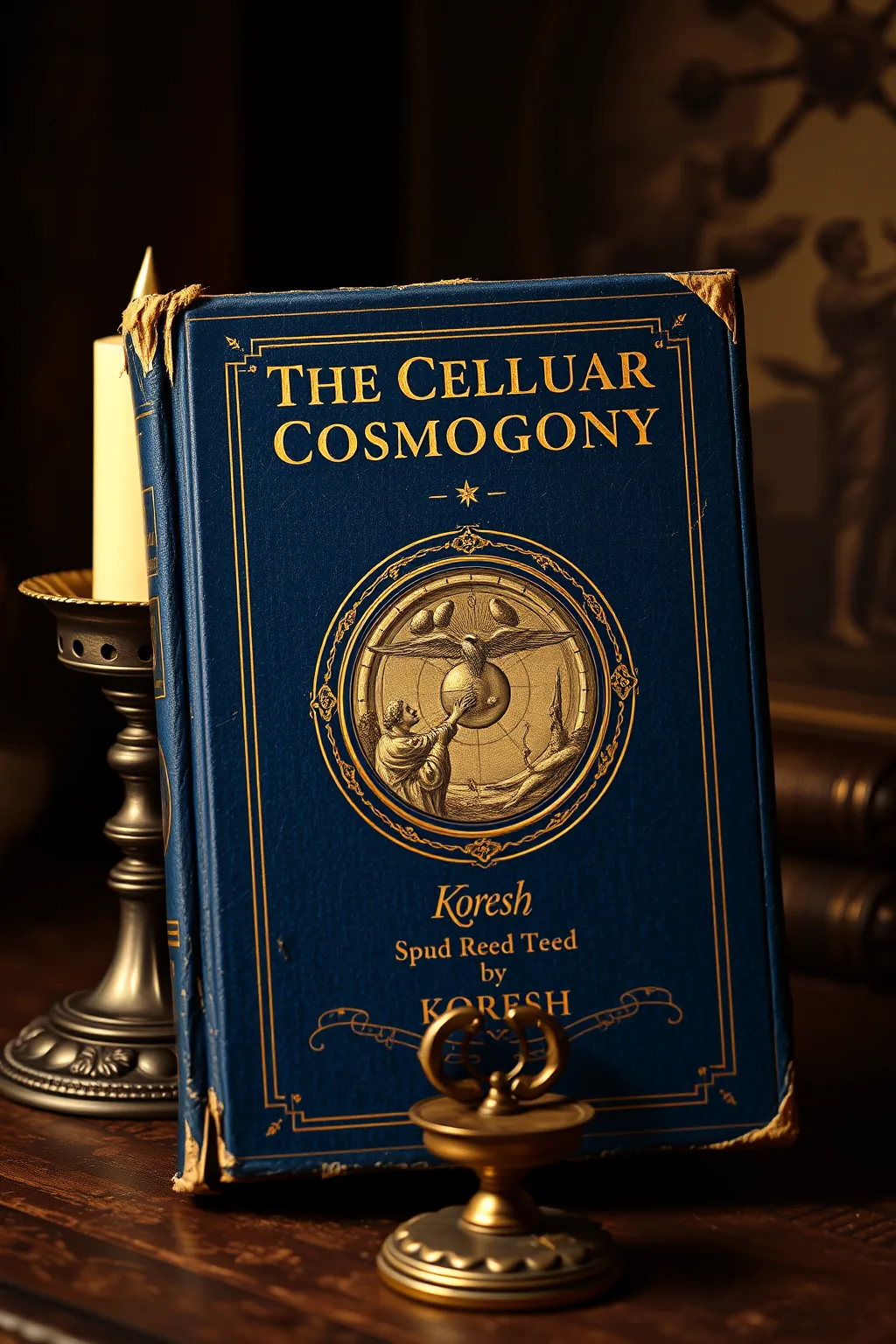
The Cellular Cosmogony
 79
79

The Cellular Cosmogony



Evander Ashcroft (Alchemy & Hermeticism Editor) — 'The Cellular Cosmogony' is an astonishingly ambitious exploration of existence, penned by the enigmatic Koresh. Teed's audacious assertion of an intra-spherical cosmos, while unconventional, is presented with fervent conviction, revealing a potent blend of proto-New Age mysticism and Gnostic undertones. The work's strength lies in its imaginative power and its deeply symbolic language, which invites readers to ponder universal principles through an entirely novel lens. For scholars of fringe science, alternative spiritualities, and the history of occult thought, this text is an indispensable, albeit challenging, artifact. It offers a rare glimpse into a unique metaphysical system.
📝 Description
79
Cyrus Reed Teed, as Koresh, published 'The Cellular Cosmogony' in 1897, detailing a universe within a sphere.
Published in 1897 under the pseudonym Koresh, Cyrus Reed Teed's 'The Cellular Cosmogony' outlines a unique cosmological model. Teed envisioned the universe as a hollow sphere, with all existence contained within its interior. This perspective challenges standard scientific and religious views of the cosmos, proposing a self-contained, 'inside-out' structure. The text meticulously details this pseudoscientific framework, attributing to it a form of alchemical creation. It suggests that understanding this cellular universe reveals deep truths about existence and consciousness.
The work invites readers to reconsider fundamental assumptions about reality. It posits a hidden order and symbolism within the structure of the cosmos, connecting it to human psychology and belief systems. 'The Cellular Cosmogony' is for those interested in alternative cosmologies and the philosophical implications of creation myths. It represents a specific branch of esoteric thought from the late 19th century, blending scientific speculation with spiritual ideas.
Cyrus Reed Teed's work belongs to the late 19th-century surge of esoteric thought, which often sought to reconcile emerging scientific ideas with spiritual or occult philosophies. It shares common ground with various millenarian movements and alternative spiritual systems of the era, which frequently proposed radical reinterpretations of creation and humanity's place within the universe. Like other texts from this period, 'The Cellular Cosmogony' constructs a complete worldview from a unique set of principles, aiming to offer a holistic understanding of existence beyond conventional paradigms.
💡 Why Read This Book?
Read 'The Cellular Cosmogony' to challenge your perception of reality and explore a profoundly unique, albeit pseudoscientific, cosmic model. It's ideal for seekers of hidden knowledge, scholars of esoteric history, and practitioners interested in unconventional spiritual frameworks. Uncover the symbolic depths and the psychological motivations behind Koresh's revolutionary 'cellular' universe.
⭐ Reader Reviews
Honest opinions from readers who have explored this book.
❓ Frequently Asked Questions
What is the central thesis of 'The Cellular Cosmogony'?
The book posits that the entire universe, including Earth and all celestial bodies, exists within a hollow, 'inside-out' sphere, functioning as a cellular structure of the divine.
Who was Koresh (Cyrus Reed Teed)?
Koresh was the pseudonym of Cyrus Reed Teed, a charismatic American visionary and founder of the Koreshan Unity movement, which promoted his unique cosmological and social doctrines.
Is this book scientifically accurate?
No, 'The Cellular Cosmogony' is considered a work of pseudoscience. Its value lies in its esoteric philosophy, symbolism, and historical significance within alternative belief systems.
What kind of symbolism is prevalent in the book?
The text is rich with alchemical, biblical, and philosophical symbolism, reinterpreting traditional concepts within Koresh's specific cosmological framework.
What is the intended audience for this work?
This book is for readers interested in esoteric history, fringe science, alternative spiritualities, the psychology of belief, and unique metaphysical systems.
🔮 Key Themes & Symbolism
The Intra-Spherical Cosmos
This theme explores Koresh's radical assertion that our reality is contained within a hollow, inverted sphere. It explores the intricate mechanics and philosophical implications of this 'cellular' universe, challenging the conventional understanding of space, gravity, and celestial movement. The book meticulously constructs this model, offering a profound, albeit unconventional, perspective on the structure of existence and the interconnectedness of all phenomena within this unique cosmic womb.
Symbolism and Esoteric Interpretation
Dive into the body of symbolism woven throughout 'The Cellular Cosmogony'. Koresh masterfully reinterprets biblical narratives, alchemical principles, and philosophical concepts through the lens of his unique cosmology. This theme examines how familiar symbols are given new meaning within his 'cellular' framework, suggesting hidden layers of understanding about creation, humanity's place in the cosmos, and the divine will. It's a journey into the symbolic language of the universe as perceived by a singular visionary.
The Psychology of Belief and Community
Beyond its cosmological claims, the work offers insights into the psychological forces that drive belief systems and the formation of communities. Koresh's detailed model, with its potential for evoking a sense of primal security and ultimate order, played a significant role in attracting followers to his Koreshan Unity movement. This theme explores the allure of such radical ideas, the human desire for comprehensive explanations of existence, and the power of visionary leadership in shaping collective consciousness.
💬 Memorable Quotes
Direct passages from the work, attributed to the author.
“All is contained; all is one.”
— Highlighting the holistic nature of Koresh's vision, this phrase emphasizes the interconnectedness of all beings and phenomena within his unified, cellular cosmic structure.
“The outer shell is the inner space.”
— A paradoxical statement that defines the fundamental inversion of Koresh's cosmology, suggesting that what appears external is, in fact, the internal boundary of existence.
💡 Key Ideas
Editorial paraphrase of the work's core concepts — not direct quotes.
The universe is not as it appears, but a sphere within a sphere.
This quote expresses the core tenet of Koresh's cosmology, urging a radical re-evaluation of perceived reality and introducing the central metaphor of an 'inside-out' universe.
Man is the microcosm of this greater cellular whole.
This quote draws a direct parallel between the individual human being and the grand cosmic structure, underscoring the belief that understanding oneself leads to understanding the universe.
Truth resides not in the seen, but in the unseen principle.
Emphasizing the esoteric nature of Koresh's teachings, this quote directs the reader to look beyond superficial appearances and seek deeper, underlying truths and forces.
🌙 Esoteric Significance
Tradition
This work is deeply rooted in a syncretic esoteric tradition, blending elements of Gnosticism, Hermeticism, and millenarianism with a unique interpretation of biblical prophecy. Koresh sought to reveal a 'hidden' science of the universe, aligning with the Gnostic pursuit of secret knowledge and the Hermetic principle of 'as above, so below,' recontextualized within his radical 'cellular' cosmology.
Symbolism
The symbolism in 'The Cellular Cosmogony' is intricate and pervasive. Key symbols include the sphere (representing both containment and divine unity), the human body (as a microcosm), and biblical figures (reimagined as cosmic principles). Koresh transforms conventional imagery into components of his inverted universe, where surface and depth, inside and outside, are perpetually interchanged, offering a symbolic map of his unique metaphysical landscape.
Modern Relevance
Despite its historical context, 'The Cellular Cosmogony' remains relevant for its exploration of alternative cosmologies and the power of visionary thought. It speaks to contemporary interests in consciousness studies, the psychology of belief, and the philosophical implications of challenging established scientific dogma. For those exploring the fringes of metaphysical thought, Koresh's work offers a compelling case study in radical paradigm construction and the enduring human drive to comprehend the infinite.
👥 Who Should Read This Book
Scholars of esoteric history and fringe science will find 'The Cellular Cosmogony' a rich primary source for understanding 19th-century American utopian and pseudoscientific movements. Seekers of alternative spiritualities and those interested in the psychology of belief will appreciate its unique worldview and the persuasive power of Koresh's vision. Practitioners of esoteric disciplines may find inspiration in its symbolic language and unconventional approach to cosmic order. Even skeptics might engage with its audacious intellectual framework and the historical context of its creation.
📜 Historical Context
Penned during the late 19th century, 'The Cellular Cosmogony' emerged from a period of intense spiritual and scientific upheaval. As established Victorian paradigms were challenged by new discoveries and burgeoning philosophical movements, figures like Cyrus Reed Teed sought to synthesize science, religion, and mysticism into comprehensive new worldviews. Teed's work reflects a broader cultural fascination with hidden orders, cosmic secrets, and the potential for radical societal reform, exemplified by the Koreshan Unity movement's communal living and utopian aspirations. It stands as a peculiar yet significant artifact of an era eager to redefine humanity's place in a rapidly changing universe.
📔 Journal Prompts
How does Koresh's concept of an 'inside-out' universe challenge your personal perception of reality?
What psychological needs or desires might have drawn individuals to Koresh's Koreshan Unity movement?
Analyze a specific piece of biblical or alchemical symbolism as reinterpreted by Koresh in this text.
Consider the concept of 'containment' in Koresh's cosmology. How does this relate to modern ideas of personal space or societal structures?
If you were to create your own 'cellular' model of existence, what core principles would you emphasize and why?
🗂️ Glossary
Cellular Cosmogony
The central doctrine presented by Koresh, describing the universe as a hollow, 'inside-out' sphere functioning akin to a biological cell, with all existence contained within its structure.
Koreshan Unity
The religious and social movement founded by Cyrus Reed Teed (Koresh), which sought to implement his unique cosmological, social, and spiritual teachings in communal living.
Inverted Sphere
A key concept in Koresh's cosmology, referring to the universe being contained within a hollow sphere where the 'inside' surface forms the boundary of existence.
Microcosm
The principle that the human being (microcosm) reflects the structure and principles of the greater universe (macrocosm), a concept central to Koresh's understanding of humanity's place.
Pseudoscience
A belief or practice presented as scientific, but lacking scientific evidence and methodology. 'The Cellular Cosmogony' is considered a prime example of historical pseudoscience.
This book appears in 1 collection
🔮 Readers Also Liked
Browse all →









From the “Transcendental Meditation” Collection
View all →








More Free Esoteric History & Biography Books
View all →