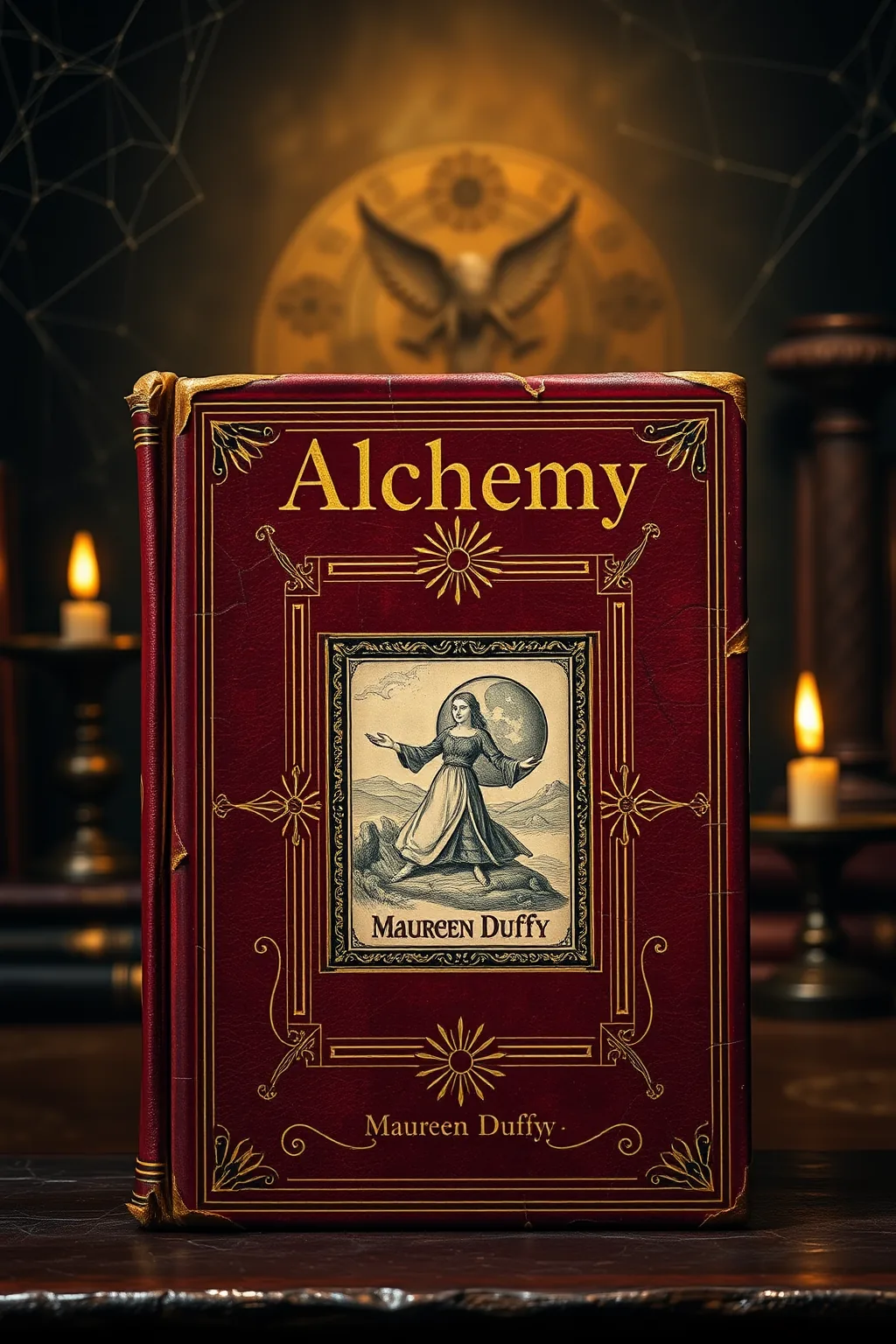
Alchemy
 74
74

Alchemy
Maureen Duffy's "Alchemy" provides a commendable overview of a subject often shrouded in arcane jargon. Its strength lies in its clarity, presenting complex ideas like the *prima materia* and the stages of the Great Work with accessible prose. The book excels at bridging the gap between the practical laboratory pursuits and the philosophical underpinnings that defined alchemy for centuries. A particularly effective section details the symbolic journey, illustrating how alchemical processes mirrored spiritual development. However, the work occasionally feels constrained by its brevity, leaving the reader wishing for deeper dives into specific alchemical texts or the lives of prominent practitioners like Nicolas Flamel. The 2004 publication date means it predates some more recent scholarship, though its core analysis remains robust. Duffy's "Alchemy" offers a solid, well-structured introduction that manages to convey the essence of this multifaceted discipline without succumbing to overly romanticized notions.
📝 Description
74
Maureen Duffy's "Alchemy" (1994) examines a practice that captivated thinkers for millennia.
Maureen Duffy's "Alchemy" traces the historical trajectory of alchemical thought. It begins with its roots in Hellenistic Egypt and Neoplatonic philosophy, moving through its medieval development and its eventual transformation into modern chemistry. The book clarifies alchemical symbolism, linking it to quests for philosophical, spiritual, and psychological change. Duffy presents alchemy not simply as a precursor to science, but as a distinct system of thought with its own logic and symbolic vocabulary.
This volume is suitable for general readers interested in the historical and philosophical aspects of alchemy. It will also appeal to students of esoteric traditions, comparative religion, and the history of science. Those wanting to understand the symbolic language that shaped Western esotericism, art, and literature will find it especially useful. The book offers a balanced overview, requiring no prior specialized knowledge, making it an accessible introduction for newcomers to the subject. Readers familiar with Jungian psychology might also note connections to concepts of individuation and psychic transformation.
Duffy places alchemy within its historical and philosophical context, starting around the 3rd century CE in Alexandria and tracing its transmission through Arabic scholars to medieval Europe. The book acknowledges the dual alchemical pursuit of material change and spiritual purification, often intertwined. It highlights figures such as Zosimos of Panopolis and discusses the influence of Hermetic philosophy on alchemical thought. The work details how alchemy was integrated into intellectual life before empirical science began to marginalize its speculative elements.
💡 Why Read This Book?
• Gain an understanding of the *prima materia*, the foundational concept of a base substance undergoing transformation, which offers a unique lens for viewing processes of change in both material and psychological realms, as explored in Duffy's "Alchemy". • Learn about the seven stages of the Great Work, from calcination to coagulation, providing a structured symbolic framework for understanding cycles of destruction and reconstruction applicable to personal development, as detailed in the book. • Grasp the dual nature of alchemical pursuits – the physical quest for the Philosopher's Stone and the spiritual quest for enlightenment – offering a historical perspective on the integration of material and spiritual aims as presented in Duffy's examination.
⭐ Reader Reviews
Honest opinions from readers who have explored this book.
❓ Frequently Asked Questions
What is the historical origin of alchemy discussed in Maureen Duffy's book?
Maureen Duffy's "Alchemy" traces origins to Hellenistic Egypt, specifically Alexandria around the 3rd century CE, influenced by Neoplatonic and Hermetic philosophies, before its transmission to the medieval West.
Does Duffy's "Alchemy" explain the Philosopher's Stone?
Yes, the book explains the Philosopher's Stone as the legendary agent of transmutation, exploring its significance not just materially but also as a metaphor for spiritual perfection and enlightenment.
Who was Zosimos of Panopolis and why is he mentioned?
Zosimos of Panopolis, discussed in the book, is considered one of the earliest known alchemical writers from Alexandria. His work was crucial in the early development and documentation of alchemical theory and practice.
How does "Alchemy" by Duffy relate to modern chemistry?
Duffy's work positions alchemy as a precursor to modern chemistry, detailing how early laboratory practices and the pursuit of material transformation laid groundwork, even as alchemy's spiritual and symbolic dimensions diverged.
What are the three principles in alchemy according to the book?
According to Duffy's "Alchemy," the three primary principles are Salt (body), Sulfur (soul), and Mercury (spirit), believed to be fundamental constituents of all matter and key to the alchemical process.
Is Maureen Duffy's "Alchemy" suitable for beginners?
Yes, the book is designed as a concise and clear introduction, making it suitable for beginners interested in the history and philosophy of alchemy without requiring prior specialized knowledge.
🔮 Key Themes & Symbolism
The Great Work
Duffy's "Alchemy" elucidates the *Main work*, or Great Work, as the central endeavor of alchemical practice. This is not solely a quest for material gold but a profound process of purification and transformation, both of substances and the practitioner's own soul. The book outlines the symbolic stages—from the initial *nigredo* (blackening) representing dissolution, through the *albedo* (whitening) of purification, to the final *rubedo* (reddening) signifying completion and the attainment of the Philosopher's Stone. This cyclical journey mirrors spiritual development and the integration of the self.
Symbolic Language
A core theme is the rich symbolic language of alchemy, which Duffy meticulously deciphers. The text explores how common elements—metals like lead and gold, celestial bodies like the sun and moon, and mythical creatures—represented complex philosophical and psychological states. The Ouroboros, the serpent eating its tail, is presented as a symbol of cyclicality and unity, while the hermaphroditic figure symbolizes the union of opposites, a critical concept in achieving balance and transformation within the alchemical framework.
Alchemy and Science
The book addresses the historical relationship between alchemy and the emergence of modern science. Duffy clarifies that while alchemists engaged in practical laboratory work, their aims were often fundamentally different from empirical science. The work details how alchemy operated within a worldview that integrated spiritual, philosophical, and material aspects, contrasting with the later reductionist approach of chemistry. It highlights how alchemical concepts, though superseded scientifically, profoundly influenced Western thought and esoteric traditions.
Spiritual Transformation
Beyond the pursuit of physical gold, Duffy emphasizes alchemy's deep spiritual dimension. The text posits that the alchemist's journey was a metaphor for inner purification and achieving a higher state of consciousness. The transformation of base metals into gold mirrored the aspirant's own journey from imperfection to enlightenment. This spiritual quest, intertwined with laboratory operations, reflects a holistic worldview where the material and the divine were seen as interconnected aspects of a single reality.
💬 Memorable Quotes
Direct passages from the work, attributed to the author.
“The Philosopher's Stone represented the ultimate state of perfection, a symbol of wholeness and spiritual attainment.”
— This interpretation underscores that the legendary Stone was viewed by many alchemists as more than a physical substance; it embodied an ideal state of being, representing the culmination of both material and spiritual transformation.
“Alchemy's symbolic language, using animals and celestial bodies, provided a framework for understanding cosmic and psychological processes.”
— This captures the essence of how alchemists encoded their understanding of the universe and the human psyche. The book illustrates that their symbols were not arbitrary but represented deep philosophical concepts about balance and change.
“Hermetic philosophy provided a crucial intellectual foundation for early alchemical thought.”
— This statement points to the philosophical lineage influencing alchemy, connecting it to the Hermetic tradition and its emphasis on correspondence between the microcosm (human) and the macrocosm (universe).
💡 Key Ideas
Editorial paraphrase of the work's core concepts — not direct quotes.
The alchemist sought not just to transmute base metals into gold, but to purify and perfect his own soul.
This paraphrased concept highlights the dual nature of the alchemical pursuit, emphasizing that the external work in the laboratory was inextricably linked to an internal, spiritual journey of self-improvement and enlightenment.
The initial stage of the Great Work, the nigredo, involved dissolution and the breakdown of the old form.
This quote refers to a specific alchemical stage, the 'blackening,' signifying necessary destruction and chaos before a new, perfected form can emerge, a concept applicable to both material processes and personal upheaval.
🌙 Esoteric Significance
Tradition
Duffy's "Alchemy" primarily engages with the Western Hermetic tradition, which historically forms the bedrock of European alchemical thought. It acknowledges influences from Gnosticism and Neoplatonism, particularly concerning the concepts of spiritual ascent and the desire to return to a divine source. The work fits within this lineage by exploring the symbolic and philosophical dimensions of alchemical practice, viewing it as a path toward self-knowledge and spiritual realization, rather than solely a protoscience.
Symbolism
Key symbols explored include the *prima materia*, representing undifferentiated potential and the starting point for all creation and transformation. The Ouroboros, the serpent devouring its tail, is presented as a potent emblem of cyclicality, eternity, and the unification of opposites – a core tenet in achieving the alchemical balance. The Philosopher's Stone itself functions as a multi-layered symbol, signifying not only material gold but also spiritual perfection, enlightenment, and the integration of the self.
Modern Relevance
Contemporary esoteric schools and psychological practitioners, particularly those influenced by Jungian analysis, continue to draw on alchemical symbolism as explored in works like Duffy's. The archetypal processes of transformation—dissolution, purification, and reintegration—resonate with modern understandings of personal growth and individuation. Alchemical imagery also remains influential in contemporary ceremonial magic, neo-paganism, and certain branches of transpersonal psychology seeking to understand the human drive for wholeness.
👥 Who Should Read This Book
• Aspiring practitioners of Western Esotericism seeking a foundational understanding of alchemical principles and their historical context. • Students of comparative religion and philosophy interested in the symbolic systems and spiritual quests that have shaped human thought across cultures. • Readers curious about the historical relationship between magic, philosophy, and the origins of modern science, particularly concerning early experimental practices.
📜 Historical Context
Published in 2004, Maureen Duffy's "Alchemy" entered a field with established scholarship but sought to offer a more accessible overview. The book engages with the long history of alchemy, acknowledging its roots in Hellenistic Alexandria around the 3rd century CE and its subsequent transmission through Arabic scholars to medieval Europe. It situates alchemical thought within the broader intellectual currents of its time, from Neoplatonism to the nascent empirical inquiries that would eventually lead to chemistry. Duffy implicitly contrasts alchemical cosmology with the increasingly mechanistic worldview emerging during the Scientific Revolution. While not detailing specific censorship or reception events for this particular volume, the book implicitly addresses the historical marginalization of alchemy's symbolic aspects as distinct from laboratory science, a process accelerated from the 17th century onwards.
📔 Journal Prompts
The concept of *prima materia* as a state of undifferentiated potential.
The symbolic journey through the stages of the Great Work (nigredo, albedo, rubedo).
The dual pursuit of material transmutation and spiritual perfection.
The role of opposing forces (e.g., Sulfur and Mercury) in achieving balance.
Interpreting alchemical symbols like the Ouroboros in personal contexts.
🗂️ Glossary
Prima Materia
The fundamental, undifferentiated substance from which all matter is believed to originate in alchemical theory. It represents chaos and potential before the work of separation and purification begins.
Main work
Latin for 'Great Work,' referring to the entire alchemical process aimed at creating the Philosopher's Stone. It encompasses both the physical operations and the spiritual transformation of the alchemist.
Philosopher's Stone
The legendary alchemical substance said to be capable of transmuting base metals into gold and silver, and often believed to possess the elixir of life. Symbolically, it represents perfection and enlightenment.
Nigredo
The first stage of the Great Work, often called 'blackening.' It symbolizes putrefaction, dissolution, and the breakdown of the original substance, representing chaos and the initial phase of transformation.
Albedo
The second stage, 'whitening,' following the nigredo. It signifies purification, washing away impurities, and the emergence of a purified, luminous substance, often associated with lunar imagery.
Rubedo
The final stage, 'reddening,' leading to the completion of the Great Work. It symbolizes the achievement of the Philosopher's Stone, perfection, and spiritual integration, often associated with solar imagery.
Hermeticism
A philosophical and religious tradition based on writings attributed to Hermes Trismegistus. It emphasizes the interconnectedness of all things and the potential for human spiritual ascent through knowledge.
🔮 Readers Also Liked
Browse all →





![Archetypal principles and hierarcheis [sic]](/img/thumb/archetypal-principles-and-hierarcheis-sic-john-peter-anton.webp)



More by Duffy, Maureen.
All books →

More Free Alchemy & Hermeticism Books
View all →