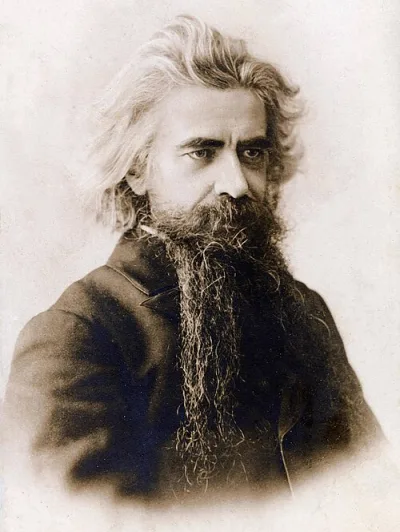
Vladimir Solovyov was a Russian philosopher and theologian who synthesized Eastern and Western thought, focusing on Sophia and sobornost.
Vladimir Solovyov was a prominent Russian philosopher and theologian of the late 19th century, influential in both Russian philosophy and the spiritual awakening of the early 20th century. Born into a scholarly family, he initially rejected Orthodoxy for nihilism but later embraced views aligned with the Orthodox Church. Solovyov's philosophical work sought to bridge Western idealism with Eastern spirituality, notably through his concept of 'sobornost,' representing organic unity. He engaged deeply with theological ideas, expressing sympathy for the reunion of the Orthodox and Catholic Churches and possibly converting to Catholicism. His thought also encompassed a fascination with the figure of Sophia, divine wisdom, which he interpreted through various religious traditions, leading to some controversy within Orthodox circles.
Beyond his theological and philosophical pursuits, Solovyov was a vocal advocate for Jewish civil rights in Russia and internationally. His later years were marked by anxieties about Asian cultures, which he expressed in his writings and a short story. Despite never marrying, his personal life included pursuits of idealized relationships. Solovyov's intellectual intensity reportedly impacted his health, and he died in relative poverty, leaving his legacy to be championed by others. His influence extended to literary figures like Dostoevsky and writers of the Symbolist movement.
Philosophical Foundations and Sobornost
Solovyov developed a philosophical system aiming for universal reconciliation of knowledge and conflicting ideas. Central to this was the concept of 'sobornost,' a Russian idea of organic unity and spontaneous order through integration, akin to the Russian word for 'catholic.' He sought to identify common ground between disparate concepts and peoples, fostering absolute unity and the fusion of opposing viewpoints. His work critiqued positivism, advocating for intuitive comprehension alongside reason to validate the essence of objects and consciousness, attempting to overcome the subject-object dualism of German idealism. This approach integrated elements from Hellenistic philosophy, Christian tradition, and even Kabbalistic thought.
Sophiology and Ecumenism
A significant aspect of Solovyov's thought was his concept of Sophia, divine wisdom, which he described as a unifying, feminine aspect of God, comparable to the Hebrew Shekinah or various goddess traditions. He detailed his experiences with Sophia in works like 'Three Encounters' and 'Lectures on Godmanhood.' This syncretic philosophy fused various religious and philosophical traditions with Orthodox Christianity, driven by a desire for unity. Solovyov actively promoted ecumenism, advocating for the healing of the schism between the Orthodox and Catholic Churches, and is believed to have converted to Catholicism. His teachings on Sophia, while influential, were later deemed heretical or unorthodox by some Orthodox authorities, though interpretations and condemnations varied.
Advocacy and Later Concerns
Solovyov was a notable defender of Jewish civil rights in tsarist Russia, actively campaigning both domestically and internationally for their cause. He is remembered as a 'friend of the Jews,' even praying for them on his deathbed. However, his later philosophical outlook developed a bias against Asian cultures. He viewed Buddhist concepts like Nirvana negatively and expressed fears of a 'Yellow Peril,' warning of an impending invasion by Asian peoples, particularly the Chinese, which he fictionalized in his writings. This shift contrasted with his earlier interest in Eastern cultures.
Key Ideas
- Sobornost: A concept of organic unity, spontaneous order, and integration, aiming for the fusion of conflicting ideas and peoples.
- Sophia: Divine wisdom, understood as a unifying, feminine aspect of God, integrated from various religious traditions.
- Intuitive Noetic Comprehension: The idea that the essence of objects and consciousness can be validated through intuition, not solely through reason or empirical data.
Books by
7 free public domain books · Read online or download