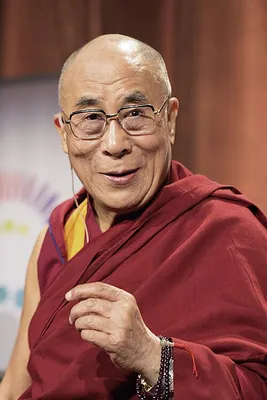
Tenzin Wangyal
The 14th Dalai Lama is the spiritual leader of Tibetan Buddhism, recognized as a reincarnation of Avalokiteśvara.
The 14th Dalai Lama, born Lhamo Thondup in 1935, is the highest spiritual leader of Tibetan Buddhism and head of the Gelug school. He was identified as the reincarnation of the 13th Dalai Lama in 1937 and formally recognized in 1939. Initially serving as the spiritual and temporal leader of Tibet, he assumed full temporal duties in 1950. Following the 1959 Tibetan uprising, he fled to India, establishing a government in exile in Dharamsala. He retired from political leadership in 2011, advocating for a democratic system and pursuing a peaceful resolution with China through the Middle Way Approach.
Central to his role is the belief that he is a living Bodhisattva, an emanation of Avalokiteśvara, the Bodhisattva of Compassion. Known by various honorific titles such as Gyalwa Rinpoche and Kundun, he has traveled extensively, sharing teachings on Mahayana and Vajrayana Buddhism, and engaging in dialogues on diverse topics including science, religion, and ethics. He was awarded the Nobel Peace Prize in 1989 for his commitment to nonviolence and peace.
Recognition and Early Life
Lhamo Thondup was born in 1935 in the Amdo region of Tibet to a farming family. His selection as the reincarnation of the 13th Dalai Lama began with signs and visions interpreted by religious leaders. Search parties were dispatched, and through a series of tests, including recognizing objects belonging to his predecessor and speaking with a Lhasa accent, the young Lhamo Thondup was identified. The process involved consultation with figures like the Panchen Lama and adherence to regulations concerning the recognition of reincarnated lamas, though the Golden Urn selection process was waived. He was formally recognized in 1939 and enthroned in Lhasa in 1940.
Spiritual Leadership and Exile
The 14th Dalai Lama is considered the highest spiritual leader of Tibetan Buddhism and a living Bodhisattva, an emanation of Avalokiteśvara, the Bodhisattva of Compassion. He held both spiritual and temporal leadership roles in Tibet until 1959, when he escaped to India following the Tibetan uprising. In exile, he established the Central Tibetan Administration in Dharamsala, which serves as the Tibetan government in exile. He stepped down from his political leadership role in 2011 to facilitate a democratic transition.
Advocacy and Global Engagement
The Dalai Lama has dedicated his life to advocating for the welfare of Tibetans and promoting peace. He champions the Middle Way Approach, a policy seeking a peaceful resolution with China that allows Tibetans to preserve their culture and identity while acknowledging Chinese sovereignty. He has traveled globally, sharing Buddhist teachings, particularly Kalachakra, and engaging in interfaith dialogue, discussions on science and ethics, and meeting with world leaders. His efforts have earned him numerous accolades, including the Nobel Peace Prize in 1989.
Key Ideas
- Reincarnation of Avalokiteśvara (Bodhisattva of Compassion)
- Middle Way Approach for Tibet's political resolution
- Interfaith dialogue and the relationship between science and religion
Books by Tenzin Wangyal
8 free public domain books · Read online or download