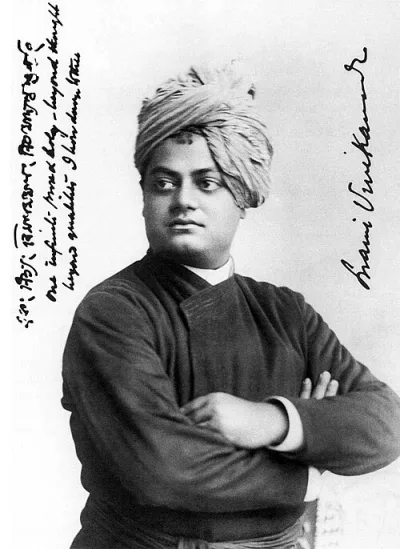
Swami Vivekananda was a key figure in introducing Vedanta and Yoga to the West, advocating religious tolerance and universal acceptance.
Swami Vivekananda, born Narendranath Datta, was a prominent Indian Hindu monk and philosopher who played a pivotal role in bringing Vedanta and Yoga philosophies to Western audiences. He was a chief disciple of the mystic Ramakrishna. Vivekananda's efforts are credited with increasing interfaith dialogue and elevating Hinduism's global standing. He was deeply inspired by his spiritual teacher, Ramakrishna, and after his death, traveled extensively throughout India, witnessing firsthand the hardships faced by the populace. This experience fueled his desire to establish social service initiatives.
His journey to the United States in 1893 for the Parliament of the World's Religions marked a significant moment, where his opening address championed religious tolerance and universal understanding. This event garnered him widespread acclaim. Following this success, Vivekananda lectured across Europe and North America, establishing Vedanta Societies in New York and San Francisco, which became foundational for similar organizations in the West. He also founded the Ramakrishna Math and Mission in India, focusing on monastic training and social welfare, education, and humanitarian aid. Vivekananda is recognized as a major modern Indian thinker and a significant contributor to the Hindu revivalist movement.
Early Life and Education
Born Narendranath Datta in Calcutta in 1863 to an aristocratic Bengali family, Vivekananda displayed an early interest in spirituality and meditation. His father was an attorney and his mother a devout homemaker, whose influences shaped his developing personality. He attended the Metropolitan Institution and later Presidency College, excelling academically. His education encompassed a broad range of subjects, including Western philosophy, logic, history, and literature, alongside a deep study of Hindu scriptures. He was known for his exceptional memory and intellectual prowess, impressing his college principal, William Hastie, who recognized his extraordinary potential. He also pursued interests in classical music and physical activities.
Spiritual Quest and Encounter with Ramakrishna
Narendranath's early spiritual journey involved exploring various philosophical and religious groups, including the Nava Vidhan and the Sadharan Brahmo Samaj. His initial beliefs were influenced by Brahmo concepts, which emphasized a rational, monotheistic theology drawn from the Upanishads and Vedanta. He sought direct spiritual experience and questioned prominent figures about their encounters with God. A pivotal moment in his life was his meeting with the mystic Ramakrishna, initially prompted by a professor's suggestion to understand the state of 'trance.' Despite initial skepticism towards Ramakrishna's teachings and ecstatic states, Narendranath was drawn to his personality and became a frequent visitor, marking the beginning of a profound spiritual discipleship that would shape his life's work.
Introduction of Vedanta and Yoga to the West
Following Ramakrishna's passing, Vivekananda embarked on extensive travels across India, gaining intimate knowledge of the struggles of its people. This experience motivated him to seek solutions for their suffering. In 1893, he traveled to the United States to attend the Parliament of the World's Religions in Chicago. His impactful speech, beginning with "Sisters and brothers of America...", introduced Hindu philosophy and advocated for religious tolerance and universal acceptance, earning him significant recognition. He subsequently lectured widely in the US, UK, and Europe, disseminating the core principles of Hindu thought. He founded the Vedanta Society of New York and the Vedanta Society of San Francisco, laying the groundwork for Vedanta's presence in the West.
Key Ideas
- Introduction of Vedanta and Yoga to the Western world
- Advocacy for interfaith awareness and religious tolerance
- Elevation of Hinduism to a major world religion
- Focus on social service and alleviating suffering
- Universal acceptance and spiritual understanding
Books by
3 free public domain books · Read online or download