Sarah Parvis
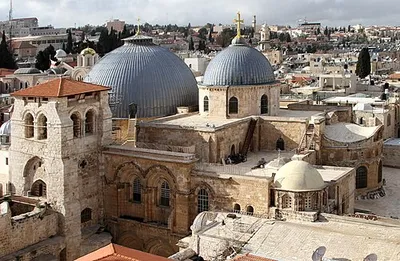
The Church of the Holy Sepulchre in Jerusalem is a significant Christian pilgrimage site, traditionally believed to contain Jesus's crucifixion and burial sites.
The Church of the Holy Sepulchre, also known as the Church of the Resurrection, is a fourth-century religious complex in Jerusalem's Old City. It is considered Christianity's holiest site and has been a major pilgrimage destination since its inception. According to tradition, the church encompasses both Calvary, the site of Jesus's crucifixion, and his empty tomb, where his burial and resurrection are believed to have occurred. The original structure was built by Constantine the Great in the 4th century and has undergone numerous destructions, fires, earthquakes, and reconstructions throughout history, including significant rebuilding in the 11th century after its near-total destruction in 1009. Control of the church is shared among several Christian denominations under a long-standing agreement known as the Status Quo.
The site's history begins with Roman occupation, where Emperor Hadrian built a temple over a cave containing a tomb. In the 4th century, following Emperor Constantine's legalization of Christianity, Bishop Macarius identified the tomb and, with Constantine's decree, a church was constructed over it and the adjacent Calvary. This first sanctuary, consecrated in 335, consisted of a rotunda (the Anastasis) and a basilica (the Martyrium). The church faced destruction in 614 by the Sassanids, was rebuilt by Emperor Heraclius in 630, and subsequently endured damage from earthquakes and fires under Islamic rule. The Fatimid caliph al-Hakim ordered its complete destruction in 1009, leaving only remnants of the tomb. Reconstruction efforts in the 11th century focused on the rotunda, with the great basilica remaining largely in ruins.
Foundational Significance and Early Construction
The Church of the Holy Sepulchre holds immense significance as the traditional location of Jesus's crucifixion at Calvary and his tomb, where his burial and resurrection are believed to have taken place. Its origins trace back to the 4th century when Emperor Constantine the Great, influenced by his conversion to Christianity, ordered the construction of a church on the site. This followed the identification of Jesus's tomb by Bishop Macarius, after a Roman temple built by Emperor Hadrian on the same location was dismantled. The original complex, consecrated in 335, comprised two main structures: the Anastasis, a rotunda built over the identified tomb, and a large basilica, known as the Martyrium, situated to the east and incorporating the traditional site of Calvary. This early designation established the church as a pivotal Christian pilgrimage site from its very beginning.
Cycles of Destruction and Reconstruction
Throughout its history, the Church of the Holy Sepulchre has experienced repeated cycles of destruction and reconstruction. It was first devastated by fire in 614 during the Sassanid invasion and subsequently rebuilt by Emperor Heraclius in 630. Later, it suffered damage from earthquakes in 746 and the early 9th century, as well as multiple fires in the 9th and 10th centuries. The most catastrophic event occurred in 1009 when the Fatimid caliph al-Hakim ordered its complete demolition, severely damaging the tomb itself. Reconstruction efforts in the 11th century, initiated under Emperor Constantine IX Monomachos and completed in 1048, primarily focused on the rotunda, with the original basilica remaining in ruins. These events highlight the site's vulnerability and the enduring efforts to preserve its sacred status.
Later Modifications and Shared Control
Following the initial reconstructions, the church continued to undergo modifications. After its capture by the Crusaders in 1099, further alterations were made, leading to a structure that significantly differed from the original. The Ottoman period also saw various renovations and restorations. The tomb itself is currently housed within a 19th-century shrine called the Aedicule. The church is also significant for containing the final stations of the Via Dolorosa, marking the last moments of Jesus's Passion. Today, the site operates under the Status Quo, an agreement dating back to 1757, which dictates a complex arrangement of shared control among multiple Christian denominations, including Roman Catholic, Greek Orthodox, and Armenian Apostolic churches, among others.
Key Ideas
- The Church of the Holy Sepulchre is traditionally believed to contain the sites of Jesus's crucifixion, burial, and resurrection.
- The site has been a central Christian pilgrimage destination since the 4th century.
- The church's history is marked by periods of destruction and reconstruction, reflecting its enduring religious importance.
- Control of the church is managed through a complex, long-standing agreement among various Christian denominations.
Books by Sarah Parvis
5 free public domain books · Read online or download