Rudolf Ritsema
Heligoland, a North Sea archipelago, has a complex history of Danish, British, and German rule, influencing its culture and language.
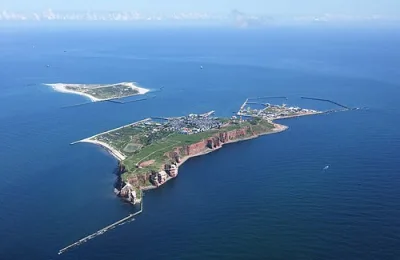
Heligoland is a small archipelago in the North Sea, currently part of Germany. Historically, it was under Danish and then British control before becoming German in 1890. The islands have a unique Frisian population who speak the Halunder dialect. Geographically, it consists of a main island and a smaller dune island, with distinct areas like the Lower, Upper, and Middle Lands. The main island features a notable rock formation called the Lange Anna. The history of Heligoland stretches back to prehistoric times, with evidence of early habitation and burial mounds. Its strategic location has led to periods of fortification and military use, particularly during the World Wars.
The name 'Heligoland' has been subject to various interpretations, with theories suggesting it means 'holy land' or 'high land.' Over centuries, ownership shifted between Denmark-Norway and the Duchy of Schleswig, eventually becoming Danish until 1807. During the Napoleonic Wars, it came under British control, serving as a base for operations against Napoleon. In the 19th century, it developed into a seaside spa and tourist resort, attracting artists and intellectuals. The island also played a role in ornithological studies with the publication of Heinrich Gätke's influential work. Under German rule, it became a naval base, and its population was evacuated during World War I. The physicist Werner Heisenberg is noted to have formulated aspects of his quantum mechanics theory there.
Historical Significance and Sovereignty
Heligoland's history is marked by shifting national control. Initially a Danish possession, it was ceded to the United Kingdom in 1807 during the Napoleonic Wars. The British maintained control until 1890, when it was exchanged with Germany for colonial territories in Africa, as outlined in the Heligoland–Zanzibar Treaty. This treaty ensured that the islanders would not lose their existing advantages due to the change in sovereignty. Following World War II, the islands, along with Schleswig-Holstein, were administered by the United Kingdom within the British occupation zone. Full control was transferred to West Germany in 1952. The island's strategic location near the entrance to the Kiel Canal was a significant factor in Germany's interest in regaining possession.
Cultural and Linguistic Identity
The archipelago is home to a distinct ethnic Frisian population, who maintain their unique cultural heritage. They speak Halunder, a dialect of the North Frisian language, alongside German. The name 'Heligoland' itself has been a subject of scholarly debate, with interpretations ranging from 'holy land' to 'high land,' reflecting its historical and geographical characteristics. The island's development in the 19th century as a seaside spa and tourist destination attracted European elites, artists, and writers, contributing to its cultural milieu. It also served as a refuge for political dissidents during periods of revolution in Germany.
Geographical Features and Development
Heligoland comprises two main islands: the larger, inhabited Hauptinsel (Main Island) and the smaller, uninhabited Düne (Dune Island). The main island is characterized by its dramatic cliffs and distinct geographical zones: the Unterland (Lower Land) at sea level, the Oberland (Upper Land) on the plateau, and the Mittelland (Middle Land), which was formed in 1947 due to British naval demolitions known as the 'Big Bang.' A prominent natural landmark is the Lange Anna, a striking free-standing rock column. The two islands were once connected but were separated by a storm flood in 1720. Düne Island hosts the island's airfield. The main island's highest point reaches 61 meters above sea level.
Scientific and Intellectual Contributions
Heligoland has been a site of significant scientific interest. It played a crucial role in the development of ornithology, particularly in understanding bird migration, largely due to Heinrich Gätke's influential 1890 book 'Heligoland, an Ornithological Observatory.' The Biological Station of Helgoland was established in 1892, focusing on marine biology. Notably, the physicist Werner Heisenberg is recognized for formulating key equations for his theory of quantum mechanics while on Heligoland in the 1920s. The island's unique environment and relative isolation fostered conditions conducive to scientific observation and theoretical development.
Books by Rudolf Ritsema
4 free public domain books · Read online or download